
Why in-demand skills matter for Sri Lankans in 2026
Sri Lanka’s economy is undergoing a difficult but important transition, with reforms aimed at restoring growth, stabilising debt, and boosting private‑sector competitiveness after recent crises.[3][4] As businesses adapt, the labour market is shifting away from low‑skill, informal work toward more productive, skills‑intensive roles in services and technology.[3]
Globalisation, remote work, and rapid advances in AI are reshaping hiring priorities worldwide, as employers seek talent that can work digitally, analyse data, and collaborate across borders.[2] This affects Sri Lankan job‑seekers too: companies serving global clients increasingly value workers who can operate online, use digital tools, and plug into international value chains.
In this context, four skill areas stand out as especially important for 2026: IT, digital marketing, logistics, and healthcare. IT skills underpin software development, cloud services, fintech, and AI‑driven solutions that export services and earn foreign revenue. Digital marketing helps local firms reach global customers cost‑effectively, supporting tourism, exports, and startups. Logistics expertise is critical as Sri Lanka seeks to leverage its strategic location and ports to become a regional trade and shipping hub. Healthcare skills remain resilient to automation and are increasingly in demand as populations age and health systems modernise.
Building these future‑proof skills can unlock clear benefits for Sri Lankans. Globally aligned IT and digital skills open doors to remote jobs with foreign employers and platforms, allowing workers to earn in stronger currencies. Globally recognised qualifications and experience in logistics and healthcare improve salary growth prospects and create mobility options across the region and beyond. In a labour force of nearly 8.5 million people, those who can demonstrate high‑value, portable skills will be better positioned as the economy restructures.[1][3]
This guide is structured to help you turn these trends into a practical learning roadmap. First, it explains what each of the four fields (IT, digital marketing, logistics, healthcare) actually involves in the Sri Lankan context. Next, it breaks down the most relevant roles and core skills for beginners and up‑skillers. Finally, it outlines step‑by‑step learning paths, from free resources and certificates to portfolio projects and job‑search strategies. Use it to choose one focus area, map out 6–12 months of learning, and align your skills with the opportunities most likely to grow in 2026 and beyond.

IT and software skills: Sri Lanka’s highest‑growth career path
By 2026, **IT and software** will sit at the core of Sri Lanka’s digital economy, with software developers, data analysts and cloud specialists among the country’s best‑paid professionals.[1][2] World Bank–backed digital projects and export‑oriented tech companies are driving a rapid expansion of digital jobs and positioning Sri Lanka as a regional software hub.[1]
Snapshot of IT demand in 2026
Employer demand is strongest in **software engineering**, **data and analytics**, **cloud computing**, and **AI‑related roles**, with full‑stack developers, data scientists, AI engineers and cloud architects all commanding high salaries and “very high” job demand ratings in 2026.[1][2] Remote‑first startups, BPOs, and global product companies in Colombo and tech corridors are competing for this talent.[1][2]
Core technical skills to focus on
To stay employable and competitive, Sri Lankan graduates should build a stack of:
- Programming: JavaScript, Python, Java or C# for web, mobile, and backend roles.[1][2]
- Databases & data tools: SQL, basic data modeling, Power BI/Tableau for analytics.[1][2]
- Cloud: Practical skills on AWS, Azure or GCP; cloud architects and DevOps engineers are among the highest‑paid roles.[2]
- Cybersecurity: Network security, ethical hacking and security standards are increasingly in demand as companies move online.[2]
- AI literacy: Understanding how to use Python, machine learning libraries and AI tools, even at a basic level, boosts employability across roles.[2]
Best entry‑level roles for beginners
For newcomers, the most accessible paths include **junior software developer**, **QA/automation engineer**, **technical support engineer**, **junior data analyst**, and **BI analyst**, all of which appear in Sri Lanka’s fastest‑growing IT categories.[1][2] These roles help you learn core tools (Git, SQL, cloud, testing frameworks) while gaining commercial experience.
Remote work and freelance opportunities
An estimated tens of thousands of Sri Lankan developers already serve overseas clients remotely, with many earning export‑level incomes through platforms like Upwork and Toptal and getting paid in foreign currency.[1] Strong English, GitHub portfolios, and experience in web, mobile, data, or cloud dramatically increase your chances of landing remote contracts.[1][2]
Practical learning roadmap
A realistic upskilling path for 2026 could look like:
- Free foundations: Use YouTube, MOOCs, and open courseware to learn programming basics, Git, and SQL.[1][2]
- Bootcamps: Local industry bootcamps (e.g., SLASSCOM and private academies) focus on React, Node.js, QA and data analytics and are designed to close Sri Lanka’s skills gap.[1]
- Degrees: Computer science, software engineering, IT or information systems degrees from universities such as Moratuwa remain valuable for long‑term growth.[1]
- Certifications: Market‑recognised credentials like AWS Solutions Architect, cloud, analytics, or cybersecurity certifications often translate to salary premiums in local and remote roles.[1][2]
How non‑tech graduates can transition into IT
Non‑STEM graduates can move into IT by following a structured plan: start with a single programming language, build small projects, then specialise in an applied area like web development, QA, business analysis, or data analytics that leverages existing domain knowledge (for example, logistics, healthcare, or marketing).[1][2] Completing a focused bootcamp plus 2–3 industry‑relevant certifications and building a portfolio (GitHub, case studies) can make you competitive for junior roles within 6–12 months, especially in entry‑level development, testing, support, and analytics positions.[1][2]

Digital marketing skills: Turning online attention into income
In 2026, Sri Lankan businesses are shifting more of their budgets from TV and print into **digital marketing** because that’s where customers now spend most of their time—on mobile, social media, and messaging apps.[1][2] Social and WhatsApp commerce already drive a significant share of online sales locally, so companies urgently need people who can convert clicks and views into leads and revenue.[1][2] Businesses that invest in digital are seeing 3–5x better ROI than traditional channels, which is accelerating hiring and upskilling in this area.[1]
To turn that demand into income, focus on core **hard skills**:
- SEO – ranking Sri Lankan and export-focused businesses on Google and local search, including Sinhala/English voice and “near me” searches.[1]
- Social media ads – running performance campaigns on Facebook, Instagram, TikTok and YouTube, especially short-form video and click‑to‑WhatsApp funnels.[1]
- Content marketing – creating blogs, videos and captions that answer local customer questions and drive organic traffic.[1]
- Analytics – reading data from websites and campaigns to improve ROI and reduce wasted ad spend.[1][2]
- Email funnels – nurturing leads into paying customers with automated sequences for e‑commerce, education, and services.
Alongside skills, learn the **tools** employers and clients expect:
- Meta Ads and Google Ads for paid campaigns and retargeting.[1][5]
- Google Analytics for tracking traffic, conversions, and customer behaviour.[1][2]
- Canva for fast, on-brand creatives and social content.[4]
- Marketing CRMs (HubSpot, Zoho, Mailchimp) for managing leads, email funnels and customer journeys.[4][6]
These skills open multiple **income paths** for Sri Lankans:
- Freelance marketer – serving local SMEs and international clients remotely.
- Agency roles – joining Sri Lankan digital agencies working with multiple brands and export clients.[3][7]
- In‑house brand roles – managing one company’s performance marketing, content, and analytics.
- Global clients – using platforms like Upwork, Fiverr and LinkedIn to work in USD while living in Sri Lanka.
Follow this **step‑by‑step plan** to go from beginner to job‑ready:
- Month 1–2: Learn fundamentals of SEO, social ads, and analytics via free courses; practise in Canva.
- Month 3–4: Pick a niche (e.g., local restaurants, online fashion) and run small test campaigns with a tiny budget or for a friend’s business.
- Month 5–6: Build a **portfolio** with 3–5 projects showing before/after metrics, ad screenshots, and funnel diagrams.
- Month 7+: Start pitching freelance projects or applying for internships and junior roles.
To stand out, you must **show results**, not just certificates. Create simple case studies that highlight:
- Key metrics: % increase in traffic, leads, ROAS, or cost‑per‑lead improvements.[1][8]
- What you did: campaigns launched, creatives designed, landing pages or email sequences built.
- Proof: screenshots from Meta Ads, Google Ads and Analytics with dates and numbers.[1][2]
Combine these with strong **personal branding**: a clear LinkedIn profile, a simple one‑page website, and consistent content (tips, mini case studies, short videos) on your preferred platform. In a market where most businesses still underinvest in digital, professionals who can link **attention to measurable revenue** will be in high demand across Sri Lanka’s IT, logistics, and healthcare sectors.[1][2][7]

Logistics and supply chain skills: Powering trade and e‑commerce
Sri Lanka’s growing e‑commerce, export manufacturing, and regional trade links are creating steady demand for logistics and supply chain talent. Online retailers, exporters, 3PLs, and freight companies now advertise roles from transport executives to warehouse operations staff on local job boards, showing a broad hiring pipeline across the country.[1][2][4]
To benefit from this demand, Sri Lankans need a solid base in core logistics skills:
- Inventory management – tracking stock levels, minimizing shortages and overstock, and understanding basic demand patterns.
- Warehouse operations – receiving, put‑away, picking, packing, and dispatch, plus safety and documentation.
- Transport planning – routing vehicles, consolidating loads, coordinating with drivers and carriers.
- Basic data analysis – using numbers to monitor lead times, costs, and service levels and suggest improvements.
Modern logistics in Sri Lanka is increasingly digital, so learning key software tools is essential:
- ERP systems (such as those used by manufacturing and export firms) for purchasing, inventory, and order management.[2]
- Warehouse management software used by retailers and distribution centers to control stock and picking processes.[2][4]
- Excel for reporting, basic dashboards, and cost or route comparisons.
- Tracking platforms for shipments and vehicle fleets, increasingly adopted by transport and delivery companies.[1][5]
These skills open doors to a range of job options already visible in the Sri Lankan market, including:
- Logistics coordinator or supply chain executive
- Import–export executive and shipping documentation roles for exporters and freight forwarders[1][2]
- Warehouse supervisor, storekeeper, and stores executive roles in retail and manufacturing[2][4]
- Dispatcher or transport operations executive managing vehicle movements and deliveries[1][2]
Many employers recruit assistants, trainees, and clerks and then promote high performers into executive and management positions, especially when they continue upskilling through professional courses in supply chain, trade procedures, or operations management.[1][2][4] Starting as a warehouse assistant or logistics assistant and moving into planner, supervisor, and then manager roles is a common pathway.
Looking ahead to 2026, the most valuable logistics professionals will blend logistics knowledge with IT and data skills. Combining supply chain expertise with skills in spreadsheets, databases, ERP configuration, or basic data analytics allows Sri Lankans to move into higher‑value roles such as process analyst, supply chain planner, or e‑commerce operations specialist, supporting the country’s push into digital trade and regional integration.[4][5]

Healthcare skills: Stable, meaningful careers in a growing sector
Even when other industries slow down, **healthcare in Sri Lanka remains resilient** because demand for essential health services continues regardless of economic cycles, and the state is committed to free universal care through the Ministry of Health.[1][3] Ongoing health‑sector master planning up to 2035 and new investments, such as a US$150 million World Bank project to upgrade primary care, signal long‑term workforce demand.[1][6]
For Sri Lankans, healthcare offers two broad paths: **clinical** and **non‑clinical** roles. Clinical roles include nursing, midwifery, medical officers, pharmacists, physiotherapists, and medical laboratory technologists, all formally recognized in national cadre planning.[1] Non‑clinical options span medical administration, health information management, hospital operations, and telehealth support, where professionals help coordinate appointments, documentation, billing, and remote consultations.
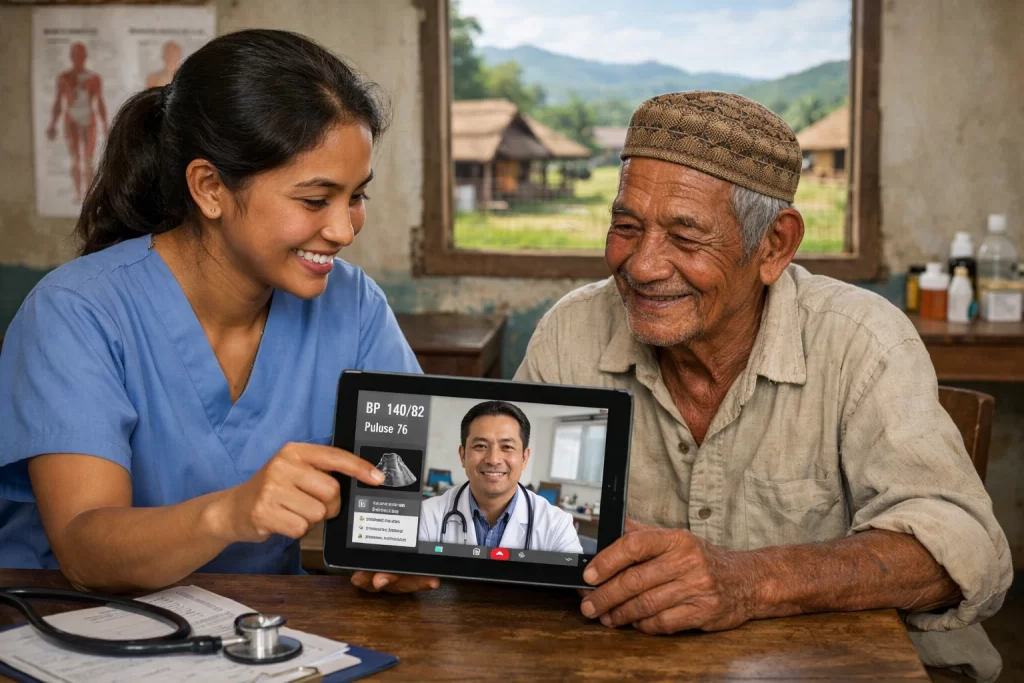
New technologies are reshaping day‑to‑day work. Public healthcare information systems, digital records, and hospital IT platforms are expanding, bringing demand for skills in **health IT systems, electronic medical records, telemedicine workflows, and data security**.[3][5] At the same time, soft skills such as clear patient communication, cultural sensitivity, and basic counseling are increasingly valued as services shift toward preventive and community‑based care.[2][3]
Demographic and market trends further strengthen prospects. Sri Lanka’s **aging population** increases the need for chronic disease management, rehabilitation, and long‑term care services.[2][6] Parallel to this, ongoing efforts to upgrade hospitals and wellness centers, as well as interest in positioning the country as a **medical tourism** hub, create roles in hospital hospitality, international patient coordination, and health marketing.[3][4]
There are **realistic training routes** for different backgrounds and budgets. Government and private institutes offer vocational certificates and diplomas for nursing assistants, pharmacy technicians, caregivers, and lab support staff.[1] Degrees in medicine, nursing, pharmacy, physiotherapy, and health information technology provide advanced clinical and managerial opportunities, while professional certifications in hospital management, health informatics, and project management help IT and business graduates pivot into the health sector.[1][5]
To balance **purpose and pay**, start with your strengths and tolerance for direct patient contact. If you enjoy hands‑on care and shift work, clinical tracks like nursing or physiotherapy may fit. If you prefer systems, data, or coordination, consider health IT, medical administration, or telehealth support. Research entry requirements, salary ranges, and migration potential for each path, then choose a track that gives you both meaningful impact and sustainable income in Sri Lanka’s evolving healthcare system.

Essential soft skills that multiply your value in any industry
Across Sri Lanka’s fastest‑growing sectors—IT, digital marketing, logistics, and healthcare—employers increasingly hire for **soft skills first**, then train the technical parts.[1][2] Global research also shows that by 2026 nearly half of core job skills are changing, with communication, problem‑solving, and self‑management topping the list.[3][4][5]
Top soft skills Sri Lankan employers value in 2026
Recruiters using AI screening tools now score **communication**, **problem‑solving**, and **adaptability** as key predictors of performance and retention in Sri Lanka.[1] These skills help IT professionals explain complex systems, marketers pitch ideas, logistics teams manage disruptions, and healthcare workers handle patients with empathy.
Critical thinking and data literacy
Future‑proof roles in ICT, digital marketing analytics, supply chain, and health informatics all depend on **critical thinking** and basic **data literacy**—reading dashboards, questioning assumptions, and making decisions from evidence.[2][4][5] Whether you are optimising an ad campaign, routing cargo, or reviewing patient data, those who can interpret numbers and ask “why?” move into leadership faster.
Collaboration and remote‑work skills
Sri Lanka’s IT‑BPM and freelance sectors now export services worldwide, giving professionals chances to work in global, remote teams.[1][2] Skills like clear written communication, using collaboration tools, respecting time zones, and giving concise status updates make you stand out in international projects and on platforms like Upwork and Fiverr.[2]
Time management and personal productivity
With many people juggling studies, part‑time work, and online freelancing, **time management** is becoming a core employability skill. Techniques such as planning your week in advance, batching similar tasks, and setting specific time blocks for learning new tools (coding, marketing, or medical tech) boost both grades and income potential.[4][5]
Simple daily practices to strengthen English and presentation
ICT, digital marketing, and healthcare documentation in Sri Lanka heavily use English.[2][6] You can build confidence by:
- Summarising one article or video in English every day.
- Recording a 2‑minute voice note explaining a concept you learned.
- Presenting in small groups at campus or work to practise slides and eye contact.
Growth mindset and resilience in uncertain times
Economic shifts are pushing hiring toward **skill‑based** and **project‑based** work in Sri Lanka.[1][2] A growth mindset—treating every setback as feedback, continuously upskilling online, and staying open to new sectors—helps you navigate layoffs, career changes, and freelance income swings without losing momentum.[3][5]

Action plan: How Sri Lankans can pick, learn, and monetize new skills
1. Pick your skill cluster strategically
Start by matching **background + interest + risk tolerance** to one of four clusters:
- IT / Data – Best if you enjoy problem‑solving and English reading; highest earning potential, but steep learning curve. Sri Lanka’s 2026 market pays software developers around LKR 300,000/month and data roles ~LKR 250,000/month, especially for exports and remote work.[1]
- Digital marketing – Good for creative, communication‑oriented people; direct demand from 50,000+ SMEs and agencies, with specialists around LKR 200,000/month.[1][2]
- Logistics / supply chain – Ideal if you like operations, planning, and dealing with people; links to ports, e‑commerce, and manufacturing, all of which rely heavily on analytical skills.[2]
- Healthcare & health IT – Fits science backgrounds and those comfortable with regulation and documentation; hospitals and insurers are hungry for IT, cybersecurity, and data skills.[2][5]
2. Design a 6–12 month learning roadmap
- Commit **8–12 hours per week** if you’re working, or 20+ hours if you’re a student.
- Months 1–3: Fundamentals (e.g., Python/HTML for IT, analytics for logistics, basic anatomy plus digital tools for healthcare, marketing foundations for digital marketing).[3][4][5]
- Months 4–6: One focused track (e.g., web dev, data analysis, performance ads, supply chain analytics, EHR/health data).
- Months 7–12: Advanced specialization + portfolio projects + first paid work.[2][3]
3. Find affordable courses and communities (Sri Lanka‑friendly)
- Use low‑cost global platforms for core theory, then combine with local bootcamps (e.g., SLASSCOM‑style IT programs, digital marketing and logistics diplomas) to close the job‑ready skills gap.[1][3][4]
- Join Sri Lankan Facebook/LinkedIn groups for developers, digital marketers, logistics, and healthcare professionals to find meetups, mentoring, and job leads.[1][2]
4. Build a proof‑of‑skill portfolio
- IT / Data: GitHub projects, small web apps, dashboards (Python, SQL, Power BI), AI mini‑tools.[1][3][4]
- Digital marketing: Sample Google/Facebook campaigns, content calendars, landing pages, and performance case studies.[1][2]
- Logistics: Process‑improvement write‑ups, simple Excel/Power BI analyses of inventory, routes, or lead times.[2][5]
- Healthcare: Documented improvements in clinic workflows, simple data audits, or patient‑education materials using digital tools.[2][5]
5. Turn skills into your first income
- Apply for **internships and trainee roles** at Colombo IT firms, marketing agencies, hospitals, and logistics companies that actively expand digital and data capabilities.[1][5]
- Use freelancing platforms for small international projects in coding, analytics, and marketing; Sri Lankan developers already earn strong USD incomes this way.[1][3]
- Offer part‑time services to local SMEs: website setup, ad campaigns, inventory tracking sheets, or clinic digitization.[1][2]
6. Long‑term strategy for 2026 and beyond
- Plan **annual upskilling** in AI, data, and automation – cross‑cutting skills that stay in demand across IT, marketing, logistics, and healthcare.[2][3][5]
- Budget for at least one recognized certification per year (e.g., cloud/AWS, analytics, cybersecurity, or specialized healthcare/logistics credentials) to unlock salary premiums.[1][3][4]
- Network consistently via Sri Lankan tech and professional associations, meetups, and online communities to access hidden jobs and remote opportunities.[1][2]