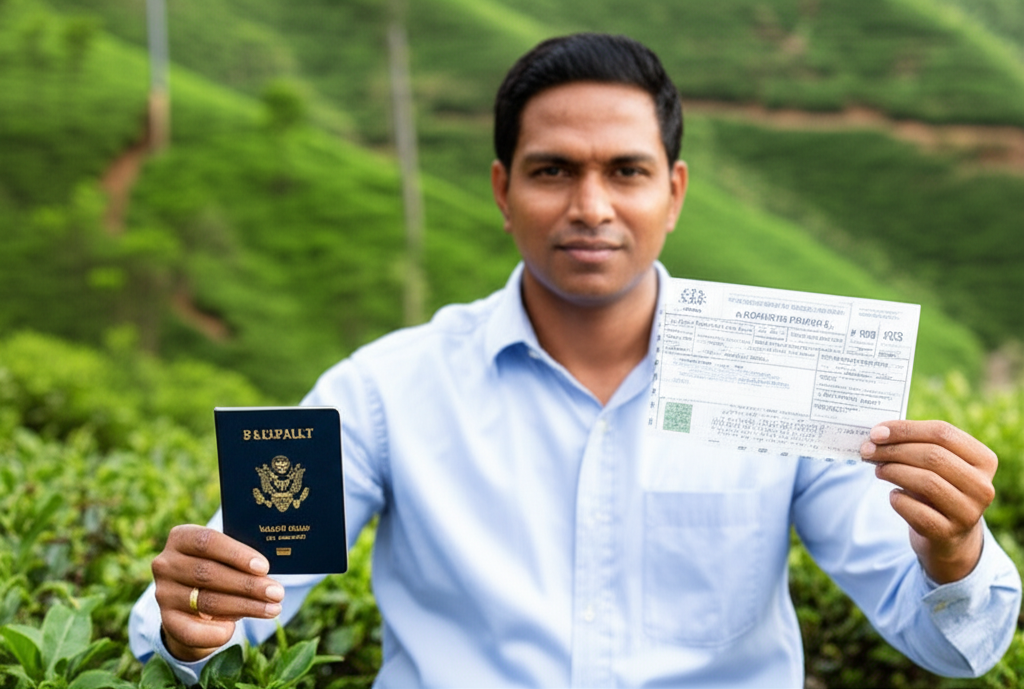
Holding your Advance Parole document feels like a paradox. You’re thrilled at the prospect of visiting family in Colombo or Kandy, but a wave of anxiety follows. What if there are issues at the port of entry? Will this trip jeopardize the work status you’ve so carefully maintained? This isn’t just a vacation; it’s a calculated risk with your entire US career on the line.
From years of experience, the most common mistake is treating the AP document like a simple re-entry permit. It is not. You are technically seeking “parole,” and a Customs and Border Protection officer has final discretion. More importantly, re-entering on AP can unintentionally terminate your H-1B or L-1 status if handled incorrectly—a detail often overlooked until it’s too late.
This article moves beyond generic advice. We will assemble the exact “re-entry packet” you should carry, outline the specific conversation to have with your employer’s immigration counsel before you book your flight, and detail the steps to take at the airport to preserve your work visa status upon your return. You’ll get the practical steps needed for a smooth journey and a secure return to your job.
What is Advance Parole and Why Do You Need It?
Let’s clear up a common point of confusion. Advance Parole (AP) is not a visa. Think of it as a pre-approved permission slip from U.S. Citizenship and Immigration Services (USCIS) that allows you to seek re-entry into the United States after temporary foreign travel. For anyone with a pending Adjustment of Status (Form I-485) application, it is absolutely essential. If you leave the U.S. while your green card application is processing without first securing Advance Parole, USCIS will consider your application abandoned. You will have to start the entire expensive and lengthy process over again.
The Application vs. The Document
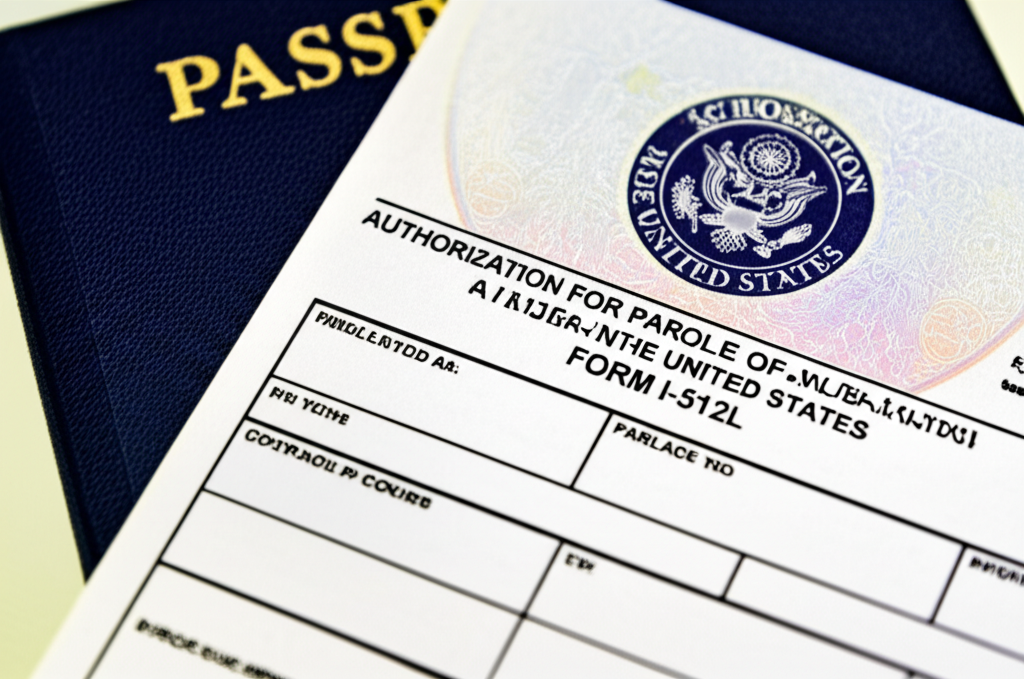
You apply for this travel permission using Form I-131, Application for Travel Document. What you receive upon approval is Form I-512L, Authorization for Parole of an Alien into the United States. This is the physical document you must carry. Many applicants now receive a “combo card,” which combines their Employment Authorization Document (EAD) and Advance Parole on a single card. This card serves as your proof of both work authorization and permission to re-enter the country.
Imagine this scenario: you’re an H-1B holder with a pending I-485, and you need to attend a family wedding in Colombo. Your H-1B visa stamp in your passport has expired. Without Advance Parole, you have no way to get back into the U.S. to continue your employment or your green card process. With your AP document (or combo card) in hand, you can travel. Upon your return, you present it to a Customs and Border Protection (CBP) officer. They will process your re-entry, and you will be “paroled” into the country to await the final decision on your I-485. Remember, parole is a specific legal status; reentry is not guaranteed and always remains at the discretion of the CBP officer at the port of entry.
Pre-Travel Checklist: Essential Documents for Your Sri Lanka Trip
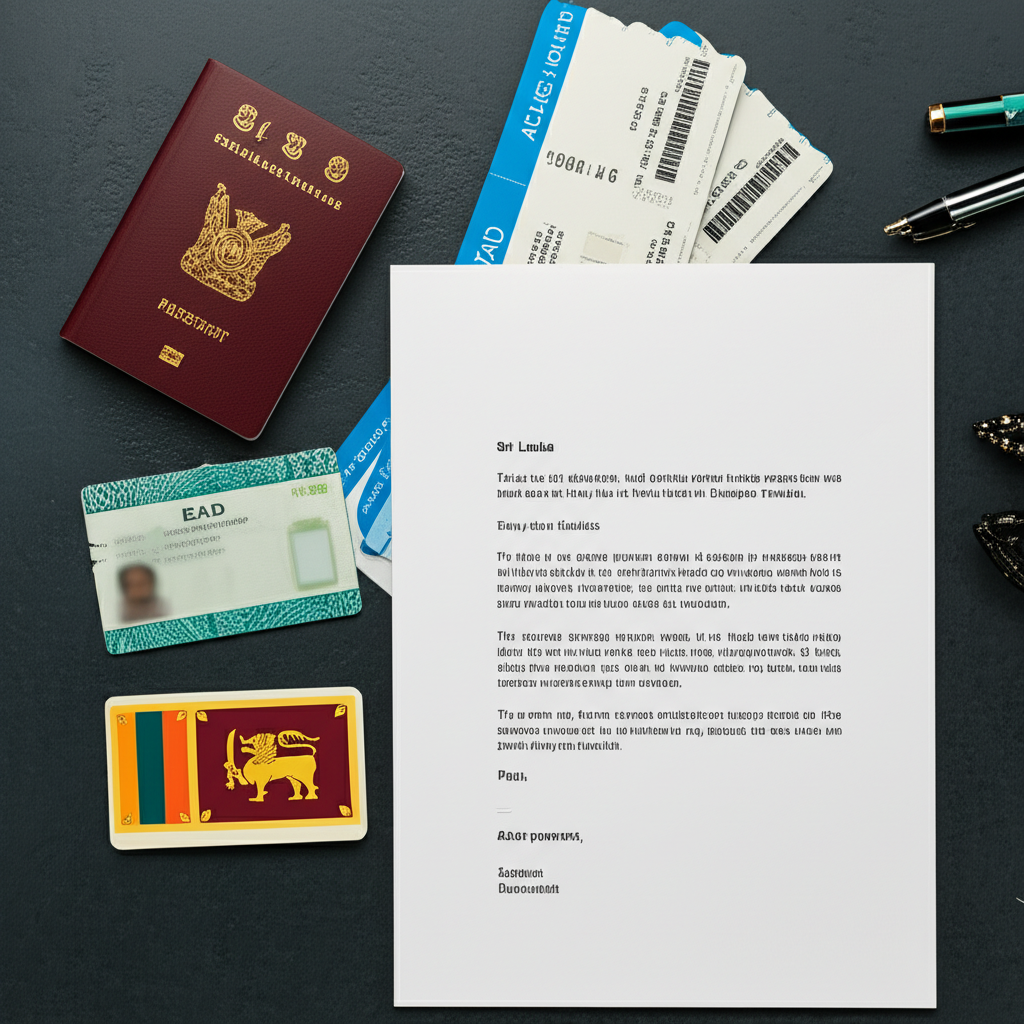
Let’s shift gears for a moment. Once your travel is approved, your focus must turn to meticulous preparation. Walking up to a Customs and Border Protection (CBP) officer upon your return is not the time to be fumbling through a disorganized backpack. Your goal is to present a clear, undeniable picture of your legitimate travel and your solid ties to the United States. Think of this not as a simple list, but as your personal travel dossier. I’ve seen travelers sent to secondary inspection over a single missing document they thought was minor.
Your Core Travel Authority
These are the non-negotiables. Without them, your trip effectively ends before it begins. Keep them accessible in your carry-on, never in your checked luggage.
Your valid Sri Lankan Passport: This seems obvious, but double-check that it is valid for at least six months beyond your planned return date. An expiring passport is a common and completely avoidable mistake.
The original Form I-512L, Advance Parole Document: A photocopy will not work. This is your golden ticket for re-entry. Before you even book your flight, inspect the “valid from” and “to” dates. I once coached a client who almost missed a family wedding because he hadn’t noticed his AP expired the week before his return flight.
Your Employment Authorization Document (EAD) Card: Your Advance Parole lets you re-enter the US, but your EAD proves you have the right to work here. A CBP officer needs to see both to get a full picture of your current status.
Proof of Your U.S. Anchor
This second set of documents proves that your life and career are waiting for you back in the States. This is how you proactively answer the officer’s unasked question: “Are you planning to return?”
A Recent Employer Letter: This is your professional anchor. Ask your HR department or manager for a letter on company letterhead confirming your current employment, job title, salary, and—most importantly—your expected date of return. A simple sentence like, “Mr. Silva is a valued Project Manager and is expected to resume his duties on September 15, 2024,” is direct and powerful.
Recent Pay Stubs: Bring the last two or three. They are tangible, recent proof of your ongoing employment relationship.
Copy of Your I-485 Receipt Notice (Form I-797C): This document provides essential context. It shows the officer the underlying green card application that makes you eligible for Advance Parole in the first place. It connects all the dots for them.
Keep these documents together in a dedicated travel folder. When the CBP officer requests them, you want to hand over an organized packet. This small step signals preparation and respect for the process, making for a much smoother reentry.
Maintaining US Work Status While in Sri Lanka
This brings us to something often overlooked: your Advance Parole document is a permission slip to travel, not a free pass from your professional obligations. The entire exercise of using Advance Parole successfully hinges on proving to a Customs and Border Protection (CBP) officer upon your return that your trip was temporary and you have not abandoned your US-based life. Your employment is the strongest anchor you have.
Formalize Your Absence
A common mistake is treating your time away like a simple vacation. Do not rely on a verbal okay from your manager. You must formalize your arrangement. This means getting written confirmation from your employer or HR department outlining the terms of your absence. Is it an approved leave of absence or a pre-authorized remote work period? This documentation is your evidence.
You must also remain on US payroll. This is non-negotiable. Receiving regular pay stubs while you are in Sri Lanka is the single most powerful piece of proof that your employment relationship is active and unbroken. Remember, your Advance Parole document does not grant work authorization; your Employment Authorization Document (EAD) does. The pay stubs prove you are using it. For anyone waiting in the queue for one of the 140,000 annual employment-based visas, breaking this chain can have serious consequences.
Avoid Conflicting Signals
While in Sri Lanka, your actions must align with your status as a US worker on a temporary visit. This means you should not engage in any local employment, even a short-term project or a consulting gig for a family business. This creates ambiguity about your primary place of work and can be interpreted as a shift in your intentions.
Here’s a practical scenario: an IT consultant on an H-1B extension with a pending green card application uses AP to visit family for six weeks. While there, she continues to log into her US company’s servers, participate in team calls, and receive her bi-weekly salary in her US bank account. She maintained her US apartment lease. Upon reentry, her documentation presents a clear, consistent story of temporary travel, not abandonment.
Keep the Trip Duration Reasonable
While there’s no hard-and-fast rule, extended trips raise red flags. Most immigration attorneys advise keeping travel under 90 days. A three-week trip is easily explained as a family visit. A five-month trip? That starts to look less like a visit and more like a relocation, inviting much deeper scrutiny from CBP. The goal is to leave no doubt that your life, residence, and career are firmly rooted in the United States.
Navigating Re-Entry: What to Expect at the US Port of Entry
Now, you might be wondering what actually happens when your flight from Colombo touches down back in the US. The re-entry process on Advance Parole (AP) is different from entering on a typical visa, and knowing the steps can make all the difference. When you approach the primary Customs and Border Protection (CBP) officer, you’ll present your passport and your original Form I-512L, Authorization for Parole of an Alien into the United States. It’s a key distinction that you are not being admitted; you are being paroled into the country. This is a specific legal status for individuals with pending applications, and CBP officers handle it through a specific protocol.
The Secondary Inspection Experience
After a quick review, the officer will likely escort you to a separate area for “secondary inspection.” My advice is simple: stay calm. For AP travelers, this is almost always standard procedure, not a sign of trouble. The officers in the main booths are not always equipped to process parole documents, so they send you to specialists. You’ll hand your documents over again and wait for your name to be called. The wait can be short or it can take a couple of hours, so be patient.
When you are called, the officer will verify your identity and status. Expect straightforward questions:
What was the purpose of your trip to Sri Lanka?
How long were you gone? (As a best practice, keep trips under 90 days.)
Where do you work in the United States?
What is your current immigration status? (e.g., “I have a pending I-485 application.”)
Have your answers ready. For instance, if asked about your job, be prepared to state your employer and role clearly. Having a copy of your I-485 receipt notice and your Employment Authorization Document (EAD) in a neat folder shows you are organized and prepared. Once satisfied, the officer will stamp your passport and the AP document, paroling you into the US for a period of one year. A few days after you re-enter, make sure to retrieve your electronic I-94 from the CBP website; this is your official record of lawful re-entry.
Potential Risks and How to Mitigate Them
Traveling on Advance Parole (AP) feels like a green light, but it’s more like a flashing yellow. You must proceed with caution. The most common mistake I see is treating an AP document like a guaranteed re-entry visa. It isn’t. Your admission to the U.S. is always at the discretion of a Customs and Border Protection (CBP) officer at the port of entry.
Understanding the Document’s Limitations
First, an Advance Parole document has a hard expiration date. Never plan your return for the last minute. I advise clients to book their return flight to the U.S. at least one month before their AP expires to account for unexpected travel delays. Second, your AP is tied directly to your pending I-485 application. If your application is denied while you are in Sri Lanka, your AP becomes invalid instantly. You would have no authorization to return to the U.S. This is not a theoretical risk; it happens.
Insider Tips for a Smoother Re-entry
To protect yourself, preparation is everything. Before you leave, create a digital folder in a secure cloud service with copies of every immigration document: your AP approval, I-485 receipt notice, passport, and Employment Authorization Document (EAD). Then, follow these professional practices:
Stay Connected: Inform your immigration attorney of your exact travel dates. Have a clear line of communication established in case of an emergency.
Monitor Your Case: Check your case status on the USCIS website every few days while you’re away. A simple check can prevent a catastrophic surprise.
Know Your Status: If you hold a nonimmigrant status like an H-1B, re-entering with AP will change your status to “parolee.” This means if your I-485 is later denied, you may have no underlying status to fall back on. The safer, though more complex, route is often to get your H-1B visa stamped in Sri Lanka and re-enter on that, preserving your nonimmigrant status as a backup.
Think of it this way: your goal isn’t just to visit Sri Lanka, but to return to your life and job in the U.S. without a single complication.
Your Final Pre-Flight Check
Traveling on Advance Parole is less about the document in your hand and more about safeguarding the employment that underpins your entire green card application. The most common pitfall we see is treating the AP document like a golden ticket—it is a conditional permission slip, not a guarantee. The insider’s key is proactive communication with your employer and having irrefutable, recent proof of your ongoing employment ready for Customs and Border Protection. This preparation is what separates a joyful reunion in Sri Lanka from a stressful secondary inspection.
Your situation is unique. Before booking your travel to Sri Lanka, schedule a consultation with an experienced immigration attorney to review your case and ensure a smooth return journey.
Frequently Asked Questions
Can I travel to Sri Lanka multiple times on one Advance Parole document?
Yes, if you were issued a multiple-entry Advance Parole document, you can use it for more than one trip abroad as long as it remains valid. Always check the 'valid for' dates and number of entries allowed on your Form I-512L.
What happens if my Advance Parole expires while I'm in Sri Lanka?
If your Advance Parole document expires while you are abroad, you will not be able to use it to re-enter the United States. You would need to find an alternative way to return, such as obtaining a visa at a U.S. consulate, which can be very difficult. It is critical to plan your return before the expiration date.
Does re-entering the US on Advance Parole affect my H-1B status?
If you have a valid H-1B status and choose to re-enter the US using Advance Parole, you will be 'paroled' in, and your status will be 'parolee.' While you can still work for your H-1B employer, you are no longer technically in H-1B status. This can have implications for future extensions. It's best to discuss this with your immigration attorney.
How long can I stay in Sri Lanka while on Advance Parole?
There is no specific legal limit, but the trip should be for a temporary purpose. A long absence (e.g., several months) could raise questions from CBP about whether you have abandoned your US residency and your pending application. It's advisable to keep trips as short as reasonably possible.
Facebook
X
LinkedIn
WhatsApp
Daily News Digest
Get the top stories delivered to your inbox every morning. No spam, ever.
Many Sri Lankan artisans believe that getting their products onto global platforms like Amazon and eBay is a logistical nightmare reserved only for large exporters. You might have a stunning
The most expensive myth for foreign investors is that buying a property in a famous US city guarantees Airbnb success. This assumption is a fast track to disappointment. The truth
Most import ventures from Sri Lanka fail before their first container even docks. It’s not a lack of US demand for Ceylon cinnamon or fiery Jaffna curry powder; it’s a
Have you ever had a truly amazing Sri Lankan meal, maybe a lamprais fresh out of the banana leaf, and thought, “Wow, more people in America need to experience this”?