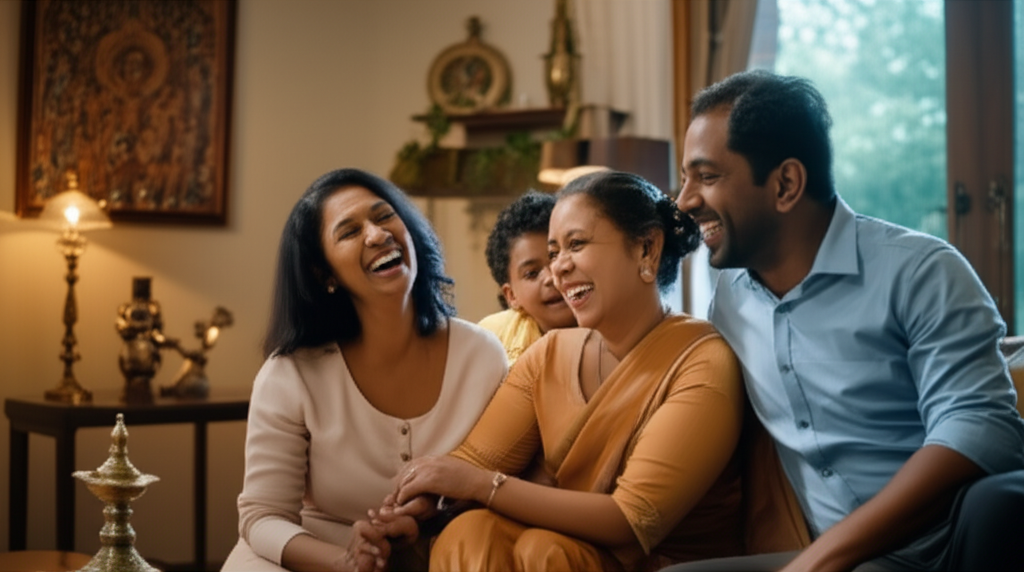
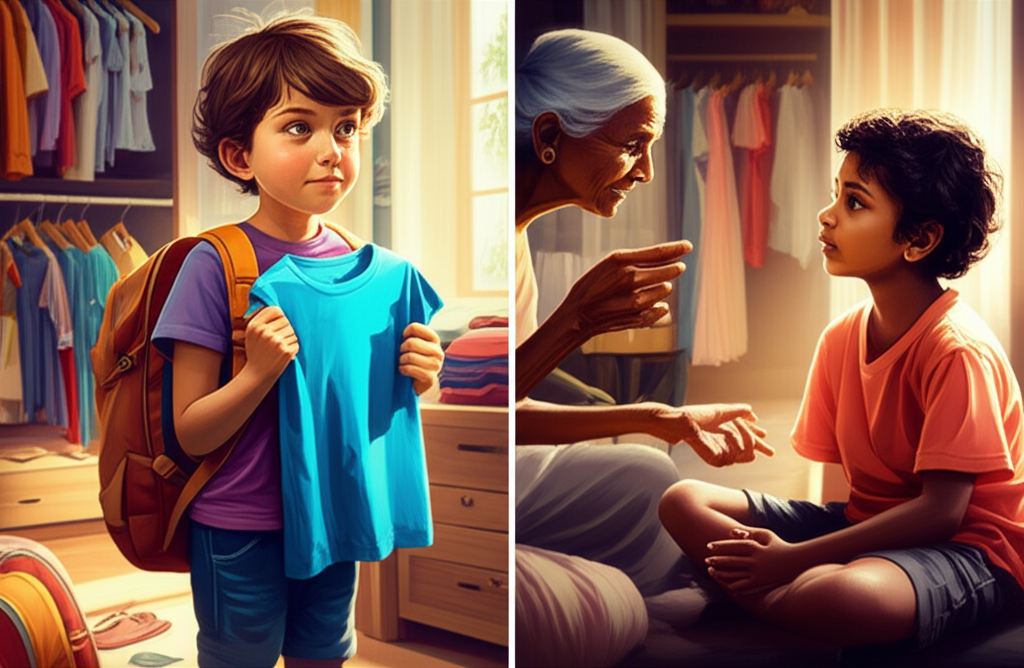
Picture this: You’re at a parent-teacher conference. The American teacher praises your child’s confidence and creative thinking, but you’re quietly wondering why their math scores aren’t higher. You feel proud, yet a familiar anxiety creeps in. Are you letting them become too “American,” forgetting the deep-rooted Sri Lankan value of academic discipline and respecting your elders—the idea of loku ayata garu karanna?
Conventional wisdom presents a false choice: the strict, academically-focused Sri Lankan way versus the permissive, creativity-focused American approach. But treating this as a simple tug-of-war is a fundamental misunderstanding of the diaspora experience. The real challenge isn’t about picking a side; it’s the exhausting mental gymnastics of trying to apply conflicting cultural scripts to the same child. We’re told to “find a balance,” but nobody explains how when the core principles—collectivism versus individualism—seem fundamentally opposed.
This article moves beyond that tired advice. Forget simply compromising. Instead, we will explore a framework for intentional integration, helping you build a unique family culture from the ground up. You will learn how to selectively blend these powerful influences to raise a child who is not torn between two worlds, but enriched by both.
The Foundations: Collectivism vs. Individualism
The common view pits American individualism as the path to freedom and Sri Lankan collectivism as a system of restrictive obligation. That’s a fundamental misreading. These aren’t opposing moralities; they are different operating systems for raising successful adults, and for diaspora parents, the conflict between them is the first and most significant challenge they face.
In a traditional Sri Lankan context, the primary goal is to raise a child who is an honorable and integrated member of a community. The family unit is paramount. This isn’t just theory; it shows up in practical ways. For instance, it’s common for unmarried adult children to live with their parents, not out of dependency, but as part of a multi-generational support system, a finding consistent among Sri Lankan Sinhalese in North America. The support network extends even further. Many Sri Lankan American families rely on what researchers call fictive kinship—the network of “super aunties” and “uncles” who are not blood relatives but are central to a child’s upbringing and identity. The goal is interdependence, not just independence.
American parenting, by contrast, prioritizes early autonomy. The signs are everywhere: sleep training infants to be self-soothing, encouraging toddlers to make their own choices, and celebrating the moment a teenager gets their driver’s license as a rite of passage toward self-reliance. The ideal outcome is a self-sufficient individual, capable of standing entirely on their own two feet.
For parents raising children between these two worlds, the friction is immediate. Do you co-sleep or sleep train? Do you expect unquestioning respect for elders or encourage your child to challenge authority? Interestingly, the resolution isn’t a simple drift toward Western norms. Research on second-generation Sri Lankan parents in Europe shows they often adopt a hybrid model, embracing dual-earner households and involved fathers while reinforcing ethnic ties through language and religion. Furthermore, some studies reveal that diaspora youth in North America show a stronger inclination to maintain traditions than their peers back in Sri Lanka. This isn’t about choosing one culture over another; it’s about consciously building a third, a unique family culture that draws strength from both.
Discipline and Respect: Two Worlds Collide
Now, you might be wondering how these different family structures handle the inevitable showdown over bedtime or a flat-out “no” from a child. The conventional wisdom often pits a supposedly “strict” Eastern approach against a “permissive” Western one. This is a fundamental misunderstanding. The conflict isn’t about being strict versus being lenient; it’s about two entirely different definitions of love and preparation for the world.
In many traditional Sri Lankan households, discipline is a direct expression of care. The goal is to raise a child who understands their place within a larger, collectivist family unit—what researchers call cultural familism. Respect for elders isn’t just a suggestion; it’s the bedrock of community harmony. A sharp word or a swift punishment isn’t seen as anger, but as a course correction to ensure the child thrives within that system. Unquestioning obedience is a sign of a well-loved, well-guided child.
Contrast this with the modern American model, which often draws from frameworks like positive reinforcement. Here, the focus is on fostering an independent, critical thinker. Parents explain the ‘why’ behind a rule, time-outs are for self-regulation, and dialogue is encouraged. Imagine a family dinner where a child publicly corrects a visiting “super aunty,” a key figure in Sri Lankan diaspora support networks. An American parent might feel a flicker of pride in their child’s confidence, while a Sri Lankan parent might feel a hot flush of embarrassment at the perceived disrespect.
This is precisely where diaspora parents create their own hybrid model. They find themselves demanding the baseline respect inherent to their culture—you do not challenge your elders publicly—while also adopting the Western practice of explaining the rules later, in private. They are teaching their children a sophisticated form of code-switching: fostering critical thought without shattering the cultural pillars of family and respect. It’s a delicate, exhausting, and ultimately necessary balance.
Education and Ambition: The Path to Success
Building on that foundation of strong family ties, the conversation inevitably turns to a child’s future. It’s a common misconception that the Sri Lankan focus on specific, high-status professions—medicine, law, engineering—is purely about prestige. The reality is more complex. This well-worn path is a cultural script for security, a time-tested formula for ensuring a child not only survives but thrives. In a community where education is so prioritized that marriage is often delayed, as noted among Sri Lankan Sinhalese in North America, this professional triumvirate represents the ultimate return on a family’s collective investment. It’s a strategy born from a different economic and social context, one where stability was never a guarantee.
Contrast this with the prevailing American ethos: follow your passion. This philosophy champions individual fulfillment and accepts a much broader spectrum of success, from entrepreneurship to the creative arts. Herein lies the diaspora dilemma. Imagine a teenager who excels in biology, making her parents dream of a white coat and a stethoscope. She, however, wants to be a marine biologist, a path her parents perceive as less stable and financially uncertain. The conflict isn’t about a lack of ambition. It’s a clash between two valid, yet different, definitions of a successful life. The parents are asking for security; the child is asking for purpose.
The most effective families I’ve seen don’t treat this as a zero-sum game. They find the balance by translating the underlying values. They reframe the conversation from “doctor vs. artist” to “how can you build a secure and respected life doing what you love?” This often involves the wider community—the “super aunties” and uncles who act as mentors and mediators, offering perspectives that bridge the generational gap. Interestingly, research from the Colombo Telegraph suggests diaspora youth often have a stronger desire to maintain cultural traditions than their counterparts in Sri Lanka. This means the negotiation isn’t just about rebellion; it’s about adaptation. It’s about finding a way for a child’s individual ambition to honor the collective dream.
The Role of the ‘Village’: Extended Family’s Influence
And this is where things get practical. The conventional wisdom suggests that the collectivist “village” of Sri Lankan culture is an unqualified source of strength for new parents. While the support is undeniable, this view misses the central conflict many diaspora families face. The village isn’t just a safety net; it’s a council of elders with deeply held opinions that don’t always translate across continents.
In Sri Lanka, the extended family is the primary child-rearing unit. Grandparents, or achchi and seeya, often act as de facto co-parents, their experience considered law. Aunts and uncles are secondary disciplinarians and caregivers. This structure is reinforced by a robust network of non-related “super aunties” and “uncles”—fictive kinship that, as research from eScholarship confirms, is fundamental to identity and care. The child belongs to everyone. This is the essence of cultural familism, a trait that studies from PubMed Central associate with surprisingly positive parent-child relationships among South Asian families in the West.
Contrast this with the typical American nuclear model, where parents are the chief executives of their household. Grandparents are cherished advisors, but their input is usually subject to parental approval. When these two models collide, the friction can be intense. Imagine a young Sri Lankan American mother in New York, part of a dual-earner household that relies on institutional childcare, as is common now per studies in Taylor & Francis Online. She gets a call from her mother in Colombo who is horrified the baby isn’t being hand-fed mashed rice at four months or is sleeping in a separate room. The advice is offered from a place of love, but it’s based on a different reality—one where mothers were often at home and safe-sleep guidelines weren’t part of the conversation.
The real skill for diaspora parents becomes learning to be a respectful filter. It’s about honoring the intention while confidently adapting the practice to a new context. You learn to say, “Thank you, Amma, we’re trying something a little different that the pediatrician recommended here.” It is a constant, delicate negotiation—building a hybrid family that values both ancestral wisdom and contemporary knowledge.
Forging a New Path: Practical Tips for Diaspora Parents
Many diaspora parents operate under a false assumption: that they must either perfectly replicate a Sri Lankan upbringing on foreign soil or surrender completely to American norms. This “all or nothing” thinking is a trap. The goal is not replication; it is the conscious creation of a new, resilient family culture. This requires intention, communication, and a willingness to adapt. Your children are not empty vessels to be filled with one culture or the other; they are active participants in building a unique identity.
Define Your Family Culture—Together
Before you can lead, you and your partner must be on the same page. Don’t assume your definitions of “respect” or “success” are identical. Schedule time to explicitly discuss which values are your family’s north star. For example, as Sri Lankan parents in the West adopt dual-earner models, the traditional family structure shifts. A husband’s role must evolve to be more involved, a point of tension for some first-generation families but a reality for the second. You must decide: Is our priority a traditional division of labor, or is it a partnership that models equality for our children? This becomes your Family Constitution, a united front that prevents children from pitting one parent’s cultural expectations against the other’s.
Integrate, Don’t Isolate
There’s a temptation to shield children from American life to preserve their heritage. This often backfires. Instead, focus on integration. Frame their biculturalism as a superpower, not a conflict. When you celebrate Thanksgiving with turkey and pumpkin pie, also celebrate Sinhala and Tamil New Year with kiribath and kokis. Teach them Sinhala or Tamil, but also explain why certain English phrases don’t translate directly. Introduce them to your community’s ‘super aunties’—the non-related elders who, as research on Sri Lankan American families shows, play a huge role in identity formation. This practice of building fictive kinship extends the support network beyond immediate family, a cornerstone of our collectivist roots.
Pick Your Battles Wisely
You cannot enforce every single cultural norm from your childhood. It is exhausting for you and alienating for your child. The key is to distinguish between core values and cultural customs. Respect for elders is a core value; it’s non-negotiable. This can be taught through language and action. A strict 9 p.m. curfew for a 17-year-old, however, is a custom that may clash with American social life, creating the intergenerational stress documented in South Asian families. Similarly, while education is a paramount value, demanding they become a doctor over a graphic designer may be a battle not worth fighting. Granting flexibility on customs, like career choices or social freedom, builds trust and makes your child more receptive when you stand firm on the core values that truly matter.
Beyond the Binary
The prevailing wisdom often frames diaspora parenting as a choice between preserving heritage and promoting assimilation. This binary is a myth. The real power lies not in compromise, but in curation. It is about intentionally selecting the deep-rooted Sri Lankan value of community and pairing it with the American ideal of individual expression to create something stronger than either part alone. Your role is not to referee a culture clash, but to architect a new family culture from the best of both worlds. This deliberate fusion is what equips our children to thrive, grounded in their identity yet confident in their individuality.
The question, then, is not which culture will win, but rather: how will you build a legacy that honors both your roots and your child’s wings? Share your experience in the comments below: What is one Sri Lankan value you prioritize and one American value you’ve embraced in your parenting?
Frequently Asked Questions
How do I handle conflicting parenting advice from my relatives in Sri Lanka?
Acknowledge their advice with gratitude by saying 'Thank you for caring.' Then, confidently make the decision you and your partner feel is best for your child in your current environment. It's helpful to explain that while you value their wisdom, some things are different in the U.S.
Is it important to teach my child Sinhala or Tamil in the US?
While it requires effort, teaching your child their heritage language is a powerful way to connect them to their culture, identity, and extended family. It can foster a deeper sense of belonging and open up communication with relatives.
How can I instill Sri Lankan values of respect without my child seeming old-fashioned to their American peers?
Frame respect not as blind obedience, but as kindness, empathy, and good manners. Teach them to listen thoughtfully to all adults and to disagree politely. This is a valuable life skill in any culture.
Facebook
X
LinkedIn
WhatsApp
Daily News Digest
Get the top stories delivered to your inbox every morning. No spam, ever.
Many Sri Lankan artisans believe that getting their products onto global platforms like Amazon and eBay is a logistical nightmare reserved only for large exporters. You might have a stunning
The most expensive myth for foreign investors is that buying a property in a famous US city guarantees Airbnb success. This assumption is a fast track to disappointment. The truth
Most import ventures from Sri Lanka fail before their first container even docks. It’s not a lack of US demand for Ceylon cinnamon or fiery Jaffna curry powder; it’s a
Have you ever had a truly amazing Sri Lankan meal, maybe a lamprais fresh out of the banana leaf, and thought, “Wow, more people in America need to experience this”?