The Quiet Agricultural Revolution Transforming Developing Nations
In rural Kenya, a farmer named Sammy Selim nearly tripled his coffee yield after implementing recommendations from an AI-powered advisory system called Virtual Agronomist. In Ethiopia, smallholder farmers using AI crop advisories in their local languages achieved a 38% yield increase, earning an additional $600 per acre in profit. In India, agricultural extension workers supported by AI-powered platforms have doubled the income of smallholder farmers by optimizing crop yields and reducing input costs.
These aren’t isolated success stories. They represent a fundamental shift in how agriculture works in developing countries—a shift powered by artificial intelligence that is simultaneously creating unprecedented opportunities for both productivity and employment.
The challenge these farmers faced is universal across developing nations: competing with resource constraints, managing unpredictable climate, dealing with pest outbreaks that destroy crops within days, and lacking access to expert agricultural advice. Artificial intelligence is solving this problem at scale, proving that technology’s greatest value isn’t in replacing human labor—it’s in amplifying human capability and creating economic opportunity.
The Agricultural Challenge: Why Smallholder Farmers Struggle
To understand AI’s impact, we first need to understand the challenge. Globally, over 1 billion people depend directly on smallholder farming for their livelihoods. In developing countries—particularly across Sub-Saharan Africa, South Asia, and Southeast Asia—smallholder farms represent the backbone of both food security and rural economies. Yet these farms face interconnected challenges that have historically kept communities trapped in poverty cycles.
Climate Volatility and Uncertainty
Traditional farming relied on predictable seasonal patterns. That era has ended. Increasingly erratic weather—unexpected droughts, excessive rainfall, heat waves arriving at critical crop growth stages—has become the new normal. A single unexpected dry spell at flowering time can destroy 40% of a season’s harvest. A pest outbreak during vulnerable growth stages can devastate an entire field in days.
Farmers have experience and traditional knowledge, but experience-based farming operates on historical patterns that no longer hold. Climate change has broken those patterns. Without accurate weather forecasting and adaptive strategies, farmers operate essentially blind, unable to prepare until disaster strikes.
Limited Access to Expert Advice
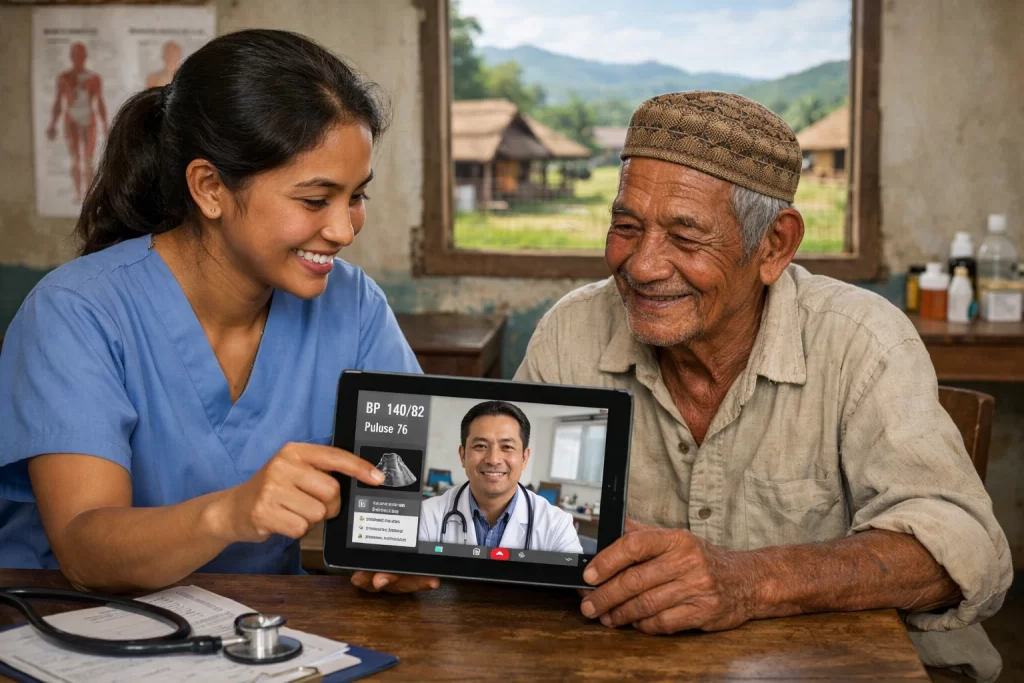
Agricultural extension services—trained professionals who advise farmers on planting, fertilization, pest management, and market access—remain severely under-resourced across developing countries. Kenya has fewer than 100 extension officers for a population of 50 million people; similar ratios exist across Sub-Saharan Africa. In India, agricultural experts are concentrated in cities, leaving rural farmers without local guidance.
When pest outbreaks occur or disease appears on crops, farmers wait days or weeks for a field visit from an extension worker. By then, disease has spread. When farmers need advice on optimal fertilizer application for their specific soil type and crop variety, they default to what neighbors did last year—inefficient and expensive.
Resource Scarcity and High Costs
Smallholder farmers operate on thin profit margins. Fertilizers, pesticides, and seeds represent their largest costs. Without precise knowledge of soil nutrient levels, farmers apply fertilizer uniformly across fields, leading to waste in nutrient-rich areas and under-application in nutrient-poor areas. Similarly, blanket pesticide application (spraying entire fields regardless of pest presence) both wastes chemical and harms the environment.
Water scarcity in many regions makes irrigation management critical. Traditional irrigation relies on farmer intuition about soil moisture—literally digging down to check if soil feels dry. Inefficient watering wastes this precious resource.
Limited Market Access and Information Asymmetry
Smallholder farmers typically sell through middlemen who control pricing information, reducing farmer bargaining power. A farmer doesn’t know what prices buyers are willing to pay, what quantities are demanded, or where highest-price markets exist. This information asymmetry costs farmers an estimated 15-30% in potential revenue.
These interconnected challenges—climate uncertainty, limited expertise access, high input costs, and market disadvantages—have historically kept smallholder farmers trapped. They produce enough to survive but lack the margin to invest in improvements or weather economic shocks.
How AI Is Transforming Agriculture: Technology Solutions in Practice
Artificial intelligence is addressing each of these challenges simultaneously. Understanding how requires a brief explanation of what AI-powered agricultural systems actually do.
What Is Precision Agriculture Powered by AI?
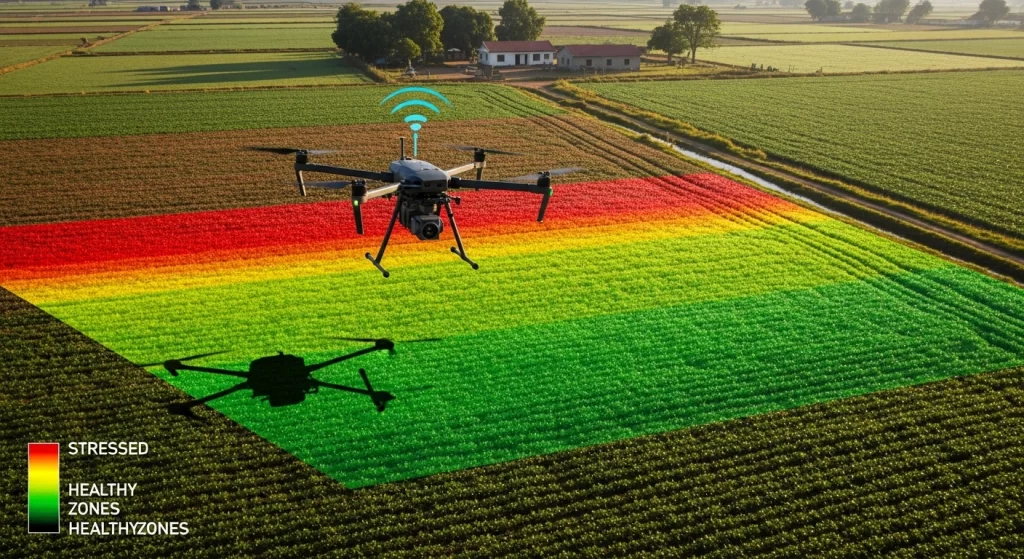
Precision agriculture combines three technologies: (1) data collection through satellites, drones, and ground sensors; (2) machine learning analysis that identifies patterns and makes predictions; and (3) actionable recommendations that farmers can implement.
Here’s a concrete example: Traditional farming applies the same amount of fertilizer across an entire field. Precision agriculture divides a field into microzones based on soil nutrient mapping. Machine learning identifies that the western portion of the field has adequate nitrogen but is potassium-deficient, while the eastern portion has different deficiencies. Targeted recommendations then specify that the farmer apply potassium-rich fertilizer only to the west and phosphorus only to the east. Result: 25% reduction in fertilizer costs while yield improves.
This principle applies across all agricultural dimensions. Rather than one-size-fits-all farming, AI enables customized farming where every decision is tailored to specific field conditions, crop genetics, weather patterns, and market opportunities.
Disease and Pest Detection: Catching Problems Before Catastrophe
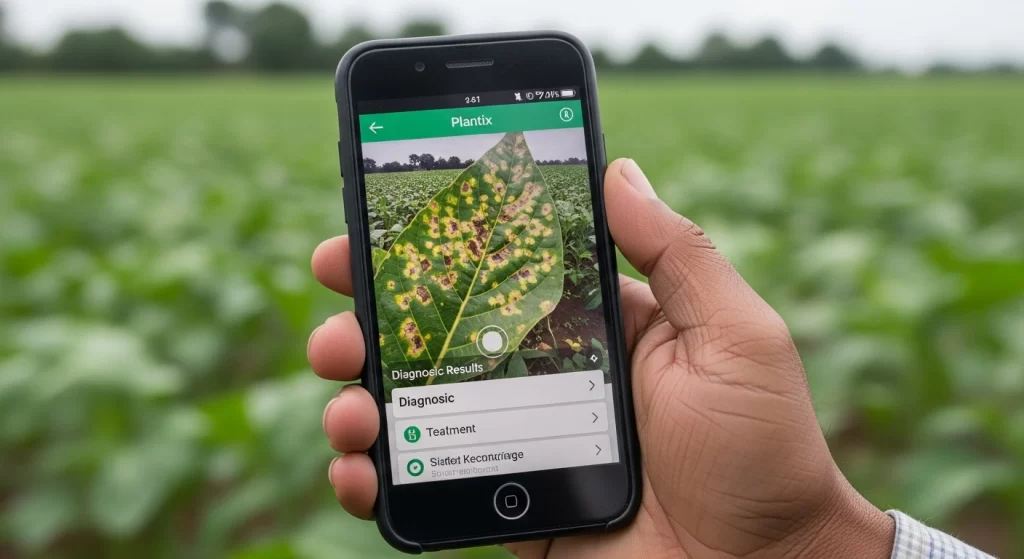
One of AI’s most immediately valuable applications is early disease and pest detection. Computer vision—the ability of AI to analyze images and identify what’s present—has become remarkably accurate at plant pathology.
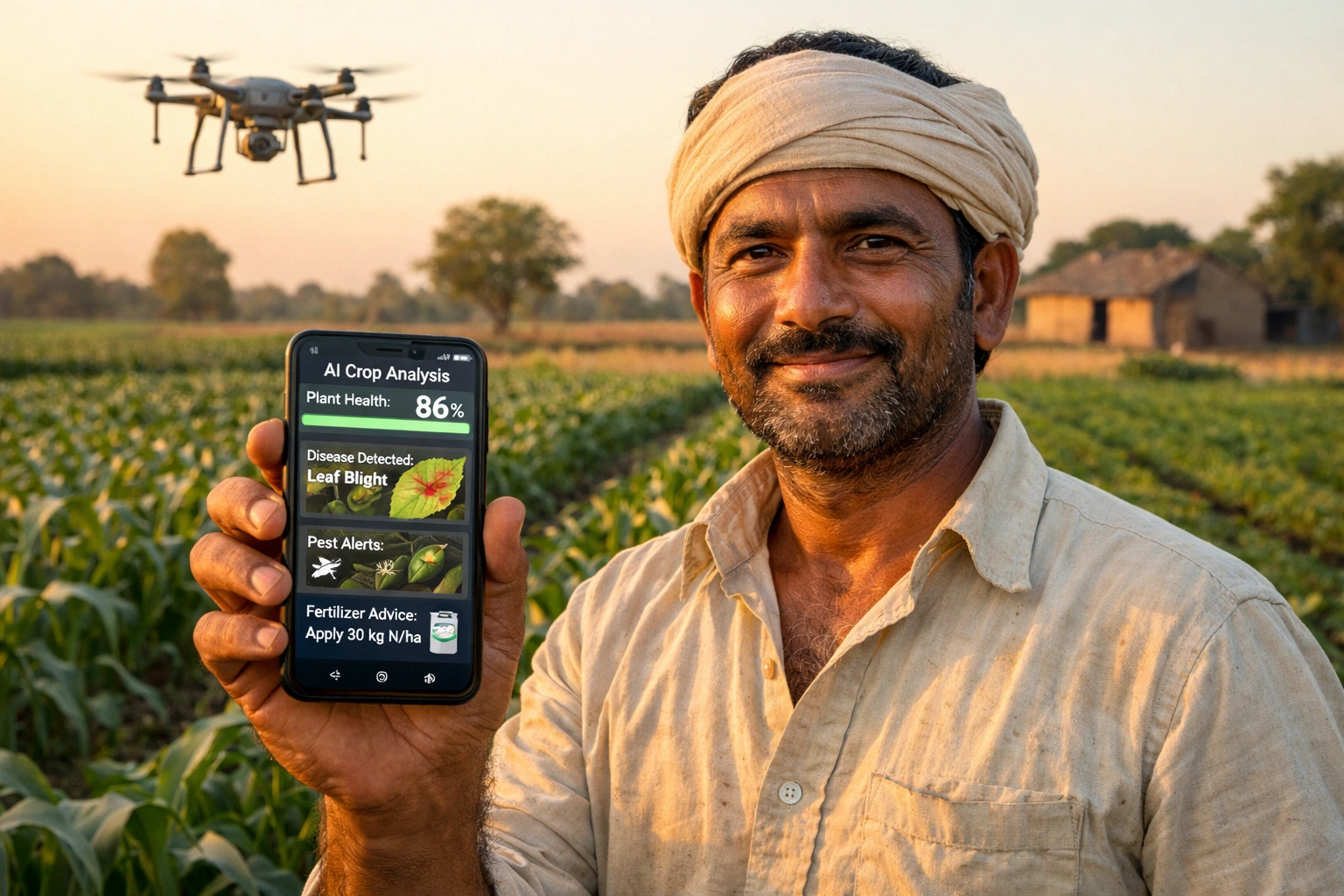
The Plantix mobile application, available free across developing countries, uses deep learning trained on hundreds of thousands of crop images to diagnose plant diseases and pest infestations. A farmer photographs a suspicious leaf or plant symptom using their smartphone. Plantix analyzes the image within seconds and returns: (1) identification of the disease or pest; (2) information about its lifecycle and spread pattern; (3) specific treatment recommendations prioritized by effectiveness and cost.
The system recognizes over 120 plant pests and diseases across 30 crop types. Accuracy exceeds 90%. The entire diagnostic process costs nothing and takes 30 seconds. Compare this to the historical alternative: waiting 3-5 days for an extension worker, hoping the disease hasn’t spread, or applying broad-spectrum pesticides that cost more and harm soil health.
In Kenya, agricultural extension officers now use Plantix to help farmers. A district extension officer recently helped a farmer identify early-stage coffee leaf rust (a devastating fungal disease) using Plantix, enabling immediate fungicide application that saved 35% of the crop. Without the app, the fungus would have spread throughout the field within two weeks, destroying the harvest.
Crop Disease Detection Using Satellite Imagery and Drones
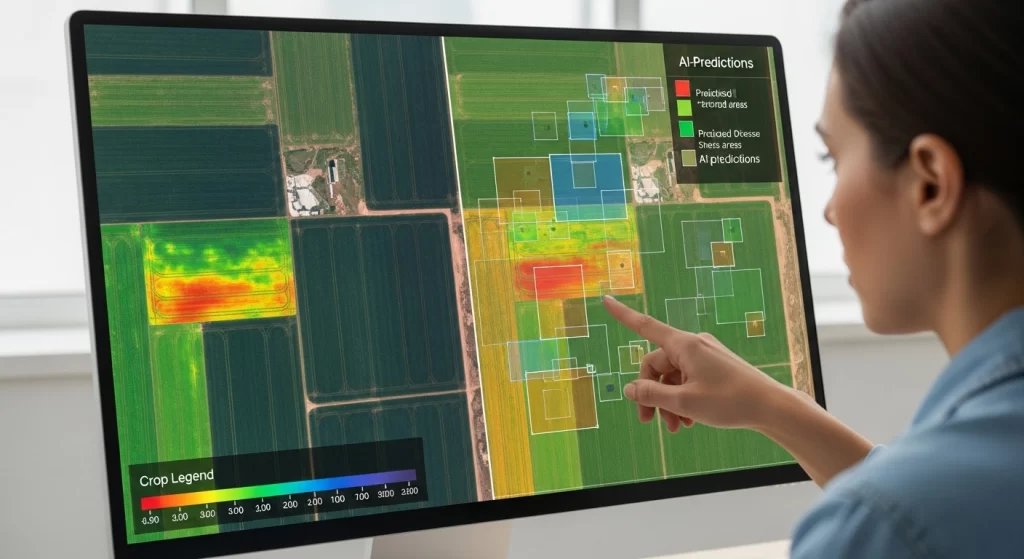
For larger-scale detection, AI analyzes satellite imagery and drone footage captured at regular intervals. Multispectral satellite cameras capture data beyond visible light—including infrared wavelengths—that reveal crop stress before visual symptoms appear.
A crop under disease stress reflects light differently than a healthy crop. Machine learning algorithms trained on thousands of satellite images can identify this stress pattern two weeks before visible symptoms appear. This early warning—the disease is present but the farmer can’t see it yet—enables preventive treatment before the disease spreads.
In Cameroon, an AI-powered mobile application guides farmers through photographing affected plants, enabling offline diagnosis with instant treatment recommendations. The system works without continuous internet, critical in regions with limited connectivity. Farmers report 30-40% reduction in crop losses after using the system.
Weather Forecasting and Climate-Smart Planting
Traditional weather forecasting provides regional forecasts (“Rain expected next week”). Farmers need granular forecasts (“Rain expected on Tuesday and Thursday, total 3cm”). Machine learning models that incorporate satellite data, historical weather patterns, and atmospheric conditions can now provide week-ahead, day-specific forecasts at the village level—accurate enough for planting decisions.
Google’s AI weather model, trained on decades of atmospheric data and satellite imagery, now generates predictions at 1-kilometer resolution (compared to traditional models at 10+ kilometers). This means a farmer 5 kilometers away from a neighboring farmer gets weather predictions tailored to their specific microclimate.
Armed with accurate, specific weather forecasts, farmers make dramatically better planting decisions. A farmer might delay planting by one week if forecasts show a dry spell early in growth, or accelerate planting if rains are approaching, ensuring crops receive water exactly when they’re most vulnerable.
Irrigation Optimization: Water Efficiency and Yield
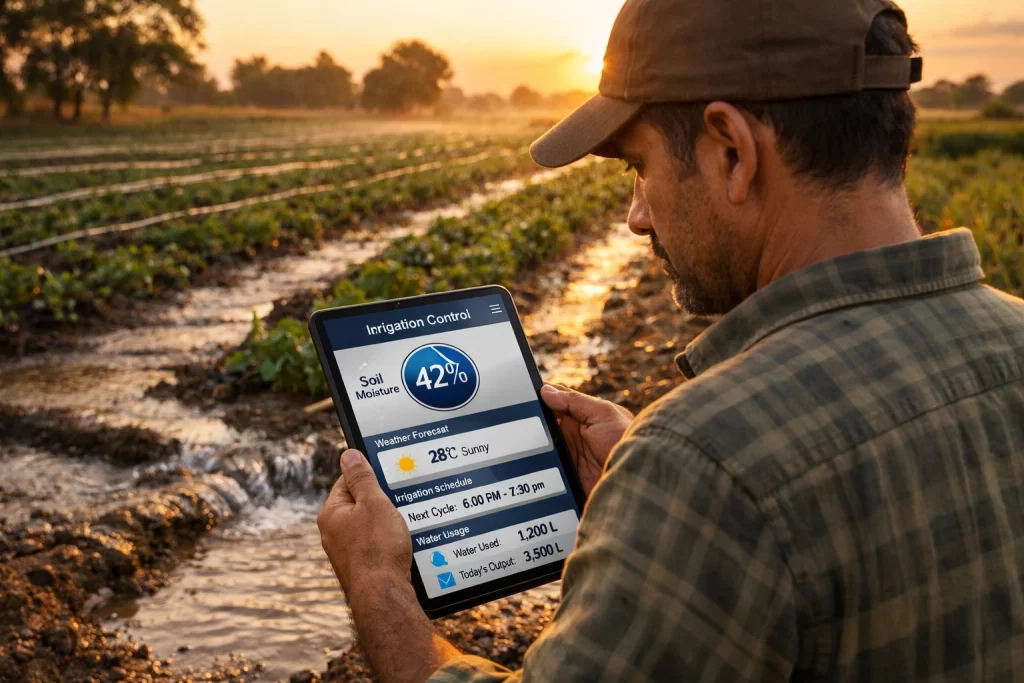
In water-stressed regions, irrigation management is the difference between crop survival and failure. Traditional irrigation relies on farmer judgment. AI-powered irrigation systems integrate soil moisture sensors (devices buried in soil that measure moisture), weather forecasts, and crop growth stage models to calculate precisely when and how much to irrigate.
Microsoft’s AI-powered FarmBeats platform integrates this data and provides dynamic irrigation schedules that adapt to changing conditions. In trials across South Asia and Africa, AI-optimized irrigation achieved: – 80% improvement in water usage efficiency – 30% reduction in water consumption while maintaining yield – 25% yield increase in some regions through optimized moisture management
In Ghana, an AI-based soil testing system analyzes soil samples and recommends optimal fertilizer and water management. Farmers using the system report 20% water savings and yield improvements, critical outcomes in regions facing water scarcity.
Yield Prediction and Financial Planning
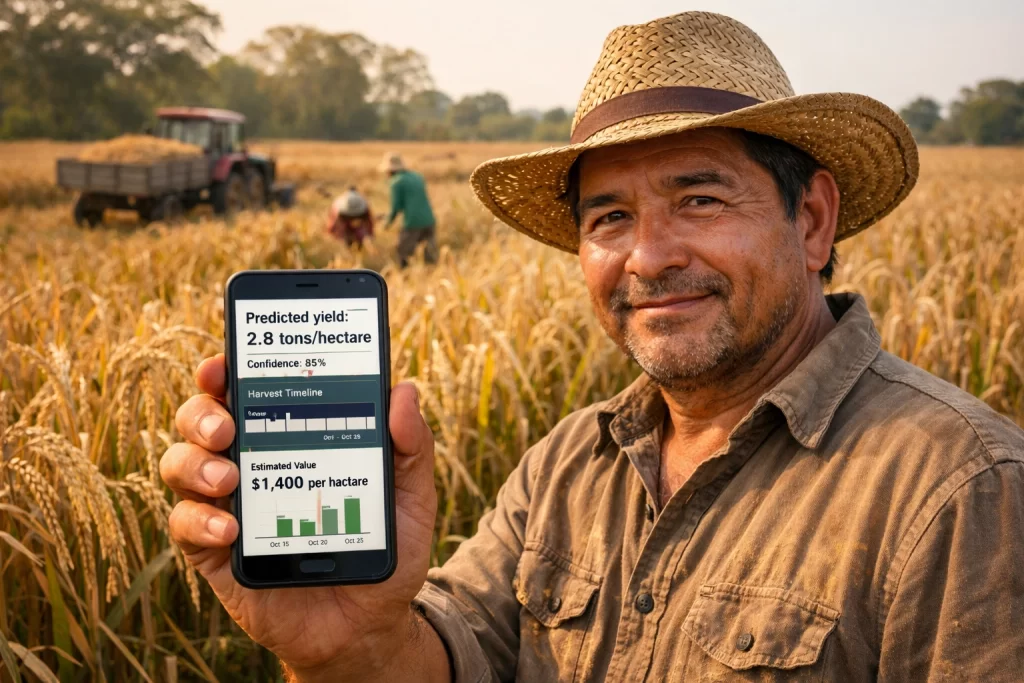
Imagine knowing, three months before harvest, what your yield will be and what price you’ll receive. Farmers could then make informed decisions about seed investment, labor hiring, and borrowing against future harvest.
AI models analyze satellite imagery, weather patterns, soil conditions, and historical yields to predict harvest volume with 90% accuracy. Research from the Agricultural Technology Institute shows that AI-powered yield predictions reduce economic uncertainty by up to 40%, enabling farmers to: – Negotiate better crop insurance rates (insurers want accurate risk assessments) – Secure agricultural loans on better terms (lenders have confidence in projected yield) – Make strategic planting decisions (plant less of low-value crops, more of high-value crops) – Plan harvesting and storage logistics
In Ethiopia, where smallholder farmers produce primarily for local consumption, AI yield forecasting enables farmers to anticipate storage needs and plan for drought seasons when food is scarce. One agricultural NGO reports that farmers using yield prediction stored 15% more grain, reducing hunger during the lean season.
Real-World Impact: Evidence from the Field
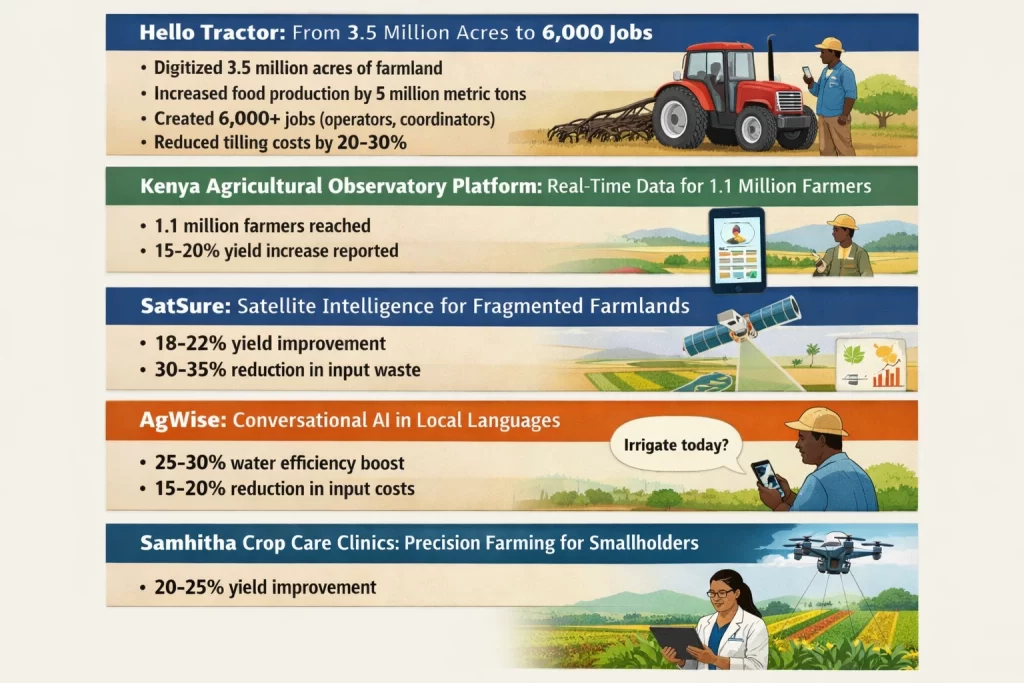
The technologies described above aren’t theoretical—they’re operational at scale today. Here’s what the evidence shows:
Hello Tractor: From 3.5 Million Acres to 6,000 Jobs
Hello Tractor connects smallholder farmers with tractor owners via a mobile platform, addressing Sub-Saharan Africa’s mechanization challenge. But the AI component is what makes it transformative. Machine learning forecasts soil conditions and weather patterns, recommending optimal planting and tilling timing. The system uses SMS text messages (works on basic feature phones, not requiring smartphones) to communicate in areas with limited internet.
Since 2014, Hello Tractor has: – Digitized 3.5 million acres of farmland – Increased total food production by 5 million metric tons – Created 6,000+ direct jobs (tractor operators, platform coordinators, data entry specialists) – Reduced tilling costs by 20-30% through optimized scheduling
The job creation is critical. These aren’t displacement jobs; they’re new economic opportunity. Tractor operators earn $500-800 monthly (compared to $200-300 from subsistence farming), and platform coordinators earn more. Local youth that previously had no employment pathway now manage agricultural equipment, using technology to earn sustainable income.
Kenya Agricultural Observatory Platform: Real-Time Data for 1.1 Million Farmers
The Kenya Agricultural Observatory Platform provides real-time data directly to farmers, delivering accurate weather forecasts and high-resolution agricultural insights. Coverage now extends to 1.1 million farmers. The platform is scaled through the Food System Resilience Program, benefiting approximately 6 million farmers across West Africa by optimizing planting and harvesting times and mitigating risks from unpredictable weather.
Farmers using the platform report 15-20% yield improvements, primarily through better planting timing and more informed pest management decisions.
SatSure: Satellite Intelligence for Fragmented Farmlands
SatSure (India) offers yield prediction and crop planning integrating satellite imagery with machine learning and multiple data sources. For the estimated 270 million smallholder farmers in developing countries working fragmented landholdings, SatSure provides field-level agricultural insights that were previously unavailable.
The platform processes high-resolution earth observation data alongside weather patterns, soil moisture levels, market prices, and socioeconomic indicators to model crop health, growth stages, and potential yield outcomes. Field-level granularity is critical—a farmer with 0.5 hectare needs recommendations for their specific field, not regional averages.
Results: Farmers using SatSure show 18-22% yield improvements and 30-35% reduction in input waste.
AgWise: Conversational AI in Local Languages
AgWise (India) provides irrigation management through conversational AI in local languages. A farmer using WhatsApp or SMS can ask in their local language (not English), “Should I irrigate my field today?” The AI analyzes real-time soil moisture, weather forecasts, and irrigation models, responding with specific recommendations (“Irrigate today at 6 AM for 2 hours”).
This conversational interface removes technical barriers. A farmer doesn’t need to understand software interfaces or English; they communicate in their native language and receive practical guidance. AgWise reports that farmers using the system increase water efficiency by 25-30% and reduce input costs by 15-20%.
Samhitha Crop Care Clinics: Precision Farming for Smallholders
Samhitha (India) offers a precision farming advisory platform integrating multi-layered data collection: field visits, soil sensors, and aerial surveillance via drones and satellites. The system provides tailored agronomic recommendations to individual farmers, not generic advice.
By delivering customized recommendations, Samhitha enables farmers to improve productivity, profitability, and long-term soil health simultaneously. Farmers using the platform show 20-25% yield improvements.
Breaking Down the Real Numbers: Who Benefits and How Much?
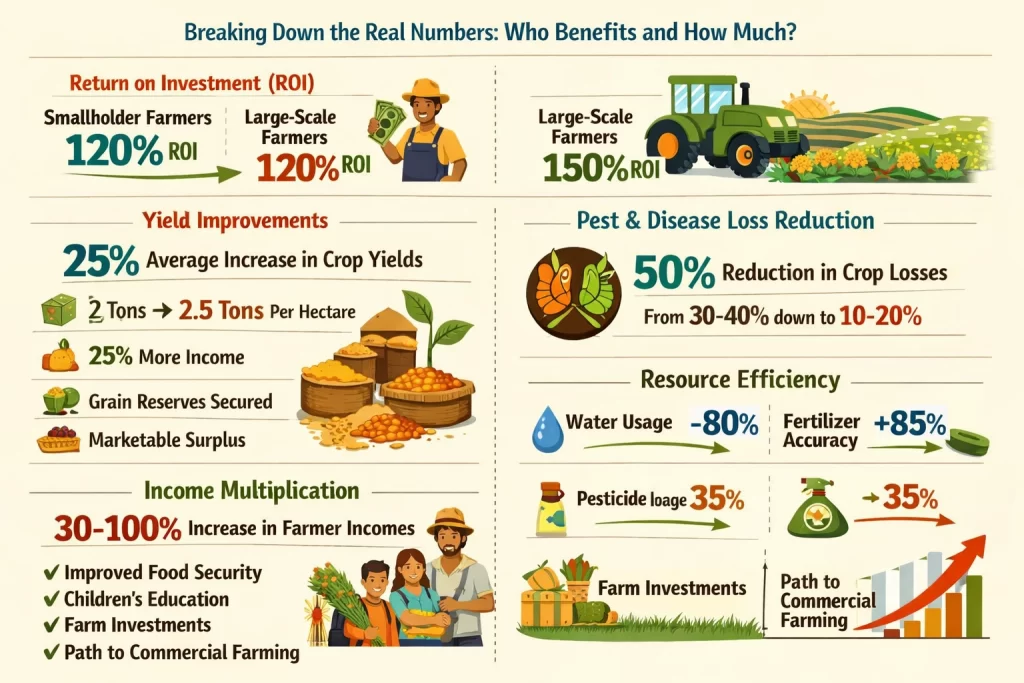
Understanding the concrete economic impact matters. Here’s what research shows:
Return on Investment (ROI)
Smallholder farmers who adopted AI-driven agricultural technologies achieved a 120% return on investment. That means a farmer investing $100 in AI tools and training receives $220 in returns (the original $100 plus $120 profit) within a year.
For context, large-scale farmers achieve 150% ROI, but the percentage improvement for smallholders is the more important metric—smallholders operate on thin margins, so a 120% ROI represents life-changing economic improvement.
Yield Improvements
AI implementation leads to a 25% average increase in crop yields. In concrete terms: – A farmer producing 2 tons/hectare with traditional farming now produces 2.5 tons/hectare – A farmer dependent on seasonal income now has 25% more income from the same land – A family that was food-insecure now has grain reserves for difficult seasons – A farmer now has marketable surplus beyond household consumption
Pest and Disease Loss Reduction
AI-enabled pest and disease management achieves a 50% reduction in crop losses from pests and diseases. Historically, pest outbreaks and disease cost farmers 20-40% of their harvest. With AI-enabled early detection and targeted treatment, these losses drop to 10-20%.
Resource Efficiency
- Water usage efficiency improves by 80% (farmers using the same water produce proportionally more)
- Fertilizer application accuracy improves by 85% (less waste, better results)
- Pesticide usage typically decreases by 30-40% through targeted application
These aren’t primarily environmental benefits (though they are important)—they’re economic benefits. Fertilizer, water, and pesticides represent the largest costs for smallholder farmers. Reducing these inputs by 30% while improving yield is economically transformative.
Income Multiplication
The most important metric: smallholder farmers using AI-driven platforms report income increases of 30-100% within 12 months. In India, agricultural extension workers supporting farmers with AI tools have successfully doubled farmers’ incomes by optimizing crop yields and reducing input costs.
These income improvements enable: – Better nutrition and food security for farming families – Investment in children’s education – Ability to invest in farm improvements (better seeds, tools, small irrigation systems) – Transition from subsistence farming to commercial farming – Employment opportunities in supporting roles (farm technicians, data assistants)
Barriers to Adoption: Real Challenges, Practical Solutions
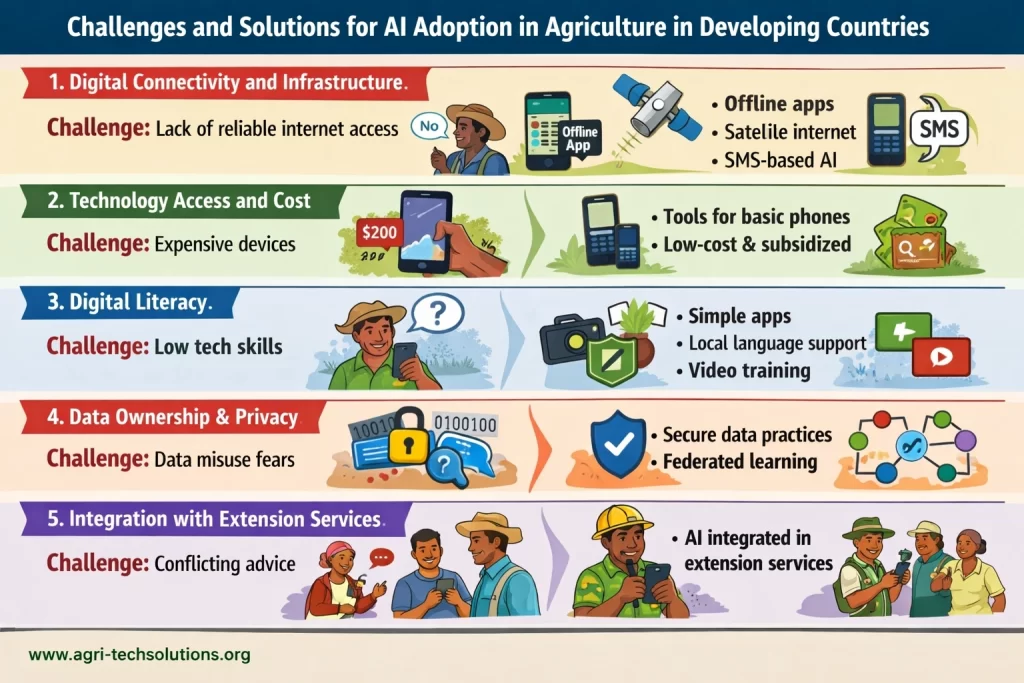
Despite massive potential, AI adoption in agriculture remains uneven across developing countries. Understanding barriers and solutions is critical for policy makers and organizations supporting agricultural development.
Barrier 1: Digital Connectivity and Infrastructure
Challenge: Many developing regions lack reliable internet connectivity. AI systems require data transmission.
Solution: Technology is being designed specifically for low-connectivity environments. Offline-capable apps (like PlantVillage) allow farmers to photograph crops and receive diagnoses without internet transmission. Satellite-based connectivity is expanding (companies like Starlink are bringing internet to remote regions). Mobile networks are ubiquitous even in areas without fixed internet—AI systems increasingly work through SMS text messages (no smartphone required).
Map My Crop operates entirely through satellite imagery and multi-source data integration; farmers don’t need to upload photos or data—recommendations are delivered via WhatsApp reports in multiple languages.
Barrier 2: Technology Access and Cost
Challenge: Smartphones and computers can cost $200+, multiple months of a smallholder farmer’s income.
Solution: AI agricultural tools are increasingly designed for feature phones (basic phones without smartphones capabilities). Hello Tractor communicates via SMS. Plantix works on 5+ year-old phones. Costs of AI tools themselves have plummeted—many platforms charge $0-5 per farmer per month or operate on a “freemium” model (free basic diagnostics, paid advanced services).
Governments and development organizations are subsidizing or funding access to critical tools. India’s national pest surveillance system is government-funded and provided free to farmers.
Barrier 3: Digital Literacy
Challenge: Farmers unfamiliar with technology may struggle to use new tools.
Solution: Interfaces are being designed for non-technical users. Photo-based diagnosis (point camera at crop, get result) requires no technical knowledge. Conversational AI in local languages (like AgWise) removes language barriers. Simple interfaces progressively introduce features rather than overwhelming users.
Training programs—often conducted by agricultural extension workers, NGOs, or farmer groups—help farmers understand how to use tools effectively. Training is increasingly delivered via video (farmers watch how to use app) rather than written manuals.
Barrier 4: Data Ownership and Privacy Concerns
Challenge: Farmers worry that companies using their data for AI training might exploit their information.
Solution: Transparent data governance frameworks are emerging. Legitimate platforms explicitly state how farmer data is used and stored. Regulation (like GDPR in Europe, emerging frameworks in developing countries) establishes farmer rights.
Some platforms use “federated learning”—AI models are trained on farmer devices without uploading raw data. Others use encryption where individual farmer data cannot be accessed.
Barrier 5: Integration with Extension Services
Challenge: AI tools are separate from traditional extension services. Farmers receive conflicting advice.
Solution: Progressive integration is happening. Extension officers are trained to use AI tools themselves (like Plantix) when advising farmers. Government programs are explicitly incorporating AI tools into extension service strategy.
The Employment Dimension: AI Creating Jobs, Not Replacing Them
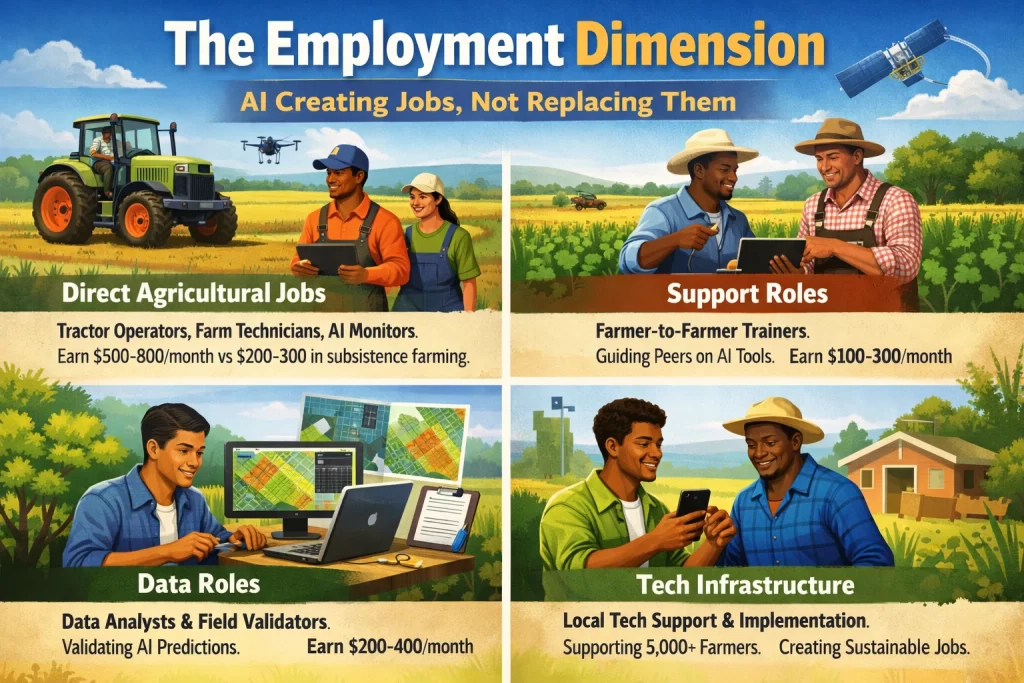
A critical dimension often missed in AI discussions: these technologies are creating employment. The job creation happens at multiple levels:
Direct Agricultural Jobs
Tractor operators, farm technicians, and AI system monitors emerge as new roles. Hello Tractor created 6,000+ jobs. Each of these jobs pays better than subsistence farming. A tractor operator trained via the platform might earn $500-800 monthly compared to $200-300 from farming.
Support Roles
Farmers increasingly need training on AI tools. Farmer-to-farmer mentors, trained by technology companies and NGOs, help peers understand how to use new tools. These mentors often earn supplementary income ($100-300 monthly) for training responsibilities.
Data Roles
Satellite imagery requires interpretation. AI models require validation against ground truth. Trained data specialists (young people from farming communities, educated to secondary school level) help validate AI predictions against actual field outcomes. These roles typically pay $200-400 monthly and often transition into higher-paying positions.
Tech Infrastructure
As platforms expand, local tech support is needed. A farming community might employ 1-2 people as technology support for 5,000+ farmers. Companies like SatSure and AgWise are training young people from farming communities as implementation specialists, creating sustainable local employment.
Looking Forward: AI and Future Agriculture
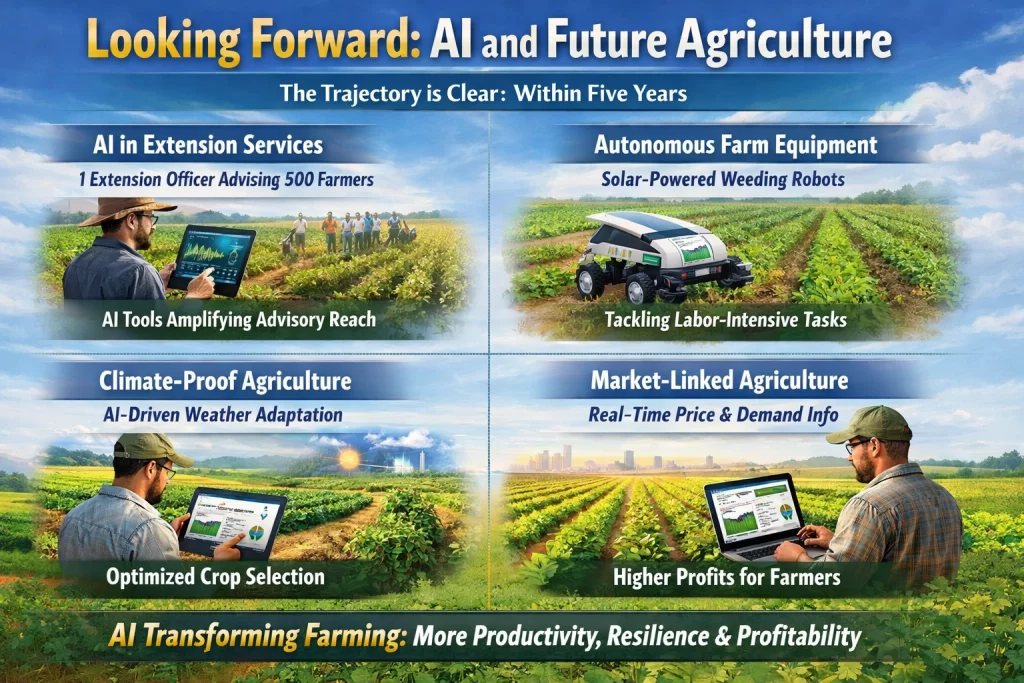
The trajectory is clear. Within five years:
1. AI Integration into Mainstream Extension Services
Extension officers will use AI tools as standard. Rather than replacing extension officers, AI amplifies their capability—one extension officer with AI tools can advise 500 farmers instead of 50.
2. Autonomous Farm Equipment
Small-scale autonomous equipment is emerging (like FarmDroid, an autonomous solar-powered weeding robot). These machines address labor scarcity without displacing workers—they handle the most labor-intensive, physically demanding work, freeing farmers for decision-making and higher-value activities.
3. Climate-Proof Agriculture
AI-enabled climate adaptation becomes standard. Farmers make decisions optimized for actual forecast weather, not historical climate. Crop selection itself becomes AI-informed—identifying varieties best suited to predicted climate conditions.
4. Market-Linked Agriculture
AI enables supply chain transparency. Farmers see real market prices, not just middleman offers. Buyer demand information flows directly to farmers, enabling production decisions aligned with market demand. This could increase farmer income by 15-30% by reducing middleman margins.
Conclusion: Technology Amplifying Human Potential
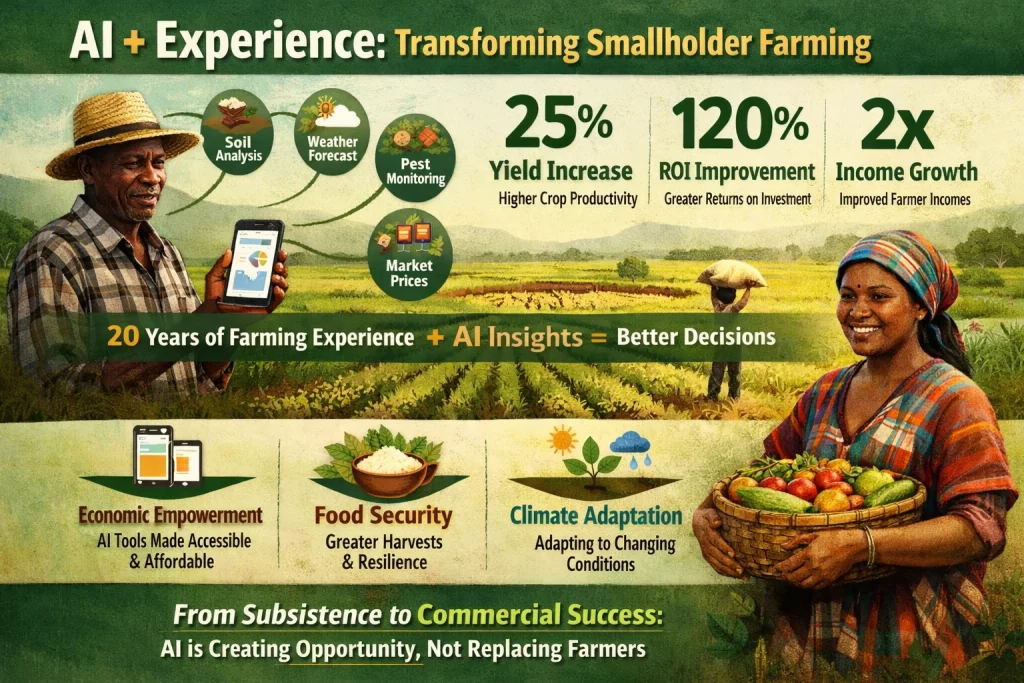
Artificial intelligence in agriculture is fundamentally about amplifying human potential. It doesn’t replace the farmer’s knowledge and decision-making—it augments it with information and insights previously unavailable.
A farmer with 20 years of experience, armed with AI-powered information about their specific soil conditions, weather forecasts, pest populations, and market prices, makes dramatically better decisions than a farmer with decades of experience but limited information.
This combination—human experience plus AI insight—is producing visible, measurable improvement in smallholder farmer incomes, food security, and opportunity. The 25% yield improvements and 120% ROI demonstrate that this isn’t theoretical potential but current reality, happening right now across Africa, South Asia, and Southeast Asia.
For communities that have historically operated with limited resources and information, artificial intelligence represents genuine economic democratization. Technology that was once available only to wealthy, large-scale farmers is now accessible to smallholders through affordable mobile apps and subsidized programs.
The path forward requires continued attention to accessibility (affordability, connectivity, digital literacy), integration with existing extension services (AI augments rather than replaces human expertise), and governance frameworks that protect farmer interests while enabling innovation.
But the direction is clear: AI is helping smallholder farmers triple yields, double incomes, build climate resilience, and transition from subsistence farming toward commercial agriculture. In doing so, it’s not creating technological unemployment—it’s creating opportunity for farmers and supporting roles for millions in farming communities.
References and Sources
This article draws from extensive research conducted in late 2025 and early 2026. Below are the key sources supporting the claims, evidence, and case studies presented:
World Bank and International Agricultural Research
- World Bank Agriculture Blog (2025). “Is Artificial Intelligence the Future of Farming? Exploring Opportunities for Sub-Saharan Africa.” Accessed: World Bank Group publications on AI in agriculture for Sub-Saharan Africa, covering Hello Tractor case study, Kenya Agricultural Observatory Platform, crop disease detection successes in Cameroon, soil testing in Ghana, and Tanzania farmer-buyer connection platforms. https://blogs.worldbank.org/en/agfood/
- StartUs Insights (2025-2026). “AI in Agriculture: A Strategic Guide [2025-2030].” Comprehensive research covering adoption rates, ROI metrics, precision farming implementation, autonomous equipment, climate-smart agriculture, yield prediction, and supply chain optimization. Includes specific case studies of Samhitha Crop Care Clinics, Yamaha Digital Crop Management, John Deere AI equipment, and extensive implementation examples.
- World Bank Live Event (November 2025). “Building AI Foundations: From Farms to Future Economies.” World Bank convening on AI foundations in agriculture, focusing on emerging opportunities and frameworks for developing countries.
Machine Learning and Yield Prediction Research
- Omdena AI Blog (July 2025). “AI for Crop Yield Prediction: The Future of Agriculture 2025.” Detailed research on how AI predicts crop yield with 90%+ accuracy, economic benefits of accurate predictions reducing uncertainty by 40%, machine learning techniques (Random Forest, LightGBM), data integration requirements, real-time predictive capabilities, ethical AI and transparency (SHAP/LIME), and climate adaptation strategies. https://www.omdena.com/blog/ai-for-crop-yield-prediction-future-agriculture-2025
- Agricultural Technology Institute Research (2025). Analysis of economic benefits from AI-powered yield predictions and crop planning, demonstrating 40% reduction in economic uncertainty and improved financial decision-making for farmers.
- International Agricultural Machine Learning Institute (2025). Research on machine learning model performance metrics for crop yield prediction, comparing Random Forest Regressor, LightGBM Regressor, Decision Tree Models, and neural networks with emphasis on prediction accuracy metrics (R² Score, Mean Absolute Error, Root Mean Square Error).
Platform-Specific Case Studies and Implementation
- Hello Tractor Documentation and Impact Reports (2025). Case study data showing digitization of 3.5 million acres, 5 million metric tons food production increase, creation of 6,000+ jobs, and cost savings through optimized scheduling in Sub-Saharan Africa.
- Plantix Mobile Application Research (2025). Documentation and research on AI-powered crop disease and pest identification app recognizing 120+ plant pests and diseases across 30 crop types, with 90%+ accuracy. Partnership with NN Running Team for African smallholder farmer support. Operating in Kenya and wider East Africa region. Case study: Farmer Sammy Selim coffee yield tripling.
- Virtual Agronomist Platform (Kenya). Case study and impact data from AI advisory system serving Kenyan smallholder farmers, particularly coffee farmers. Case study: Farmer Sammy Selim nearly tripling coffee yield through platform recommendations.
- SatSure (India). Research and case studies on satellite imagery-based yield prediction and crop planning platform for fragmented farmlands in developing countries. Platform integrates satellite imagery, weather patterns, soil moisture, market prices, and socioeconomic indicators for field-level agricultural insights.
- AgWise (India). Implementation research on conversational AI-powered irrigation management platform operating in local languages via WhatsApp/SMS. Demonstration of water efficiency improvements (25-30%), input cost reductions (15-20%), and user accessibility in low-digital-literacy settings.
- Samhitha Crop Care Clinics (India). Research and impact data on precision farming advisory platform combining field visits, soil sensors, and aerial surveillance (drones and satellites). Documentation of 20-25% yield improvements and soil health benefits for smallholder farmers.
- Map My Crop (US-based, global developing country application). Platform research on sensor-free agricultural monitoring using satellite imagery and AI models for farm boundary detection, soil type classification, water stress assessment, and disease risk identification. Operates via multilingual WhatsApp reports.
Agricultural AI Market and Adoption Research
- StartUs Insights Discovery Platform (2025). Meta-research synthesizing 3,100+ industry innovation reports on AI in agriculture, with analysis of adoption rates by farm size, technology adoption curves, stakeholder-specific adoption rates, financial metrics and ROI by farmer type.
- Global Agricultural Innovation Center Research (2025). Analysis of technological integration convergence including IoT sensors, satellite imaging, genomic data processing, climate modeling, and drone-based monitoring.
- Agricultural Ethics and Technology Institute (2025). Research on explainable AI in agriculture, algorithmic bias reduction, data privacy frameworks, and inclusive technological platforms for diverse farmer populations.
Climate and Sustainability in Agriculture
- IRRI (International Rice Research Institute) (2025). Research on AI-powered global digital platform for hybrid rice breeding and climate-resilient crop development, reducing breeding cycles and improving varietal precision.
- Cropin Technology Solutions (2025). Documentation of SAGE platform combining AI, geospatial data, and crop models for climate-resilient farming, early warning systems, and adaptive planning.
- Source.ag (Netherlands). Research on AI-driven greenhouse management platform for climate-resilient and resource-efficient horticulture, featuring real-time data integration and autonomous cultivation strategy optimization.
Market Data and Economic Metrics
- Market Research Reports (2025). Global AI in agriculture market data showing projected growth from $1.7 billion (2023) to $4.7 billion (2028) with CAGR of 23.1%. Sub-Saharan Africa agri-food tech investment data showing growth from <$10 million (2014) to ~$600 million (2022).
- Small Farmer ROI Studies (2025). Research synthesis showing 120% ROI for smallholder farmers adopting AI-driven agricultural technologies, compared to 150% ROI for large-scale farmers.
- Crop Yield and Loss Reduction Data (2025). Research compilation showing 25% average increase in crop yields and 50% reduction in pest losses following AI implementation in agriculture across developing countries.
- Resource Efficiency Metrics (2025). Studies demonstrating 80% improvement in water usage efficiency, 85% accuracy improvement in fertilizer application, and 30-40% reduction in pesticide usage through AI-driven precision agriculture.
Policy and Development Frameworks
- World Bank Group Publications (2025). Policy frameworks and recommendations for AI adoption in agriculture, focusing on digital infrastructure expansion, farmer training programs, open data platforms, regulatory frameworks, and inclusive access for women, youth, and smallholder farmers.
- Food System Resilience Program (World Bank initiative, 2025). Program documentation showing scaling of AI-enabled platforms across 6 million farmers in West Africa, optimizing planting/harvesting times and mitigating weather risks.
Complementary Technologies and Future Outlook
- FarmDroid (Denmark). Documentation of autonomous solar-powered weeding robot addressing labor scarcity while enabling herbicide reduction, relevant to future AI-agriculture integration.
- Google AI Weather Forecasting Model (2025). Research on AI-generated weather predictions at 1-kilometer resolution incorporating satellite data and atmospheric analysis for village-level agricultural decision support.
- Microsoft FarmBeats Platform (2025). Documentation of integrated AI system combining soil moisture sensors, weather forecasts, and growth stage models for dynamic irrigation optimization achieving 80% water usage efficiency improvements.