For most Sri Lankans, the word “Australia” is synonymous with serious migration, Master’s degrees, and high-pressure PR points. But there is a hidden gem in the Australian visa system that is specifically designed for adventure, cultural exchange, and short-term work: the Subclass 462 (Work and Holiday) visa. If you are between 25 and 35 and want to experience life in Sydney, Melbourne, or the Outback without committing to a 4-year degree, this is your ticket.
Unlike the traditional “Student to PR” route, the Work and Holiday visa is about freedom. It allows you to fund your travels by working in almost any industry, from high-end hospitality in Brisbane to harvesting fruit in the Northern Territory. In 2026, with Australia facing labor shortages in the tourism and agriculture sectors, the opportunities for Sri Lankan “Work and Holidaymakers” are at an all-time high.
This 1,500-word guide covers everything a Sri Lankan applicant needs to know—from the “Lottery” system and educational requirements to the financial costs and the reality of finding work in the Southern Hemisphere.
What is the Subclass 462 Visa?
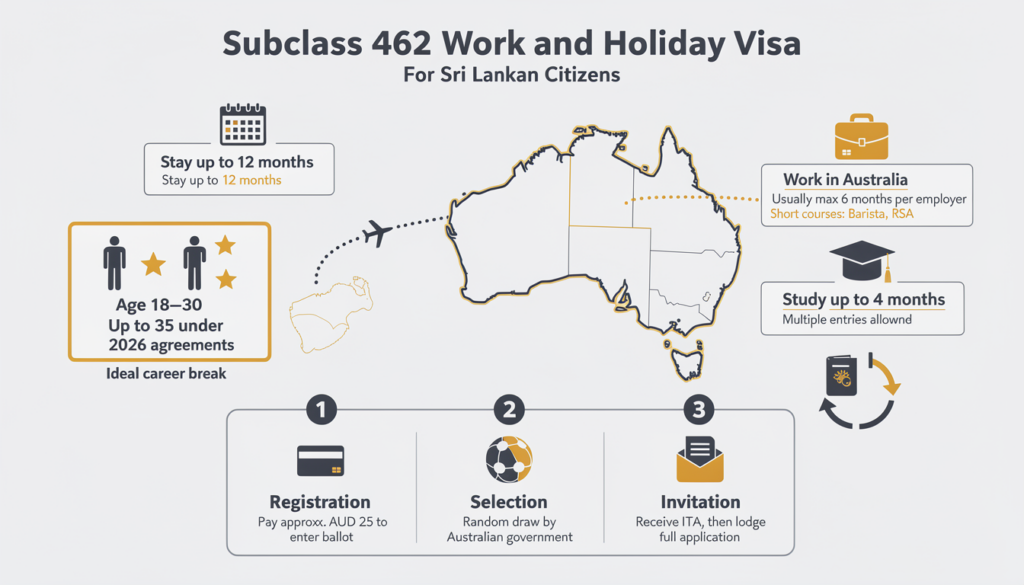
The Subclass 462 visa is a temporary visa that lets people aged 18 to 30 (and for some countries, up to 35) stay in Australia for 12 months. Since 2024/2025, Sri Lanka has been part of a specific group of countries that can access a set number of these visas each year.
What you can do: 1. Stay in Australia for 12 months. 2. Work in Australia (usually up to 6 months with any one employer). 3. Study for up to 4 months (great for short certifications like a Barista course or RSA). 4. Travel in and out of Australia as many times as you want.
The “Age 35” Exception
While many believe the cutoff is 30, under the 2026 bilateral agreements, certain Work and Holiday arrangements for Sri Lankan citizens allow for applications up to 35 years of age. This makes it an ideal “career break” for young professionals in Colombo who feel burnt out and want a year of international exposure.
The Selection Process: The Pre-Application “Ballot”
Because the demand for this visa in Sri Lanka far exceeds the supply (the annual “cap”), Australia uses a Visa Ballot system. This is essentially a lottery. You cannot just apply; you must first register your interest.
- Registration: You pay a small fee (approx. AUD 25) to enter your name into the ballot pool.
- Selection: The Australian government randomly selects names from the pool.
- The Invite: If you are selected, you receive an “Invitation to Apply” (ITA). Only then can you submit your full visa application.
Eligibility Criteria for Sri Lankans
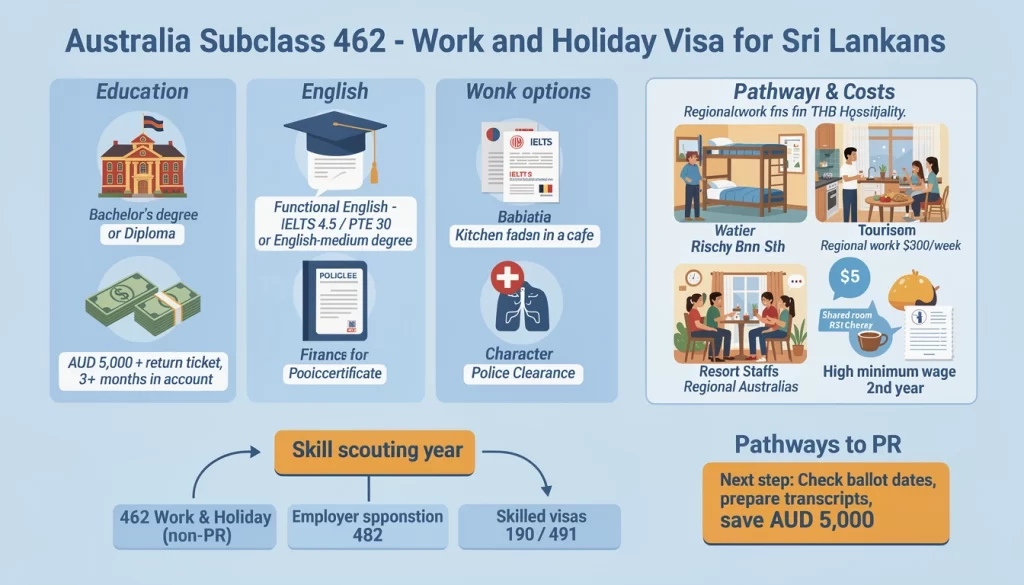
Australia is strict about who gets these visas. Even if you win the ballot, you must meet these five core requirements:
1. Education: Degree or Diploma
You must have at least a tertiary qualification. This means a Bachelor’s degree or a Diploma from a recognized institution (like SLIIT, NIBM, or a state university). High school (A-Level) results alone are not enough for Sri Lankan applicants.
2. Functional English
You don’t need the “Superior” scores required for PR, but you must show “Functional” English. This means an IELTS average of 4.5 or a PTE Academic score of 30. If you completed your degree in English medium, a letter from your university is often enough to waive the test.
3. Financial Capacity
Australia wants to ensure you don’t get stranded. You must show proof of at least AUD 5,000 (approx. 1 million LKR, depending on the rate) in your bank account, plus enough money for a return airfare. Expert Tip: Keep this money in your account for at least 3 months before applying to show it is your own “settlement fund” and not a temporary loan.
4. Character and Health
You will need a Police Clearance Certificate from Sri Lanka (and any other country you’ve lived in for 12 months). You may also be asked for a chest X-ray (TB screening) at an approved clinic in Colombo.
Finding Work: What Will You Actually Do?
The “Work” part of the Work and Holiday visa is usually in “Frontline” industries. While you can work in an office, most employers are reluctant to hire someone who can only stay for 6 months. Most Sri Lankans find success in:
- Hospitality: Working as a waiter, kitchen hand, or barista. If you are in a city like Melbourne, a good barista can earn AUD 30–35 per hour.
- Tourism: Working at resorts in the Whitsundays or tour companies in Cairns.
- Regional Work (The “Second Year” Hack): If you work for 3 months in “specified work” (like fruit picking, plant cultivation, or construction in Northern Australia), you become eligible for a Second Work and Holiday visa, giving you another year.
The Lifestyle: What Surprises Sri Lankans?
The lifestyle on a 462 visa is vastly different from the student life. You aren’t tied to a library. You will likely live in “Hostels” or “Share-houses” with travelers from Germany, the UK, and South America. The Cost of Living: While you earn AUD, you spend AUD. A coffee is $5, and a week’s rent in a shared Sydney room can be $300. However, the minimum wage in Australia is high, meaning if you work 20–30 hours a week, you can live comfortably and still save for travel.
Converting to PR: Is it Possible?
Technically, the 462 is a “non-immigrant” visa. It does not lead directly to PR. However, many Sri Lankans use this year to “scout” the country. If you find an employer who loves your work, they might offer to sponsor you on a Subclass 482 (Employer Sponsored) visa. Alternatively, you might decide to apply for a Skilled Migration visa (190 or 491) while you are onshore, which is often easier than applying from Colombo.
Conclusion
The Subclass 462 visa is the ultimate “try before you buy” option for Australia. It allows you to build a global resume, improve your English, and see the world while getting paid. For a young Sri Lankan, it is a chance to step out of the traditional family structure and prove you can survive and thrive in a Western economy.
Next Step: Check the Home Affairs website for the next ballot opening date. Ensure your university degree transcripts are ready and start saving that AUD 5,000 settlement fund. This could be the most transformative year of your life.
References
- Department of Home Affairs. (2026). Subclass 462 Work and Holiday Visa Requirements.
- Australian Government. (2026). Work and Holiday Visa Ballot for Sri Lanka.
- Fair Work Ombudsman. (2026). Pay and Conditions for 462 Visa Holders.
- Australian High Commission, Sri Lanka. (2026). Applying for Australian Visas from Colombo.