One of the biggest hurdles for Sri Lankan professionals moving to Australia is “Credential Recognition.” You may be a senior engineer in Colombo or a lead developer in Kandy, but to the Australian Department of Home Affairs, your skills don’t exist until they are “validated” by an Australian assessing authority. This process, known as a Skills Assessment, is the foundation of any skilled migration application.
In 2026, the assessment criteria have become more granular. It is no longer just about having a degree; it is about how your specific modules and daily work tasks align with the Australian and New Zealand Standard Classification of Occupations (ANZSCO). Whether you graduated from a state university like Moratuwa or Peradeniya, or a private institution like SLIIT or IIT, you must prove your equivalency to the Australian Qualification Framework (AQF).
This 1,500-word guide details the assessment pathways for the most common Sri Lankan professions, the role of the Washington and Seoul Accords, and how to avoid the “deduction” of years that can cripple your points score.
The Core Concept: AQF Equivalency
The Australian Qualification Framework (AQF) is the national system for regulated qualifications. Most Sri Lankan 4-year Bachelor’s degrees (Honours) from recognized universities are assessed as equivalent to an AQF Bachelor Degree. However, 3-year degrees or certain diplomas might only be assessed as an AQF Associate Degree or Advanced Diploma, which carries fewer points.
1. Engineers: The Washington Accord Advantage
Engineers are assessed by Engineers Australia (EA). For Sri Lankans, the path depends entirely on where and when you graduated.
The Washington Accord Route
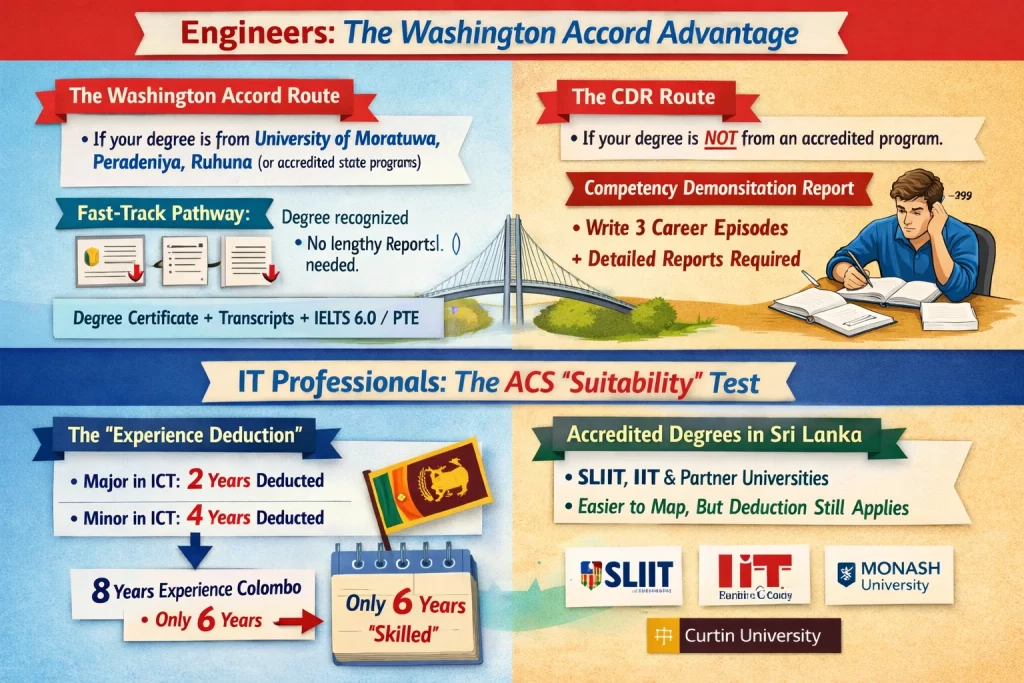
If your degree is from the University of Moratuwa, Peradeniya, or Ruhuna (and certain programs at other state universities), it is likely accredited by the Institution of Engineers Sri Lanka (IESL) under the Washington Accord. The Benefit: This is a “fast-track” path. EA recognizes your degree as internationally equivalent, and you do not need to write lengthy reports to prove your competency. The Requirement: You typically only need to provide your degree certificate, transcripts, and an English test score (IELTS 6.0 or PTE equivalent).
The CDR Route (Competency Demonstration Report)
If your degree is not from an accredited program (e.g., many private university degrees or older state degrees), you must take the CDR Pathway. The Challenge: You must write three “Career Episodes”—detailed essays describing specific engineering problems you solved in your career. This is highly scrutinized by EA to ensure you are working at a professional engineering level, not just a technician level.
2. IT Professionals: The ACS “Suitability” Test
IT specialists are assessed by the Australian Computer Society (ACS). This is often the most frustrating assessment for Sri Lankans due to the “skill level requirement met date.”
The “Experience Deduction”
ACS does not count your work experience from day one. If you have a “Major” in ICT (like a CS degree from Colombo University), ACS will typically deduct the first 2 years of your work experience to “qualify” you. If your degree is a “Minor” in ICT, they may deduct 4 years. Example: If you have 8 years of experience in Colombo, ACS may only give you a letter for 6 years of “Skilled” experience. This can drop your PR points significantly.
Accredited Degrees in Sri Lanka
Institutions like SLIIT and IIT often have programs that align with the Seoul Accord or have direct partnerships with Australian universities (like Curtin or Monash). These degrees are generally easier to map to ACS requirements, but the experience deduction still applies.
3. Accountants: CIMA, ACCA, and CA Sri Lanka
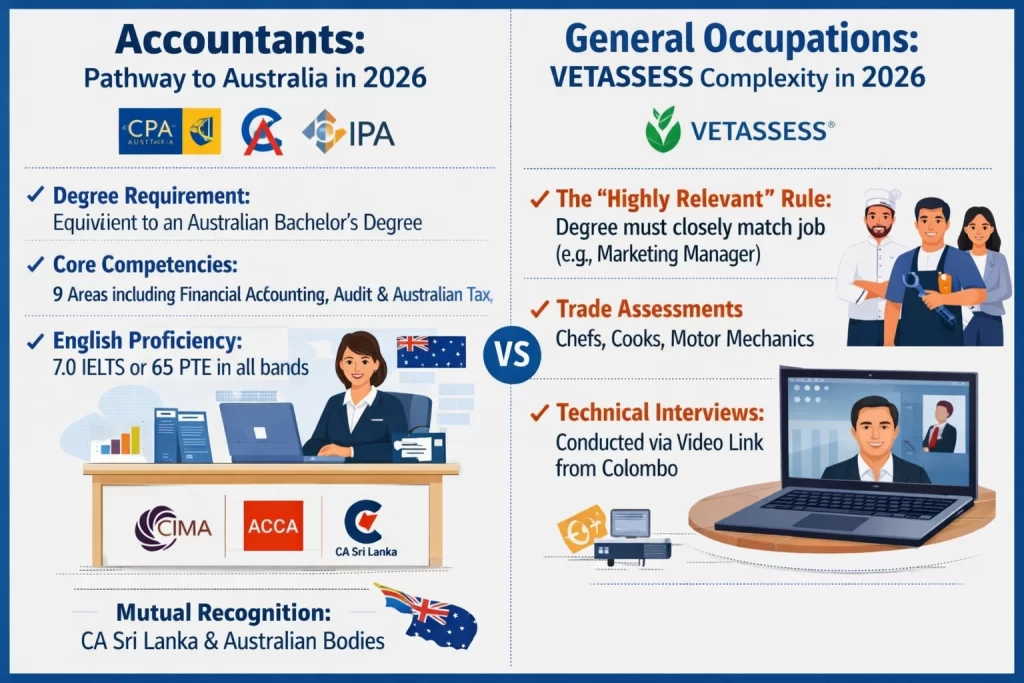
Accountants are assessed by CPA Australia, CA ANZ, or IPA. In 2026, the mutual recognition between CA Sri Lanka and Australian bodies remains a powerful tool.
- Degree Requirement: You must hold a qualification equivalent to an Australian Bachelor’s degree.
- Core Competencies: The assessing body will check your transcripts for 9 core areas, including Financial Accounting, Audit, and Australian Tax/Law. If you are missing one (usually Australian Tax), you may get a “provisional” assessment and be required to bridge that subject in Australia.
- English: Accountants have the highest English requirement for assessment—typically a 7.0 IELTS or 65 PTE in all bands just to get the assessment started.
4. General Occupations: The VETASSESS Complexity
If you are a Marketing Manager, HR Advisor, or Hotel Manager, you will be assessed by VETASSESS. They divide jobs into Groups (A, B, C, etc.).
The “Highly Relevant” Rule: For Group A roles, your degree must be “highly relevant” to the job. If you are a Marketing Manager but your degree is in Zoology, VETASSESS will likely reject you, even if you have 10 years of marketing experience. Trade Assessments: For Chefs, Cooks, and Motor Mechanics, VETASSESS (or TRA) often requires a “Technical Interview” or a practical demonstration of skills. In 2026, these interviews are frequently conducted via video link from approved centers in Colombo.
Common Mistakes and Pitfalls
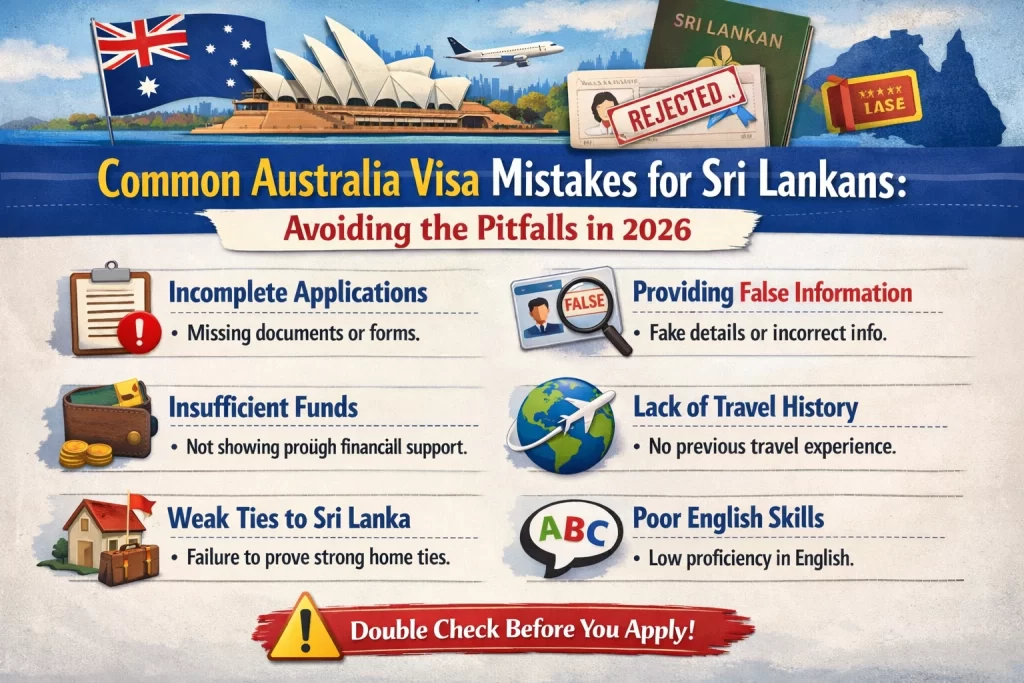
1. Incorrect ANZSCO Code: Choosing “Software Engineer” when your daily tasks are more like a “Web Developer” can lead to a rejection. You must match your job description, not your job title. 2. Inadequate Reference Letters: An experience letter that says “He was a good employee” is useless. It must list your specific daily duties, hours worked, and salary, and be on official company letterhead. 3. Missing Payslips/Tax Records: Assessing authorities increasingly ask for third-party evidence of employment. If you were paid in cash or don’t have EPF/ETF records, proving your experience is extremely difficult.
Conclusion
Credential recognition is the “foundation stone” of your Australian dream. Without a positive skills assessment, you cannot lodge an Expression of Interest (EOI). For Sri Lankan professionals, the key is Documentation. Start gathering every transcript, every syllabus, and every detailed service letter now. If your degree is Washington Accord accredited, you are halfway there; if not, prepare for the rigors of a CDR or VETASSESS filing.
Next Step: Find your 6-digit ANZSCO code on the ABS website. Then, visit the website of your relevant assessing authority (EA, ACS, or VETASSESS) and download the “Migration Skills Assessment Booklet” for 2026. Read it twice before paying any fees.
References
- Engineers Australia. (2026). Migration Skills Assessment (MSA) Booklet.
- Australian Computer Society. (2026). Summary of Criteria for ICT Skills Assessment.
- VETASSESS. (2026). Professional Occupations Assessment Criteria.
- CPA Australia. (2026). Accounting Skills Assessment for Migration.
- IESL Sri Lanka. (2025). Washington Accord Accreditation Status of Degrees.