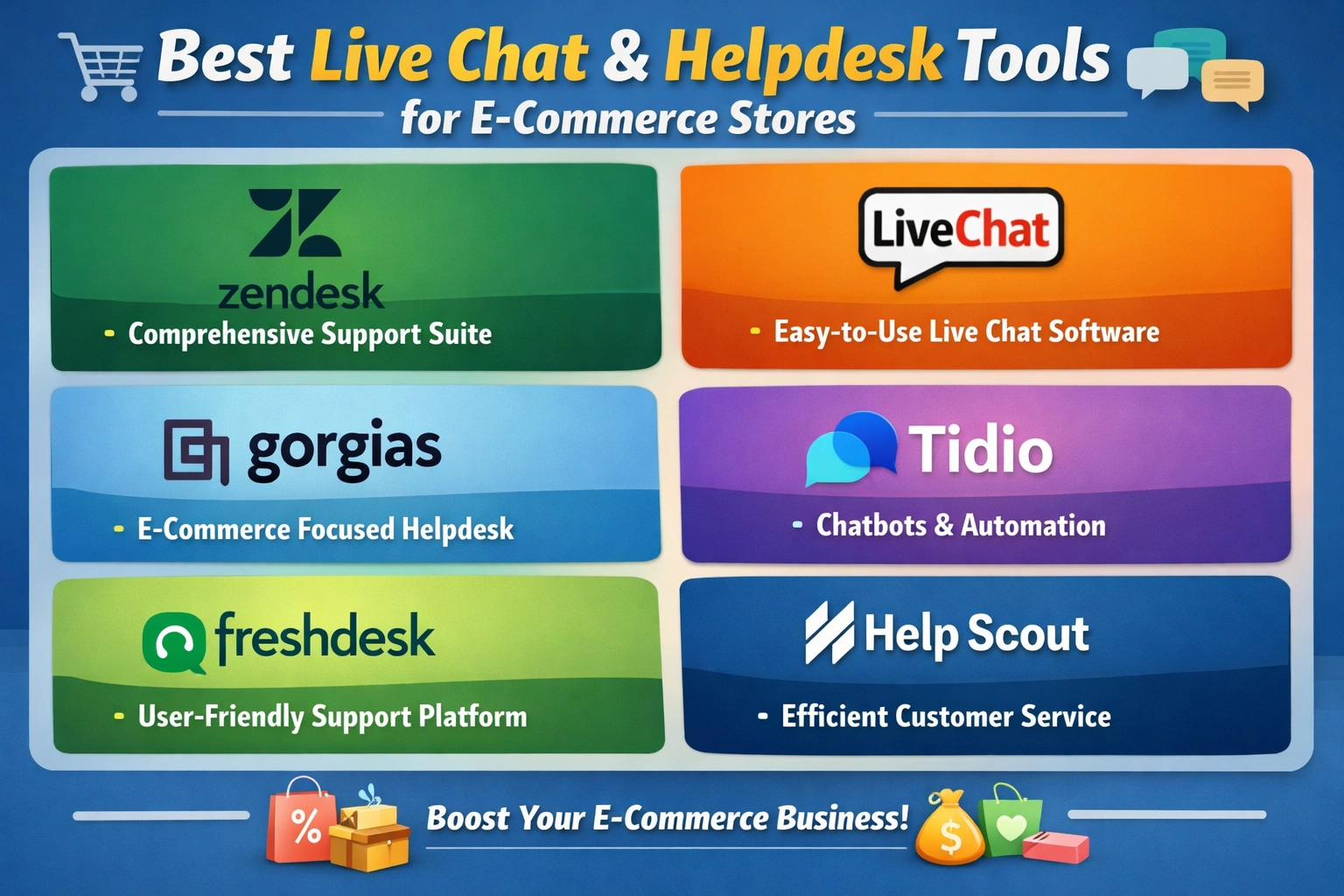
Introduction to Live Chat and Helpdesk Tools for E-Commerce
In today’s fast-paced online shopping world, real-time customer support is a game-changer for e-commerce stores. Shoppers expect instant answers to questions about sizing, shipping, or stock availability—without it, they bounce, leaving abandoned carts in their wake. Studies show that quick live chat can slash cart abandonment by up to 30% and lift conversions by providing that personal touch right when it matters most.[1][2]
Why Real-Time Support Drives E-Commerce Success
Picture this: a customer hesitates at checkout, unsure about delivery times. A proactive chat pops up offering reassurance, and boom—they complete the purchase. That’s the power of live chat and helpdesk tools. These platforms tackle the top reasons for cart abandonment, like unresolved queries or lack of trust, turning potential losses into sales. Beyond that, they build loyalty by making shoppers feel valued, encouraging repeat visits and positive reviews that fuel organic growth.[1][2]
Key Benefits That Make These Tools Essential
The best live chat and helpdesk solutions pack features tailored for e-commerce hustle:
- Unified Inboxes: No more juggling emails, chats, social DMs, and tickets. Everything lands in one dashboard, so your team stays organized and responsive across channels.
- AI Automation: Smart bots handle routine questions like “Where’s my order?” 24/7, freeing agents for high-value interactions. Tools like proactive messaging and auto-ticket creation save hours daily.
- E-Commerce Integrations: Seamless connections with Shopify, WooCommerce, Amazon, and more pull in order details, customer history, and cart data instantly—giving agents full context without endless clicking.
Platforms like eDesk, Gorgias, Tidio, and Zendesk shine here, blending chat with ticketing for a smooth support flow.[1][2]
How to Choose the Right Tool for Your Store
Selecting the perfect fit boils down to a few core criteria:
- Pricing: Look for scalable plans starting as low as $10/month (like Gorgias) up to enterprise tiers. Free trials let you test without commitment.
- Scalability: Start small? Tools like Freshdesk offer free tiers for teams. Growing fast? Zendesk handles surges for big operations.
- Platform Compatibility: Ensure deep integrations with your stack—Shopify natives like Gorgias excel there, while eDesk covers multi-channel marketplaces.
Assess your customer channels, team size, and growth plans first. Test a few via demos to see what clicks. With the right tool, you’ll not only recover lost sales but supercharge your entire customer experience.
(Word count: 452)
Top Live Chat and Helpdesk Tools Reviewed
When running an e-commerce store, lightning-fast customer support can make or break sales. Live chat and helpdesk tools with e-commerce integrations turn chaotic inquiries into smooth conversations, pulling in order details and automating responses to keep agents focused on conversions. I’ve tested several top options, and here are the standouts for 2026: eDesk, Gorgias, Zendesk, and Freshdesk. Each shines in multi-channel support, but picks the right one based on your store’s scale and platforms.
eDesk: Premier Multi-Channel Powerhouse
eDesk is my top pick for multi-channel sellers juggling Shopify, Amazon, eBay, and more. Its unified inbox pulls messages from email, social, marketplaces, and native live chat into one spot, with AI routing tickets and auto-pulling order history for instant context. Love the proactive chat widget that greets visitors and real-time translation for global shops. Agents get suggested replies based on past patterns, slashing response times. Pricing scales with volume, starting affordable for growing stores. Perfect if you’re selling across platforms and need deep integrations.[1]
Gorgias: Shopify’s Best Friend
For Shopify-focused stores, Gorgias feels like it was built yesterday just for you. It integrates seamlessly with orders, letting agents view carts, track revenue from support chats, and manage everything in-ticket. Live chat includes customer tracking and automation templates, plus social media ties. Starts at $10/month for basics, scaling to $60 for pros—super cost-effective. It’s a game-changer for DTC brands wanting to link support directly to sales metrics. If Shopify’s your world, this boosts recovery and upsells effortlessly.[2][1]
Zendesk: Enterprise Muscle with Analytics
Zendesk handles big leagues with multi-channel ticketing, live chat (via Zendesk Chat), and killer analytics on everything from resolution times to CSAT. Visitor tracking, self-service bases, and 1,000+ integrations make it flexible for e-com giants. Pricing kicks off at $19/agent/month, but unlocks advanced AI routing and mobile apps. Great for scaling beyond e-com into full service ops, though it might feel heavy for tiny shops. Reliable for high-volume surges like Black Friday.[1][2]
Freshdesk: SMB-Friendly with Smart Chatbots
Freshdesk keeps it simple and cheap for small-to-medium stores. Its intuitive dashboard unites channels, with Freshchat bots handling FAQs and escalating seamlessly. Automation workflows, team collab, and performance reports are baked in—no steep learning curve. Beacon widget mixes chat, KB, and forms for one-click help. Affordable tiers suit bootstrappers. Ideal if you want quick setup without enterprise bloat.[1][2]
Quick tip: Match your channels—multi-marketplace? eDesk. Shopify pure-play? Gorgias. These tools recover abandoned carts and build loyalty, but test trials to fit your flow. (Word count: 452)
Key Features to Look for in E-Commerce Tools
When running an e-commerce store, the right live chat and helpdesk tools can turn support into a revenue driver. They help you engage shoppers in real time, resolve issues fast, and keep customers coming back. But not all tools are created equal—focus on these standout features to find the best fit for your online business.
Proactive Messaging, AI Ticket Routing, and Automatic Order Lookup
Imagine greeting a browsing customer before they even ask for help. Proactive messaging lets tools like LiveChat send personalized invites based on visitor behavior, boosting conversions by reducing cart abandonment. Pair that with AI ticket routing, which smartly assigns queries to the right agent using machine learning, and automatic order lookup—a game-changer for e-commerce. Agents can pull up order details instantly without switching tabs, speeding up resolutions for refunds, tracking, or status checks. Tools like Gorgias and YourGPT shine here, integrating deeply with Shopify and WooCommerce for seamless workflows.[1]
Mobile Apps, Real-Time Translation, and Omnichannel Support
Your team isn’t always at a desk, so mobile apps are essential for on-the-go support. They let agents handle chats from phones, ensuring 24/7 coverage. Real-time translation breaks language barriers, translating conversations instantly to serve global customers—perfect for expanding stores. And omnichannel support unifies email, chat, WhatsApp, social media, and more into one dashboard, so nothing falls through the cracks. Platforms like Zendesk and ArminCX excel with these, offering native mobile access and multi-channel hubs that keep support consistent across touchpoints.[1][2]
Reporting, Automation Rules, and Self-Service Knowledge Bases
Smart tools go beyond reacting—they analyze and automate. Reporting dashboards track metrics like response times, resolution rates, and revenue impact, helping you optimize. Automation rules trigger actions like auto-replies, escalations, or tag assignments, cutting manual work. Finally, self-service knowledge bases empower customers to find answers via searchable articles, FAQs, or AI bots, slashing ticket volume. Freshdesk and HelpCrunch lead with intuitive reporting, no-code automations, and easy-to-build knowledge bases that scale with your store.[1]
Prioritizing these features means choosing tools that don’t just handle support—they enhance the shopping experience. Start with integrations for your platform (like Shopify), test free trials, and scale as you grow. The result? Happier customers and a healthier bottom line.
How to Choose the Best Tool for Your Store
Picking the right live chat and helpdesk tool for your e-commerce store can transform customer support from a chore into a sales driver. It all starts with matching the tool to your unique setup—think channel mix, business size, and budget—then zeroing in on features that boost engagement and efficiency.
Assess Your Channel Mix, Business Size, and Budget Constraints
Begin by mapping out where your customers reach out: email, social media, marketplaces like Amazon or eBay, or your website’s live chat? If you’re a multi-channel seller juggling Shopify, WooCommerce, and beyond, you’ll want a unified inbox that pulls in order details and customer history automatically. Solo Shopify shops might prioritize seamless native integrations over broad marketplace support.
Scale matters too. Small teams need intuitive interfaces with quick onboarding, while growing operations demand multi-agent collaboration, AI routing, and analytics. Budget-wise, most tools offer free tiers or trials, but plans ramp up from $10/month for basics to $60+/month for enterprise features like advanced automation and real-time translation. Always factor in agent count, ticket volume, and hidden costs like add-ons for proactive chat or mobile apps.[1]
Compare Pricing: Free Tiers to Enterprise Plans
Pricing varies widely to fit every store. Free plans (like Tidio’s) handle light use with chatbots and basic ticketing. Paid starters kick off at $10/month for Gorgias’ Shopify-focused live chat and order management, or $20/agent/month for LiveChat’s engagement tools. Mid-tier options like eDesk or Freshdesk hit $29–$60/month, adding AI suggestions, multi-language support, and performance reports. Enterprise scales custom for high-volume needs, often $19+/agent via Zendesk. Test trials to see real costs based on your traffic—pro tip: look for revenue attribution tracking to justify the spend.[2]
- Free/Low-end ($0–$20/month): Basic chat, limited agents—great for startups.
- Mid-tier ($20–$60/month): Automation, integrations—ideal for scaling stores.
- Enterprise ($60+): Full analytics, custom AI—built for big ops.
Top Recommendations Tailored to Your Needs
Here are standout picks:
- Gorgias: Perfect for Shopify merchants. Native integration, live chat with customer tracking, automated templates, and revenue tracking. Starts at $10/month.
- eDesk: Multi-channel champ for marketplace sellers. Unified inbox, proactive chat, AI routing, and 200+ integrations. Tiered pricing scales with volume.
- LiveChat: Engagement king. Proactive invites, visitor tracking, product recs, and unlimited seats. From $20/agent/month.
Ultimately, demo a few based on your channels and test ROI through conversion lifts. The best tool feels like an extension of your store, turning queries into loyal customers.
References
- eDesk. (2026). Best eCommerce Helpdesk with Integrated Live Chat 2026. https://www.edesk.com/blog/ecommerce-helpdesk-integrated-live-chat/
- YourGPT. (2026). 7 Best E-Commerce Customer Support Tools in 2026. https://yourgpt.ai/blog/comparison/best-customer-support-tools-for-e-commerce
- JeeCart. (2026). 10 Best Ecommerce Live Chat Tools to Watch in 2026. https://jeecart.com/top-ecommerce-live-chat-tools/
- Efficient App. (2026). 7 Best Help Desk & Chat Software & Tools 2026. https://efficient.app/best/help-desk
- Zapier. (2026). The 5 best live chat apps for customer support in 2026. https://zapier.com/blog/best-customer-support-chat-apps/
- Noupe. (2026). Top 10 live chat solutions: Complete 2026 guide. https://www.noupe.com/blog/best-live-chat-software/