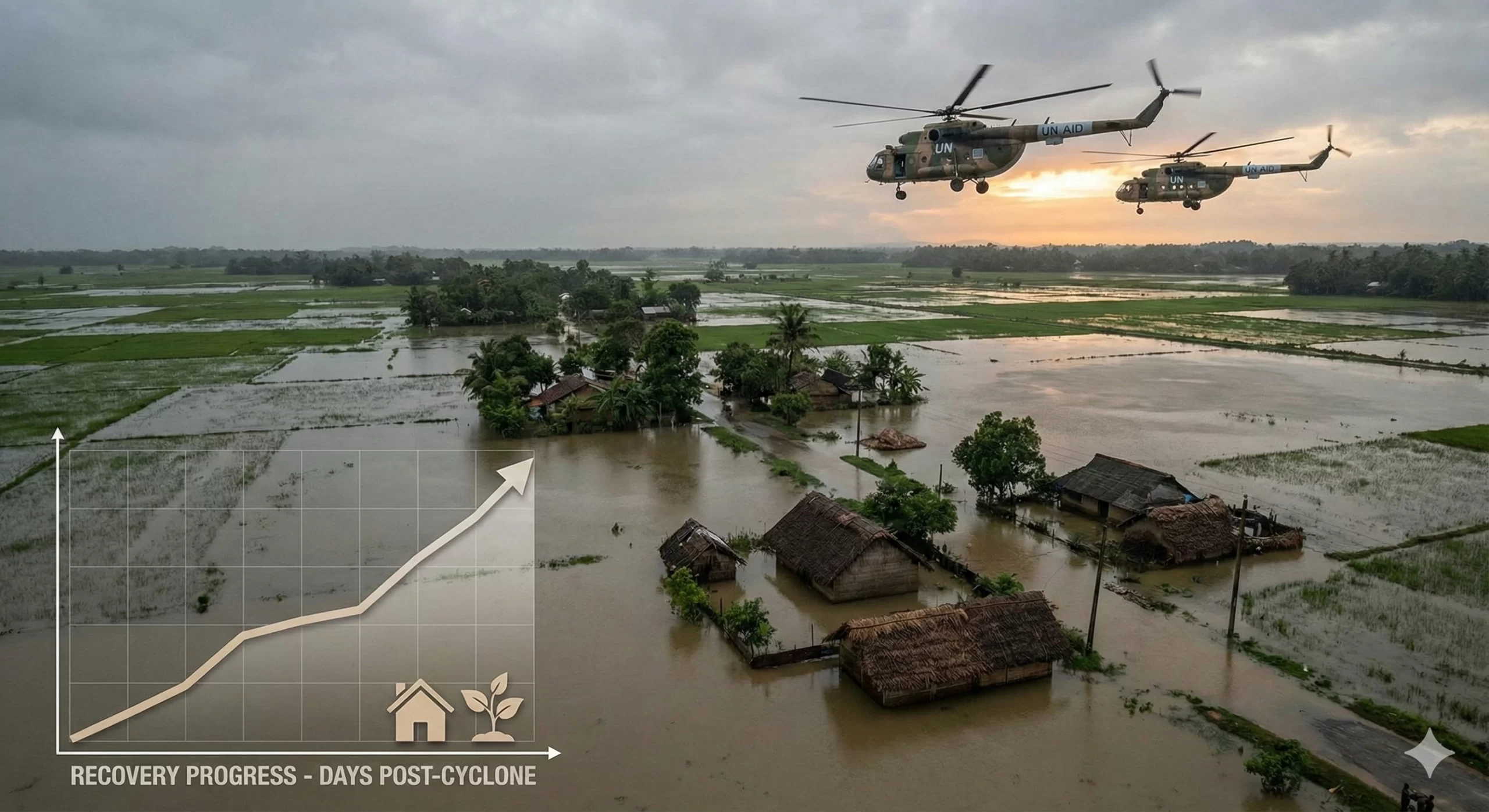
Cyclone Ditwah struck in early December 2025 with devastating force, inflicting an estimated $2 billion in damages across Sri Lanka’s Eastern and Northern Provinces, contracting GDP growth by 0.5-0.7% and displacing over 500,000 people from their homes. The storm’s torrential rains flooded 150,000 hectares of paddy fields, causing Rs150 billion in agricultural losses alone, while fisheries output in key ports like Batticaloa plummeted 30%, stranding 20,000 fishermen without income. Tourism, a vital 12% GDP contributor, suffered 40% cancellations in southern resorts like Galle and Unawatuna, temporarily idling 50,000 hospitality workers and threatening remittances from 200,000 seasonal jobs. Infrastructure damage included 2,000 km of roads, 500 bridges, and 50,000 homes, with reconstruction costs projected at 2% of GDP, straining foreign reserves that stood at $5.2 billion pre-storm.
For rural families, the human toll is profound: women, who comprise 40% of agricultural labor, lost micro-enterprises and livestock, pushing household food insecurity to 22% nationwide. Urban supply chains disrupted as vegetable prices spiked 25% in Colombo markets, exacerbating inflation pressures already at 5.8%. The government’s swift response includes Rs25 million SME loan refinancing at concessional 2-3% rates through state banks like People’s Bank, targeting 50,000 enterprises in affected districts with moratoriums up to 12 months. International partners mobilized rapidly: the IMF disbursed $206 million under its Rapid Financing Instrument for balance-of-payments support, while the World Bank repurposed $112 million from existing programs for emergency imports of fuel, medicine, and seeds.
The Asian Development Bank (ADB) injected $40 million in trade finance guarantees, ensuring apparel and tea exporters—accounting for 40% of merchandise exports—could meet global orders despite port backlogs at Colombo. These measures prevented a deeper recession, with economists estimating a 1.2% GDP stimulus from reconstruction spending on local labor and materials. Community-level initiatives, such as divisional secretariat grants for women’s cooperatives rebuilding fish processing units, highlight targeted relief reaching the most vulnerable.
Yet, climate models from the IPCC warn of doubled cyclone frequency by 2040 due to warming Indian Ocean waters, underscoring systemic vulnerabilities. Current strategies emphasize resilient infrastructure: seawalls in vulnerable coastal zones, crop insurance schemes covering 1 million farmers, and early warning apps that credited with saving 5,000 lives during Ditwah. Public-private partnerships for green bonds aim to fund mangrove restoration, which could absorb 20% of future storm surges in the East. Lessons from 2019 floods, where delayed aid fueled discontent, inform transparent dashboards tracking fund disbursement, audited by the Auditor General to prevent elite capture.
Broader societal implications demand policy evolution. Agriculture, employing 25% of the workforce, requires drought-resistant seeds and irrigation upgrades serving 2 million hectares. Tourism pivots to eco-certification, attracting resilient high-value travelers while preserving beaches. Integrating climate risk into national budgeting—allocating 5% of revenues proactively—could avert $5 billion in cumulative losses by 2030.
In conclusion, Cyclone Ditwah exposes the fragility beneath Sri Lanka’s growth story, but coordinated aid and forward-thinking resilience measures offer a blueprint for protection. By prioritizing vulnerable communities, climate-proof infrastructure, and transparent governance, the nation can transform disaster into durable safeguards, ensuring economic stability serves all citizens against nature’s escalating fury.
References:
https://www.worldbank.org/en/news/press-release/2025/12/12/the-world-bank-group-statement-on-sri-lanka-following-cyclone-ditwah
https://www.reuters.com/world/asia-pacific/sri-lankan-economy-grew-54-third-quarter-2025-2025-12-15/
https://money.usnews.com/investing/news/articles/2025-12-15/sri-lankan-economy-grew-5-4-in-third-quarter-of-2025
https://www.imf.org/en/news/articles/2025/12/19/pr-25436-sri-lanka-imf-approves-us-206-million-in-emergency-financial-support
https://www.newswire.lk/2025/12/19/imf-approves-us206-million-in-emergency-financial-support-for-sri-lanka/