Why certificates from online courses matter to Sri Lankan employers
For many Sri Lankan employers, a recognised certificate from an online course is clear proof that you have job‑ready skills, not just theoretical knowledge. It signals that you can apply what you learned immediately in the workplace, which is exactly what hiring managers look for when filling competitive roles.[1][4]
1. Clear evidence of practical, job‑ready skills
Employers increasingly complain that traditional degrees are heavy on theory and light on practical skills, so they pay attention to certificates that clearly state the tools, platforms and methods you have used.[1][4]
Professional‑style certificates in areas such as digital marketing, data analytics, cloud computing, cybersecurity, finance and HR emphasise hands‑on projects, labs and real business scenarios, which employers in Sri Lanka value because the skills can be applied from day one.[1][2][4]
2. Signals commitment, discipline and self‑motivation
Finishing an online course with a certificate shows that you can manage your time, stay motivated and complete a structured programme without constant supervision. Local employers increasingly view this as proof of a strong work ethic, especially when you have completed courses outside normal working hours while employed or studying.[1][3]
In interviews, many HR managers use such certificates as talking points to assess your initiative, willingness to learn and ability to handle remote or self‑directed work.[3]
3. Bridges the gap between degree and workplace expectations
Many Sri Lankan organisations now use short online certificates to bridge the gap between academic education and the specific skills needed in roles such as business analysis, marketing, IT support, data analysis and operations.[1][4]
Local training providers explicitly design certificate programmes to match what employers ask for in job descriptions, so adding similar online certificates (even free or low‑cost ones) to your CV helps you align closely with those role requirements.[1][2][4]
4. Enhances employability, promotions and salary growth
Employers often regard relevant certificates as a reason to shortlist a candidate, offer a higher starting salary, or prioritise them for promotion compared to colleagues who rely only on their degree.[1][2]
Local data from professional certificate providers in Sri Lanka shows that additional certifications can contribute to salary increases, faster promotions and better job security, because they make it easier for managers to justify expanded responsibilities and role upgrades.[1]
5. Recognised in both local and international job markets
Many Sri Lankan employers are familiar with major international online learning platforms and industry certifications, and they recognise accredited or well‑known online programmes as valid credentials.[2][3]
For roles that serve overseas clients or remote teams, online certificates are often viewed positively because they demonstrate that your skills are aligned with international standards and technologies, not just local syllabi.[2][3]
6. Cost‑effective upskilling for both employers and employees
Free and low‑cost online courses allow you to gain marketable skills without the high fees of traditional programmes, which is attractive to both job‑seekers and employers in Sri Lanka’s cost‑conscious market.[1][2]
For companies, encouraging staff to complete structured online courses is a low‑risk way to upgrade team capabilities compared to sending employees on lengthy, expensive in‑person programmes.[1][2]
7. Helps career changers and freshers stand out
If you are switching fields—say, from general business to data analytics, or from non‑IT to cloud computing—certificates from focused online courses provide concrete proof that you have started building skills in the new area.[1][2]
For fresh graduates and A/L leavers with limited experience, a cluster of relevant certificates can make a CV more competitive, demonstrating that you took proactive steps to become employable rather than waiting for a first job to learn everything.[1][2][4]
8. Easy to verify and showcase
Employers appreciate that most reputable online certificates come with digital verification (such as certificate IDs or online profiles), which makes it easier to check authenticity than with informal training.[2][3]
You can also add these certificates to LinkedIn and online portfolios, which many Sri Lankan recruiters now review as part of their standard screening process.[2][3]
9. Aligns with the shift towards e‑learning and hybrid work
As Sri Lankan organisations adopt more e‑learning and remote collaboration tools, managers are more comfortable with qualifications earned online and often prefer candidates who have already demonstrated that they can learn and work effectively in virtual environments.[2][3][4]
This trend makes credible online certificates increasingly relevant—and sometimes essential—for staying competitive in the local job market.[3][4]

Best free and low‑cost global platforms with employer‑recognized certificates
For Sri Lankan job‑seekers and professionals, the most valuable free and low‑cost certificates are those linked to well‑known global companies or accredited institutions, and to skills employers in Sri Lanka already hire for (IT, data, digital marketing, project management, HR, finance, and office productivity). Employers often see these as evidence of practical skills and commitment to professional development, especially when combined with local qualifications and experience.[1][2][5]
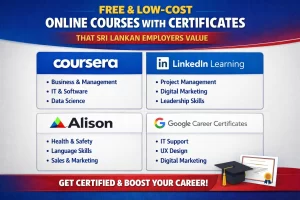
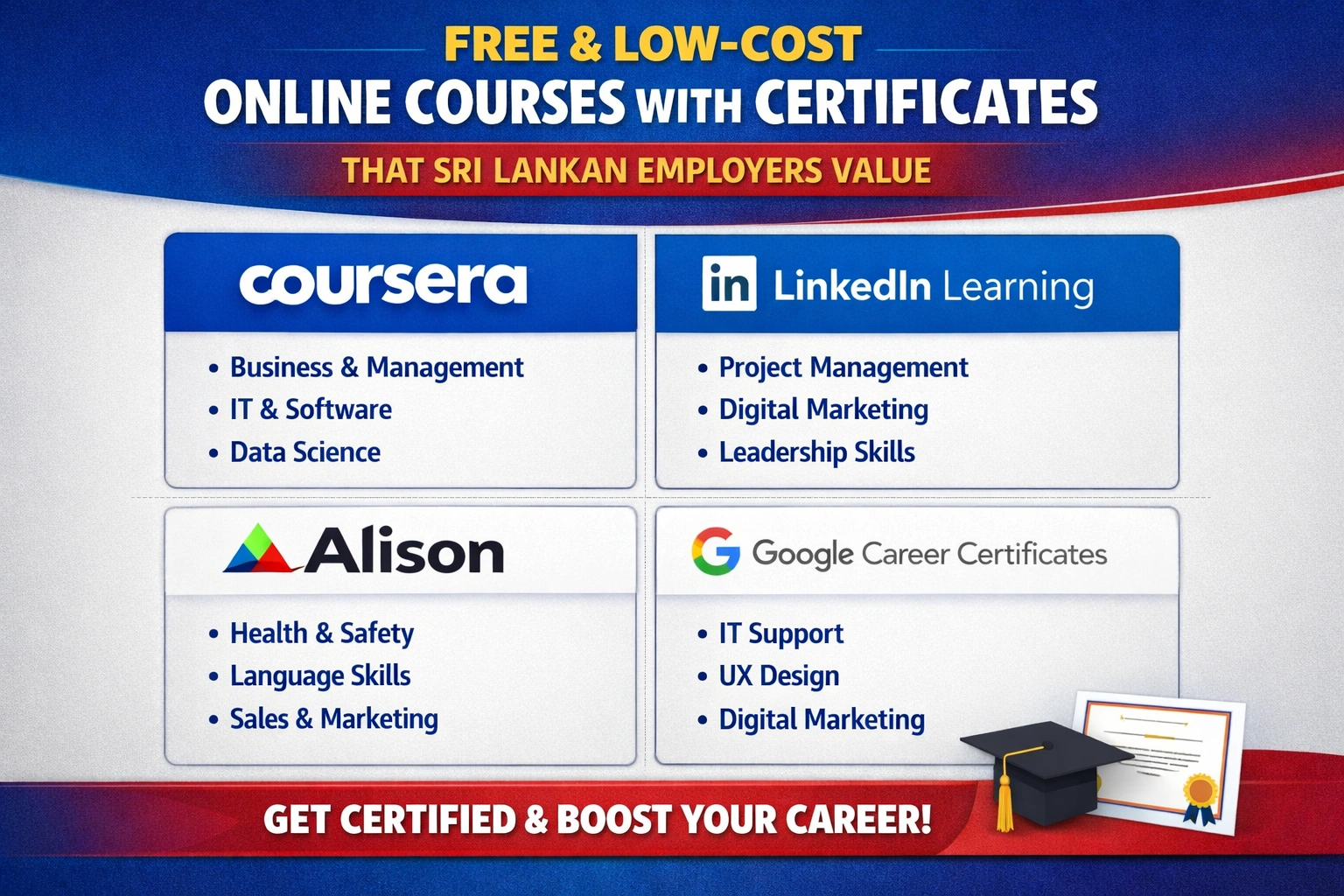
1. Coursera
Why Sri Lankan employers value it: Many courses are from globally reputed universities (e.g., Google, IBM, Meta, top US and European universities), and cover in‑demand skills like data analytics, cloud, project management, and business foundations that align with skill needs in Sri Lankan companies.[2][5]
- Cost: Audit most courses free; pay only if you want a certificate. Regular prices are moderate, and Coursera frequently offers financial aid and discounts.
- Certificate value: Professional Certificates such as Google Data Analytics, Google Project Management, Google IT Support, and IBM Data Science are widely recognized by international employers and are increasingly cited in job ads across Asia for entry‑level roles.
- Best for Sri Lankan learners:
- IT support, networking, cybersecurity and cloud basics.
- Data analytics, business analytics, Excel, SQL, Python.
- Digital marketing, social media marketing, business communication.
- How to use it on your CV: Mention course provider and industry partner, e.g. “Google Data Analytics Professional Certificate (Coursera)” under a Certifications section.
2. edX
Why Sri Lankan employers value it: edX hosts courses and “MicroCerts” from institutions such as MIT, Harvard, and major tech companies. These names carry strong brand recognition and signal that your learning content is rigorous and up‑to‑date, which Sri Lankan employers increasingly look for in areas such as IT and management.[5]
- Cost: Audit tracks are free; verified certificates and MicroBachelors/MicroMasters are low‑ to mid‑cost compared to degrees.
- Certificate value: Short course certificates and MicroMasters in areas like project management, cybersecurity, supply chain, and business analytics align well with the competency‑based hiring seen in Sri Lankan corporates and multinationals.[1][2]
- Best for Sri Lankan learners:
- Introductory programming, cloud computing, and cybersecurity.
- Project management, operations, and supply chain basics.
- Business communication and finance fundamentals.
- Use it strategically: Combine an edX certificate with local CPD or professional certificates (for example, in HR, project management, or finance) to strengthen your profile.[1][2][6]
3. LinkedIn Learning
Why Sri Lankan employers value it: LinkedIn is widely used by recruiters in Sri Lanka, and LinkedIn Learning certificates integrate directly with your LinkedIn profile, making your skills visible during hiring and screening.
- Cost: Subscription‑based but often available free through employers, telecom promotions, or limited trials; individual courses are relatively low‑cost.
- Certificate value: Certificates in Excel, Power BI, project management basics, leadership, and soft skills complement more formal professional certificates from Sri Lankan providers.[1][2][5]
- Best for Sri Lankan learners:
- Office productivity (Excel, PowerPoint, Word, Teams).
- Soft skills: communication, teamwork, leadership, customer service.
- Short upskilling in HR, finance, sales, and digital marketing to support your main qualification.
4. Google, Microsoft, and other Big‑Tech academies
Why Sri Lankan employers value them: Tech multinationals are well known by local hiring managers, and their skill‑based certificates align closely with tools actually used in Sri Lankan workplaces (Google Analytics, Microsoft Office, Azure, etc.).[5][9]
- Google:
- Free/low‑cost Professional Certificates (via Coursera) in IT Support, Data Analytics, Project Management, UX Design, and Digital Marketing.
- Short, free “Google Skillshop” modules for Google Ads and Analytics are useful for marketing and freelance work.
- Microsoft:
- Free learning paths on Microsoft Learn for Excel, Power BI, Azure, Microsoft 365.
- Low‑cost exam‑based certificates (e.g., Microsoft Office Specialist, Azure Fundamentals) are directly relevant to office and IT jobs in Sri Lanka.[9]
- Other big‑tech:
- Meta (Facebook) marketing certificates for digital marketing roles.
- AWS cloud practitioner essentials for cloud‑related roles, especially in the IT sector.
- Use with local credentials: Combining a recognized big‑tech certificate with a local professional program in digital marketing, data analytics, or IT significantly strengthens your employability.[1][2][5]
5. Alison
Why Sri Lankan employers value it: Alison is known for offering free online diplomas and certificates in practical subjects such as project management, HR, and health and safety. These map well to common training needs in Sri Lankan companies and industries.[1][2][8]
- Cost: Course content is free; certificates and diplomas are low‑cost compared to traditional programs.
- Certificate value: Particularly useful to show structured learning in:
- Project management and leadership in support roles.
- Occupational health and safety (OHS), which is relevant in sectors like construction, manufacturing, and logistics.[8]
- Basic HR, admin, customer service skills.
- Limitations: Alison is less prestigious than university‑backed platforms; it is best used as a supplementary credential, not your only qualification.
6. FutureLearn
Why Sri Lankan employers value it: FutureLearn partners with British universities and professional bodies, which aligns with Sri Lanka’s long‑standing recognition of UK‑based qualifications in business, management, and education.[4][5]
- Cost: Short courses can often be joined free for limited access; certificates and micro‑credentials are low‑ to mid‑cost.
- Certificate value:
- Short courses in teaching and training, healthcare, business management, and English communication.
- Micro‑credentials can complement local diplomas and professional certificates from Sri Lankan providers.[1][2][10]
7. Linked platforms to professional bodies and local providers
Beyond global MOOCs, Sri Lankan employers place strong value on certificates tied to professional bodies and accredited institutions, especially when they align with international standards.[1][2][4][6][9][10]
- Local professional development providers:
- Providers like Ceylon Open Campus offer online professional certificates in digital marketing, data analytics, project management, HR, finance, IT and cybersecurity, designed to match current employer needs in Sri Lanka.[1][2]
- These programs are structured as CPD (Continuing Professional Development) and specifically marketed as “industry‑recognized,” which means they are built around practical, job‑relevant skills rather than only theory.[1][2]
- Professional bodies:
- HR: Local and global HR bodies such as CIPM (Sri Lanka) and international options like CIPD/SHRM are widely regarded by employers for HR roles.[1][3][6]
- Quality, safety, and IT service management: Certifications linked to Six Sigma, ISO, ITIL, and occupational health & safety are recognized in Sri Lankan industry and often delivered via blended/online formats.[1][8][9]
- Regional and British online schools:
- British and regional providers offering Ofqual‑regulated or globally accredited online diplomas and degrees are attractive to Sri Lankan employers because they meet international standards.[4][9]
How to choose and present global certificates for Sri Lankan employers
- Match the certificate to your target role: For example, data and IT roles benefit more from Google/Microsoft/Coursera/edX certificates, while HR or management roles benefit from HR, leadership, and project management certificates combined with local professional development.[1][2][3][6]
- Prioritize recognized brands: Choose courses backed by known universities, big‑tech companies, or accredited bodies, as these are more easily understood by hiring managers.[1][2][4][9][10]
- Combine global with local: A low‑cost global certificate plus a local professional certificate or CPD program often has more impact than either alone because it signals both global exposure and local relevance.[1][2][5]
- Show outcomes, not just badges: On your CV and LinkedIn, list key tools and skills gained (e.g., “Excel dashboards, SQL queries, Google Analytics, HRIS basics”) and link them directly to tasks you can perform in a Sri Lankan workplace.

Sri Lanka–based free and affordable online courses employers recognize
Sri Lankan employers increasingly look for verifiable certificates from recognized providers, even when the course is free or low‑cost. Choosing platforms and programs that align with local accreditation standards and industry expectations can make a clear difference in hiring and promotion decisions.[8]
1. What Sri Lankan employers typically value in online certificates
When screening candidates, many employers in Sri Lanka focus less on the price of the course and more on:
- Recognition or accreditation of the provider – certificates from institutions or programs that are accredited, endorsed by industry bodies, or aligned with national/International quality frameworks are more likely to be accepted.[4][8]
- Clear relevance to in‑demand skills – courses that match real job roles (IT, business, digital marketing, data, safety, logistics, English, etc.) and demonstrably close skill gaps employers report.[2][8]
- Evidence of assessment – certificates earned through graded assignments, exams, projects, or proctored tests usually carry more weight than simple “participation” badges.[4][8]
- Industry‑linked content – programs designed with or referencing real‑world projects and case studies from businesses signal stronger workplace applicability.[1][4]
- Ability to verify the certificate – online verification links or IDs help HR teams confirm authenticity quickly.
2. Free and sponsored online programmes connected to Sri Lankan employers
2.1 Skills Online Sri Lanka (National Library & Commonwealth of Learning)
The Skills Online Sri Lanka Programme, implemented by the National Library of Sri Lanka in partnership with the Commonwealth of Learning (COL), provides access to thousands of online courses hosted on Coursera at no cost to selected learners.[2]
- What it offers – free access (through scholarships) to around 3,800 Coursera courses aimed at helping citizens upskill or reskill for employment.[2]
- Local employer alignment – the programme explicitly works with local organizations, private training centers, educational institutions, and employers to respond to employer and industry needs and close skills gaps for in‑demand jobs.[2]
- Support and mentoring – programme coordinators and experts at the National Library provide guidance for choosing courses and completing them, which helps learners focus on certificates that are more relevant to local job markets.[2]
Even though the original scholarship rounds had fixed deadlines, Skills Online Sri Lanka illustrates how international certificates (Coursera) gain local credibility when they are sponsored, curated, or promoted by a respected national institution and directly linked to employer needs.[2]
3. Affordable online corporate and professional training in Sri Lanka
3.1 Upkamp for Business (Online Corporate Training in Sri Lanka)
Upkamp for Business offers online, hybrid, and in‑person corporate training programs in Sri Lanka, with certificates that are positioned as globally recognized and tailored to local industries.[1]
- Employer‑centric design – programs are built specifically for organizations across finance, technology, logistics, tourism, education, and manufacturing, making the resulting certificates directly relevant to employer requirements.[1]
- Flexible online and hybrid formats – self‑paced online, hybrid, and customized learning paths allow employees to complete recognized training while working, which appeals to HR teams looking for minimal disruption.[1]
- Hands‑on, business‑focused content – real‑world projects, case studies, and simulations help learners build demonstrable skills that can be showcased in interviews and performance reviews.[1]
- Recognized certifications – Upkamp emphasizes that its participants receive globally recognized certifications, which can strengthen a CV when combined with local experience.[1]
Although pricing depends on the company and program, corporate licenses are typically more affordable per learner than traditional classroom courses, and employees gain online certificates that employers already know and use internally.[1]
3.2 Sector‑specific professional certificates (e.g., safety and compliance)
In fields like occupational health and safety, employers often prioritize globally recognized certificates obtained online at comparatively low cost:
- Providers such as Redhat Safety highlight that their health and safety training and ESC (Emergency Safety Certification) courses are “globally recognized and valued by employers in the health and safety industry,” which includes Sri Lankan companies that operate against international safety standards.[6]
- Such sector‑specific, standards‑based certificates are particularly useful in industries like construction, manufacturing, logistics, and oil & gas.
4. Low‑cost online degrees and micro‑credentials
4.1 Nexford University (online BBA and MBA for Sri Lanka)
For learners seeking affordable, fully online degrees that employers recognize, Nexford University offers BBA and MBA programs that directly target skills Sri Lankan employers value.[4]
- Employer‑relevant skill focus – Nexford states that its programs build strategic thinking, leadership, and artificial intelligence skills that Sri Lankan employers value, and all courses include hands‑on projects mapped to workplace challenges.[4]
- Accreditation – Nexford is accredited by the Distance Education Accrediting Commission (DEAC), which is recognized by the U.S. Department of Education and the Council for Higher Education Accreditation (CHEA).[4] Degrees from accredited institutions are more likely to be recognized by employers and other educational institutions.[8]
- Flexible, relatively low‑cost model – a subscription‑style fee structure often makes these degrees significantly cheaper than comparable on‑campus international programs, while still offering formal qualifications.
While a full degree is not “free,” the combination of lower tuition, online delivery, and recognized accreditation can be a cost‑effective way to obtain credentials that employers in Sri Lanka and abroad take seriously.[4][8]
5. International certification bodies active in South Asia
Beyond purely Sri Lanka–based initiatives, several international certification bodies operate across South Asia and provide online and blended qualifications that Sri Lankan employers know and trust.
5.1 City & Guilds and ILM
City & Guilds and its leadership and management arm ILM offer a range of technical, vocational, and management qualifications in South Asia, including recognition and “Assured” status for local training programs.[5]
- Employer recognition – City & Guilds and ILM are long‑standing brands in vocational and leadership training, and their qualifications are widely recognized by employers internationally, including across South Asia.[5]
- Support for e‑learning – their “Assured” service is designed to recognize training in multiple formats, including e‑learning, assessed and non‑assessed programs, and local‑language delivery.[5]
- Value for local learners – when a Sri Lankan provider uses City & Guilds or ILM assurance, learners can gain locally delivered, often lower‑cost courses with the added advantage of an internationally respected endorsement.[5]
6. How to evaluate whether a free or low‑cost online course will matter to Sri Lankan employers
Before investing time in a course, learners can use the following checks to improve the chances that Sri Lankan employers will value the resulting certificate:
- Check accreditation or recognition – confirm whether the institution is accredited by a recognized body (e.g., DEAC, national accreditation agencies) or uses reputable assurance partners like City & Guilds/ILM.[4][5][8]
- Confirm employer and industry links – look for programs that explicitly state they work with employers, training centers, and industry organizations to align with in‑demand skills, as Skills Online Sri Lanka does.[2]
- Look for structured assessment – favor courses with exams, graded assignments, or capstone projects over unassessed attendance certificates.[4][8]
- Match the course to specific job descriptions – choose certificates that clearly align with the skills listed in job ads in Sri Lanka (e.g., Excel, digital marketing, project management, safety standards, English proficiency).
- Ask HR or hiring managers – when possible, check which platforms or providers your target companies already recognize or reimburse (for example, internal corporate platforms like Upkamp).[1]
7. Practical pathway for Sri Lankan learners
A realistic, budget‑friendly pathway for building a CV that Sri Lankan employers respect might combine:
- Free international courses curated by local initiatives – e.g., Skills Online Sri Lanka/Coursera selections tied to local employer needs.[2]
- Affordable corporate‑style programmes – such as employer‑sponsored Upkamp modules or similar locally delivered online training with recognized certificates.[1]
- Targeted professional certificates – low‑cost, globally recognized sector‑specific programs (e.g., safety, compliance, IT) that match your industry.[6]
- Optional accredited online degree – for those who need a formal qualification, a lower‑cost accredited degree such as Nexford’s BBA or MBA.[4][8]
Combining these elements allows learners in Sri Lanka to stack free and low‑cost certificates into a portfolio of credentials that employers can verify, understand, and connect directly to workplace performance.
Top in‑demand subjects and certificates for Sri Lankan job markets
Sri Lankan employers – especially in IT, BPO, finance, and export‑oriented services – increasingly recruit on skills and verifiable certificates rather than only degrees, and many of these skills can be built through free or low‑cost online courses with credible certificates.[2] Employers and AI‑driven hiring platforms now prioritise profiles that show job‑ready technical skills, portfolio work, and recognised certifications in areas such as web development, cloud, cybersecurity, data, and digital marketing.[1][2]
Below are the main subject areas and certificate types that are both in‑demand in Sri Lanka and realistically achievable through affordable online learning.
1. Software & web development (Python, JavaScript, React, .NET)
- Why it’s in demand: Skills in Python, front‑end frameworks like React.js/Vue.js, and back‑end development appear among the top skills required for remote and local tech jobs linked to Sri Lanka.[1][2] React/Vue front‑end roles are highlighted as commanding high starting salaries in the local market.[2]
- Valuable certificate types:
- Foundations in Python programming and JavaScript from reputable MOOC platforms.
- Front‑end web development or React specialisations and professional certificates.
- .NET / C# developer pathways, relevant for enterprise and outsourcing firms that use Microsoft stacks.[1]
- How employers use them: AI screening tools and tech recruiters often filter for specific stacks (e.g., “Python”, “React.js”, “.NET Core”) and look for online course certificates plus GitHub projects demonstrating production‑ready applications.[1][2]
2. Data analysis, data engineering & machine learning
- Why it’s in demand: Data science, analytics, SQL, machine learning, and data engineering are consistently flagged as high‑growth skills globally and across Asia, supporting roles like data engineer, data architect and ML engineer.[1][3][5][6] Sri Lankan job listings and remote roles increasingly request SQL, data warehousing, machine learning, and tools like Tableau.[1]
- Valuable certificate types:
- Introductory and professional certificates in data analysis with Excel, SQL and Python.
- Data science / machine learning specialisations (covering statistics, model building, ML workflows).
- Business intelligence and visualization (e.g., Tableau, Power BI–style courses) which map to “Tableau” and “data visualization” skills seen in job ads.[1]
- How employers use them: Employers and bootcamps supported by industry bodies use certifications plus portfolio projects (dashboards, prediction models) as proof of job‑readiness, and AI recruitment tools score candidates on these concrete skills.[1][2][6]
3. Cloud computing & DevOps (AWS, GCP, Azure)
- Why it’s in demand: Skills in AWS, Google Cloud, infrastructure as code, data lakes, and deployment appear in skill lists tied to Sri Lankan‑serving remote jobs and are highlighted among the most in‑demand tech capabilities towards 2026.[1][3][5][6]
- Valuable certificate types:
- Foundational cloud certifications (e.g., entry‑level AWS/GCP/Azure cloud practitioner‑type courses) often available at low cost or subsidised.
- DevOps and CI/CD fundamentals, including containerisation, basic infrastructure as code (IaC), and cloud deployment pipelines.[1][6]
- How employers use them: Sri Lankan IT companies and global clients benchmark candidates using vendor‑backed cloud certificates and expect ongoing recertification and 40+ hours of annual cloud upskilling to keep skills current.[2]
4. Cybersecurity & IT infrastructure
- Why it’s in demand: Cybersecurity and information security are projected to be among the highest‑demand tech areas through 2035, and certifications such as CompTIA Security+ are cited as high‑value for Sri Lankan professionals, with strong starting salaries.[2][6]
- Valuable certificate types:
- Introductory cybersecurity fundamentals and network security courses.
- Ethical hacking, security operations and compliance–oriented tracks, which can build towards Security+ or similar industry exams.
- How employers use them: Banks, telcos, and software firms increasingly require demonstrable knowledge of security principles; vendor‑neutral certificates and applied labs are used to validate entry‑level hires before internal training.[2][6]
5. Digital marketing, SEO & social media management
- Why it’s in demand: Digital marketing, Google Ads, social media management and SEO feature in skill lists for remote roles linked to Sri Lanka and are identified as growth areas in global job‑market forecasts.[1][6]
- Valuable certificate types:
- Digital marketing fundamentals and SEO/SEM certificates from recognised platforms.
- Social media marketing and content strategy badges, especially those aligned with advertising platforms (search ads, social ads).[1][6]
- How employers use them: SMEs, agencies, and export‑oriented brands increasingly rely on portfolio work plus platform‑specific certificates to judge candidates’ ability to run campaigns, optimise funnels, and manage budgets.[1][2][6]
6. Business, finance & analytics (BFSI, risk, Excel, FP&A)
- Why it’s in demand: Business, banking, and finance continue to generate large numbers of openings worldwide, including roles in risk management, financial analysis, and business analytics.[3][5] Job‑market analyses for the region emphasise risk professionals, financial analysts, and data‑driven decision‑makers.[5][6]
- Valuable certificate types:
- Financial accounting and financial statement analysis (including Excel‑based modelling).[1][5]
- Business analytics, focusing on dashboards, KPIs, and decision support.[3][6]
- Introductory courses in risk management and compliance, relevant for BFSI roles.[5]
- How employers use them: Banks, insurers and corporate finance teams value certificates that prove strong Excel, data, and analytical thinking skills when recruiting graduates and career switchers.[3][5][6]
7. AI, automation & prompt engineering
- Why it’s in demand: AI and automation are projected to reshape many roles by 2028, displacing routine tasks while raising demand for professionals who can use AI tools effectively and ethically.[2][3][6] In‑demand tech skills for 2026 explicitly include AI, data analytics, and automation.[3][6]
- Valuable certificate types:
- Foundations of AI and machine learning for non‑specialists.
- Prompt engineering and AI productivity courses that teach how to integrate AI into daily work, coding, content creation, and analysis.[3][6]
- How employers use them: Employers increasingly look for candidates who can collaborate with AI tools, automate workflows, and stay relevant as AI takes over repetitive tasks, with some firms mandating annual AI and cloud upskilling hours.[2][3][6]
8. Project management & Agile (Scrum, stakeholder management)
- Why it’s in demand: Skills like project management, stakeholder management, Scrum, and collaboration appear frequently among the top requirements for remote and local roles linked to Sri Lanka.[1][3] As organisations digitise, they need professionals who can manage complex projects across distributed teams.[1][3][6]
- Valuable certificate types:
- Project management fundamentals and Agile project management micro‑credentials.
- Scrum master / Agile team member courses, including low‑cost introductions aligned with common frameworks.[1][3]
- How employers use them: AI hiring tools and HR teams often shortlist candidates with project management keywords and related certificates when screening for coordinator, analyst, and junior PM roles.[1][2][3]
9. Soft skills: communication, teamwork & leadership (with verifiable badges)
- Why it’s in demand: Top‑skills lists and hiring platforms emphasise communication skills, collaboration, interpersonal skills, and critical thinking as key to employability and leadership.[1][3] AI‑driven recruitment tools now score communication and presentation abilities from video interviews with high accuracy.[2][3]
- Valuable certificate types:
- Business communication, presentation, and negotiation courses that offer shareable certificates.[1][3]
- Leadership and people‑management micro‑credentials, useful for team leads and supervisors.[3][6]
- How employers use them: While soft skills are often evaluated in interviews, formal short courses plus evidence from video pitches and group projects help candidates stand out in AI‑screened hiring funnels.[1][2][3]
10. How to choose and use these certificates strategically in Sri Lanka
- Focus on 2–3 relevant subjects at a time: Career advisors recommend choosing a few high‑demand skills that match your target role rather than collecting many unrelated certificates.[3][6]
- Combine certificates with portfolio and online profiles: In Sri Lanka’s evolving hiring landscape, candidates who pair online certificates with a strong LinkedIn profile, GitHub portfolio, or sample projects gain significantly more recruiter views and callbacks.[2]
- Prioritise recognised platforms and industry‑aligned content: Employers and AI hiring systems place more weight on courses from established global platforms or industry bodies, especially when content clearly maps to the skill keywords in job ads (e.g., “React.js”, “SQL”, “AWS”, “Security+”).[1][2][3][6]
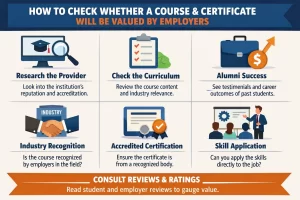
How to check whether a course and certificate will be valued by employers
Before you invest time in any free or low‑cost online course, take a few practical steps to see whether Sri Lankan employers are likely to respect the certificate.
1. Check the provider’s reputation and accreditation
- Look for accredited or regulated institutions. Sri Lankan employers generally trust courses from universities, professional bodies, and recognized training institutes (for example, HR bodies like CIPM or specialist institutes such as SLITAD for training and development).[4][5]
- Search the provider’s name on LinkedIn and job sites. See whether Sri Lankan professionals list these certificates on their profiles and whether local companies mention the provider in job ads.
- Confirm any international accreditation. Many e‑learning qualifications are respected when they come from accredited institutions that meet recognized standards.[3] Look for clear statements about accreditation or recognition by industry bodies on the course page.
2. See whether the certificate aligns with in‑demand skills
- Start from job advertisements in Sri Lanka. Search for roles you want (e.g. HR assistant, data analyst, digital marketer) and list the skills, tools, and certifications employers ask for.
- Match the course content to those requirements. A course is more valuable if its syllabus directly covers skills advertised in local roles—such as HRM, analytics, occupational health & safety, quality management, or IT service management that are already linked to salary growth and promotions for professionals.[1][2][5][8]
- Prefer courses that prepare you for recognized industry exams. For example, programs that lead to well‑known certifications (CIPD, SHRM, Six Sigma, ISO, ITIL, agile, etc.) tend to be valued because employers already understand their standards.[1][5]
3. Investigate employer and industry recognition
- Look for “recognized by employers” or “industry‑endorsed” wording. Many good providers clearly state that their programs are recognized by employers in Sri Lanka and sometimes internationally, and highlight career impact such as promotions or salary increases.[1][4][5][7]
- Check for corporate clients or partnerships. If the training provider delivers corporate programs to Sri Lankan organizations or is used for internal staff development, that is a strong signal employers value it.[1][4][7]
- Ask HR professionals directly. When possible, talk to HR staff or hiring managers (via LinkedIn, alumni groups, or events) and ask whether they consider certificates from that platform credible.
4. Review instructor quality and course design
- Favour courses taught by industry practitioners. Many Sri Lankan professional programs emphasise that they use active practitioners and executives with real‑world experience; employers tend to trust such practical training more.[1][2][6]
- Check for practical components. Courses that use case studies, simulations, projects, or Sri Lanka–relevant examples are more likely to build job‑ready skills that employers notice.[1][2][6][9]
- Look for clear learning outcomes and assessments. A certificate carries more weight if it reflects assessments (quizzes, assignments, projects) rather than just watching videos.
5. Look at the certificate format and verification
- Ensure there is a verifiable digital certificate. Employers increasingly like certificates that can be checked online through a unique link or ID, or added to LinkedIn with automatic verification.
- Check what information appears on the certificate. Ideally it should show the provider’s name, course name, completion date, and sometimes the skill level or number of learning hours.
- Confirm any additional credentials. Some local and international programs provide both a course certificate and eligibility to sit an external professional exam (for example, an HR or safety certification), which employers often see as stronger evidence of competence.[1][5][8]
6. Evaluate graduate outcomes and reviews
- Read reviews on and off the platform. Look at learner feedback about how the certificate was perceived in Sri Lankan job interviews or promotions.
- Search for success stories. Many reputable providers share testimonials showing salary increases, promotions, or career transitions following certification—these signals suggest employers do value the program.[1][7]
- Check alumni presence in Sri Lanka. If many Sri Lankan professionals list the certificate on LinkedIn and are employed in reputable companies, that is an encouraging sign.
7. Balance cost with recognition
- Use free courses for skills, low‑cost ones for credentials. Free MOOCs from major platforms are excellent for learning, but Sri Lankan employers may give more weight to low‑cost or paid certificates from accredited or professional bodies, especially in regulated or specialist areas (HR, safety, quality, finance, etc.).[1][3][5][8]
- Consider “stackable” pathways. Some short courses and micro‑credentials can stack towards larger diplomas or degrees from accredited institutions, which significantly increases long‑term recognition.[3][5]
8. Do a quick checklist before enrolling
Before you sign up, ask:
- Is the provider accredited or widely recognized in Sri Lanka or internationally?
- Does the course teach skills that appear in current Sri Lankan job ads for my target role?
- Is the certificate verifiable and clearly branded by a respected institution?
- Can I find Sri Lankan professionals or employers who already use this provider’s programs?
- Does the course include practical work and assessment, not just theory?
If you can confidently answer “yes” to most of these questions, there is a good chance Sri Lankan employers will value the course and its certificate.