Overview: IT & Engineering Study Paths for Sri Lankans
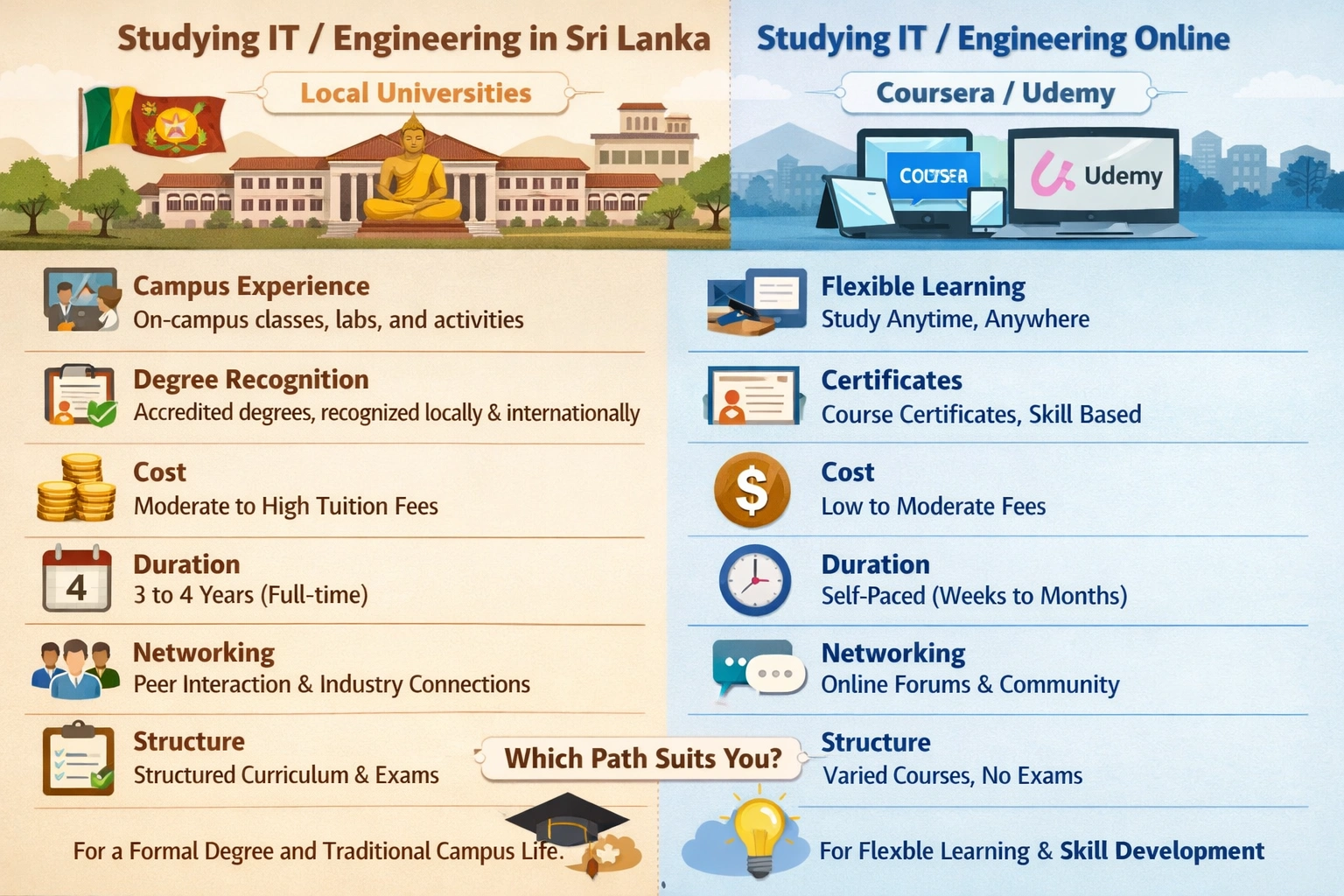
Sri Lankan students interested in IT or engineering currently have two broad study routes:
(1) structured degrees at local universities/institutes and
(2) flexible online learning through platforms like Coursera and Udemy.
The best path usually combines both: a recognised local or foreign degree delivered in Sri Lanka, supplemented with targeted online courses for up‑to‑date skills.
1. Studying IT/Engineering at Local Universities & Institutes
Sri Lanka has a mix of public universities and non‑state institutes offering full degrees in IT and engineering, many of which are recognised by the University Grants Commission (UGC) or foreign partner universities.[3][6][8]
1.1 Typical IT Study Paths (On‑Campus / Local Delivery)
Common on‑campus IT paths include:
- Public university IT faculties – e.g. the Faculty of Information Technology at the University of Moratuwa offers BSc (Hons) in Information Technology, Information Technology & Management, and Artificial Intelligence, plus an external Bachelor of Information Technology and postgraduate MSc/MPhil/PhD options.[3]
- Non‑state IT universities and institutes – e.g. Sri Lanka Institute of Information Technology (SLIIT), recognised as Sri Lanka’s largest IT degree institute with dedicated faculties for Computing and Engineering, and strong emphasis on practical, industry‑oriented education.[5][6]
-
Private institutes with foreign degrees – e.g. NSBM’s Faculty of Computing delivers UGC‑approved IT degrees and UK/Australian degrees (University of Plymouth, Victoria University) in areas like Computer Science, Data Science, Software Engineering, Computer Networks and Cyber Security.[1]
Similar models exist at IIT (UK degrees from University of Westminster/Robert Gordon University)[4], ECU Sri Lanka (Australian pathway diplomas in Computing/IT)[2], ICBT (international IT degrees)[9], and Java Institute (BEng/BSc in Software Engineering).[10] - Open and distance degrees – e.g. the Open University of Sri Lanka’s UGC‑approved Bachelor of Software Engineering (Honours), designed to ACM/IEEE global standards and aligned with the Sri Lankan software industry via SLASSCOM.[7]
1.2 Typical Engineering Study Paths (On‑Campus / Local Delivery)
For engineering (civil, electrical, mechanical, electronic, etc.), students usually follow:
- Public university engineering faculties (e.g. University of Moratuwa, Peradeniya, Ruhuna) – highly competitive intake via A‑Levels, with strong local recognition and good pathways to chartered status.
- Non‑state engineering faculties – such as the Faculty of Engineering at SLIIT, which positions itself as a major centre for engineering education and research with strong industry links.[6]
- Private colleges with foreign engineering degrees – various institutes deliver UK/Australian BEng/BSc Engineering degrees in Sri Lanka (for example, through the same providers that offer IT degrees), giving an international brand plus local industry exposure.
1.3 Strengths of Local Degree Routes
- Formal recognition for jobs & migration – UGC‑approved or accredited degrees are strongly preferred for local government jobs, many private‑sector roles, and professional registration. Public universities and recognised non‑state institutes feature on official Ministry of Higher Education lists.[3][6][8]
- Structured curriculum & depth – 3–4 year bachelor’s programmes provide broad foundations (maths, algorithms, electronics, engineering science) plus specialisations (AI, software, networks, cyber security, etc.).[1][3][6]
- Campus experience & networking – labs, projects, societies, internships and peer networks often translate directly into job opportunities.[5][6]
- Industry alignment – many IT faculties work closely with industry bodies (e.g. SLASSCOM for software engineering at OUSL)[7] and maintain internship pipelines, guest lectures and industry‑based projects.[1][5][6]
1.4 Limitations of Local Degree Routes
- Entry competition – public university places (especially IT and engineering) are highly competitive; private options can be expensive.
- Curriculum change speed – degree programmes must pass formal approvals, so they may lag slightly behind fast‑moving fields like cloud, DevOps or new frameworks; this is often mitigated by elective modules and industry projects.[1][3][6]
- Geographical & time commitment – full‑time study requires commuting or relocation and a fixed timetable, which is harder for working students.
2. Studying IT/Engineering Online (Coursera, Udemy & Other Platforms)
Online platforms such as Coursera and Udemy give Sri Lankans access to thousands of short courses, professional certificates and specialisations in programming, data science, AI, cloud, cybersecurity, and some engineering‑related topics (e.g. embedded systems, CAD, control systems).
2.1 Typical Online Paths
- Beginner–to–intermediate IT skill tracks – Python, web development, mobile app development, game development, databases, DevOps, cloud (AWS/Azure/GCP) and more.
- Professional certificates & “nanodegrees” – vendor‑backed tracks from big tech companies and universities (e.g. Google/IBM certificates, US/European university specialisations).
- Targeted engineering skills – MATLAB, simulation tools, electronics, PLCs, AutoCAD/SolidWorks, basic robotics; often more tool‑focused than full engineering curricula.
2.2 Strengths of Online‑Only Study
- Flexibility – self‑paced, can be done alongside work, A‑Levels, or a local degree.
- Cost‑effective – many courses are cheaper than full degrees; some offer financial aid or free audit options.
- Latest industry tech – courses on new frameworks, cloud services and tools often appear online long before they reach formal university syllabi.
- Global perspective – content from top universities and practitioners across the world, broadening exposure beyond the Sri Lankan context.
2.3 Limitations of Online‑Only Study
- Recognition gap – most Coursera/Udemy certificates are not equivalent to a degree in the eyes of employers, immigration authorities or professional bodies. They are valued, but primarily as skills proof, not as a replacement for a bachelor’s.
- Lack of formal structure – without a curriculum and academic supervision, it is easy to develop gaps in fundamentals (e.g. algorithms, discrete maths, engineering mechanics, signals and systems).
- Limited hands‑on hardware exposure for engineering – simulations and virtual labs cannot fully substitute for physical labs in fields like electrical, mechanical or civil engineering.
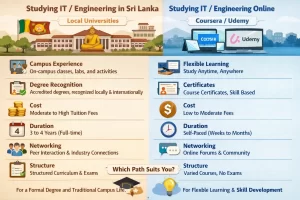
3. Local Universities vs Online Platforms: Choosing Your Path
| Aspect | Local Universities / Institutes | Online Platforms (Coursera/Udemy) |
|---|---|---|
| Primary outcome | Recognised degree (BSc/BEng, etc.), often UGC‑approved or foreign university‑awarded.[1][3][6] | Certificates or course completions; useful but not equivalent to a degree. |
| Best for | Students wanting strong foundations, recognition, and traditional graduate career paths in Sri Lanka and abroad. | Upskilling, reskilling, exploring IT/engineering topics, or complementing an existing degree. |
| Curriculum | Broad, sequenced and formally assessed; accreditation helps guarantee depth and quality.[1][3][6] | Narrow and skills‑focused; quality varies between instructors. |
| Cost & funding | Public universities: low fees; non‑state and foreign degrees: higher cost but may offer scholarships or instalments.[1][5][6] | Low–moderate per course; subscription or one‑time payments, some free audit options. |
| Learning environment | Labs, group projects, campus culture, direct access to lecturers and peers.[5][6] | Self‑directed, fully online; community depends on course/provider. |
| Industry links | Formal internship programmes, career fairs, industry‑driven curricula and collaborations (e.g. SLASSCOM partnerships).[5][6][7] | Occasional project‑based learning and portfolios; networking is mostly informal and online. |
| Engineering suitability | Strong, especially where there are accredited engineering faculties and physical labs.[3][6] | Good for supplementary theory and software tools; not sufficient for full professional engineering training alone. |
4. Practical Study Path Strategies for Sri Lankans
- A‑Level student aiming for IT: Target a UGC‑approved IT degree (e.g. University of Moratuwa, SLIIT, NSBM, IIT, OUSL, etc.), then add Coursera/Udemy courses in modern tools (frameworks, cloud, DevOps) during your degree.[1][3][5][6][7]
- A‑Level student aiming for engineering: Aim for a public university engineering faculty or a recognised non‑state/foreign BEng programme with labs; use online courses to reinforce maths, programming, and software tools used in your specialty.[3][6]
- Working professional or career‑switcher: If you lack a degree, consider an open/distance or part‑time local degree (e.g. OUSL BSE, external IT programmes) plus intensive online courses tailored to your desired role (web dev, data, cloud, etc.).[3][6][7]
- Already have a degree: Use Coursera/Udemy and vendor certifications to specialise (e.g. AI/ML, cybersecurity, cloud, data engineering) and stay current without committing to another full degree.
In summary, for most Sri Lankans, the strongest long‑term strategy is a recognised IT/engineering degree delivered in Sri Lanka (public or reputable non‑state/foreign‑partner institute) combined with targeted online learning to keep skills current and aligned with global industry trends.[1][3][5][6][7]
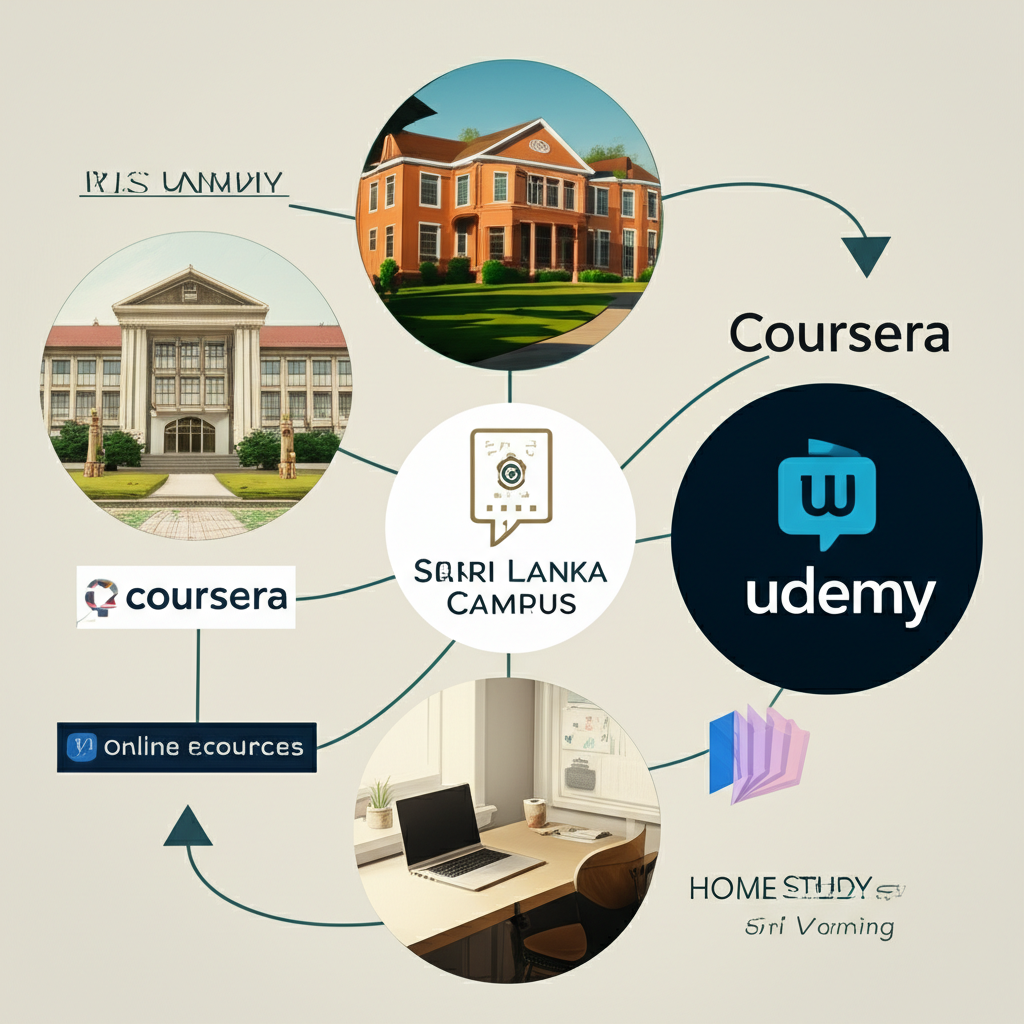
Studying IT/Engineering at Local Sri Lankan Universities
If you want a structured, recognised path into IT or engineering in Sri Lanka, a local university (public or private) gives you a formal degree, strong industry recognition and a clear route to professional registration, which online platforms alone (Coursera/Udemy) currently cannot provide in Sri Lanka.
Types of Local Institutions for IT/Engineering
Sri Lanka has several categories of institutions that offer IT and engineering-related qualifications:
- Public universities (UGC funded) – e.g. University of Moratuwa, University of Peradeniya, University of Ruhuna, University of Sri Jayewardenepura, University of Jaffna, South Eastern University, Open University of Sri Lanka (OUSL), etc., which have dedicated engineering faculties and strong reputations locally.[2][6][7][5]
- Autonomous / non-state universities – e.g. Sri Lanka Institute of Information Technology (SLIIT), NSBM Green University, SLTC Research University, Colombo International Nautical and Engineering College, which offer industry-driven IT and engineering degrees.[2][1][3]
- Technology & diploma institutes – e.g. Institute of Technology University of Moratuwa, Uva Wellassa University (engineering technology), Sri Lanka Institute of Advanced Technological Education, and other technical colleges that offer engineering technology and diploma-level programmes.[2][4]
What IT and Engineering Programs Look Like
Most local IT and engineering degrees follow a 3–4+ year structure with a heavy emphasis on mathematics, core theory, and labs.
- IT / Computing degrees – offered by faculties or schools of computing at universities like SLIIT and APIIT, with specialisations in software engineering, information technology, data science, AI, networking, information security, etc.[1][3]
- Traditional engineering degrees – civil, mechanical, electrical & electronic, computer engineering, etc., usually as BSc Eng (Hons) programmes at public universities such as Peradeniya and Sri Jayewardenepura.[2][6][7]
- Engineering technology degrees – more application-focused, like the Bachelor of Engineering Technology Honours in Mechanical Engineering Technology at Uva Wellassa University, aligned with IESL and the Sydney Accord to ensure professional-level outcomes.[4]
- Open and distance-mode engineering – e.g. the BSc Honours in Engineering – Computer Engineering at the Open University of Sri Lanka, with a minimum duration of 5 years and a blend of software, hardware, mathematics, management, and a final-year industry-oriented project.[5]
Recognition and Professional Pathways
One major advantage of local universities is formal recognition by local professional bodies.
- The Institution of Engineers, Sri Lanka (IESL) recognises specific four-year full-time engineering degrees for registration as Associate Engineers and supports the pathway to Chartered Engineer status.[2]
- Degrees like Uva Wellassa’s BET (Hons) in Mechanical Engineering Technology are explicitly designed according to the IESL accreditation manual and Sydney Accord standards, signalling international comparability in engineering technology education.[4]
- Programmes at the Open University and other recognised institutions provide structured eligibility criteria (A/L combinations, entry qualifications) that map directly into professional categories such as Associate Engineer, Incorporated Engineer, Engineering Diplomate, etc.[2][5]
By contrast, individual Coursera or Udemy certificates do not currently provide a stand-alone pathway to IESL registration or to formal engineer titles in Sri Lanka; they are best seen as supplements to an accredited degree rather than replacements.
Learning Environment and Experience
Studying at a local Sri Lankan university generally offers:
- Structured curriculum – with clear progression from fundamentals (maths, physics, basic programming) to advanced topics, plus mandatory labs, group projects and often a final-year industry project (especially in engineering and computer engineering degrees).[4][5][6][7]
- On-campus facilities – access to laboratories, hardware equipment, testing facilities, libraries and student support services, which is essential for areas like electronics, mechanical engineering and embedded systems.[1][4][6]
- Peer and academic networks – exposure to lecturers, researchers and peers, which helps with group projects, competitions, research and internships; for example, the engineering faculties at Peradeniya and SLIIT emphasise research and knowledge creation.[1][6]
- Soft skills and campus life – clubs, societies, hackathons, and industry events hosted by universities and faculties of computing/engineering, which build communication, leadership and teamwork beyond pure technical skills.[1][3][6]
Admission Requirements and Time Commitment
Entry into local university IT/engineering programmes is competitive and heavily tied to G.C.E. A/L results:
- Public engineering faculties generally require strong results in the physical science stream (Combined Mathematics, Physics, often Chemistry) in a single sitting.[2][5]
- The Open University’s Computer Engineering degree, for example, specifies A/L passes in Combined Mathematics, Physics and Chemistry or equivalent preparatory certificates as entry requirements.[5]
- Programmes usually take 4 years full-time (sometimes longer for part-time or open/distance modes such as OUSL, which has a minimum of 5 years for the Computer Engineering degree).[4][5]
- Autonomous institutes and private universities may offer more flexible entry routes (pending UGC/IESL recognition) but still follow multi-year, semester-based structures with exams and continuous assessment.[1][3]
Career Outcomes in Sri Lanka
Locally recognised IT and engineering degrees are still the main credential that employers and regulators look for in Sri Lanka.
- Public university engineering graduates (e.g. from Peradeniya, Moratuwa, Sri Jayewardenepura) are widely accepted for roles in government, infrastructure projects, utilities, and large private-sector engineering firms.[2][6][7]
- Graduates from established non-state institutions with strong computing and engineering faculties (such as SLIIT and APIIT) are well represented in the IT and software industry, where practical skills and project experience are highly valued.[1][3]
- Holding an IESL recognised engineering degree is often essential for progressing to titles like Associate Engineer or Chartered Engineer, which affect seniority, salary scales and eligibility to sign off on professional work.[2][4]
- For purely software roles, employers may be more open to strong portfolios plus online learning, but a local degree still gives a clear advantage in structured hiring pipelines and for fresh graduates.
How Local Degrees Complement Online Platforms (Coursera/Udemy)
In practice, the most effective approach for Sri Lankan students is often a combination of both: a local degree for recognition and depth, plus online platforms for extra breadth and specialisation.
- Use a local IT/engineering degree to obtain the core fundamentals, labs, projects, and recognised qualification required by local employers and professional bodies.[1][2][4][5]
-
Layer Coursera/Udemy courses on top of the degree to:
- Learn the latest frameworks, tools and libraries that may not yet be in the formal curriculum.
- Explore niche areas (e.g. specific cloud platforms, DevOps tools, new AI frameworks) for personal interest or job readiness.
- Fill gaps if you switch specialisations (for example, mechanical engineering student learning programming and data analysis online).
-
When choosing online courses, prioritise:
- University-backed programmes or well-known industry partners on Coursera for stronger credibility.
- Udemy instructors with high ratings, recent updates and hands-on projects.
When Local Universities Are Preferable vs Online-Only
| Goal | Local Sri Lankan University | Coursera/Udemy (online only) |
|---|---|---|
| Become a recognised engineer (IESL path, chartered engineer, government roles) | Essential – need an accredited engineering degree or recognised technology qualification.[2][4] | Not sufficient; can only support learning, not formal registration. |
| Work in core engineering (civil, mechanical, electrical), design and sign-off | Strongly preferred and often required by employers and regulators.[2][6][7] | Not acceptable as a stand-alone qualification. |
| Enter software/IT industry (developer, QA, DevOps, data) | Very helpful; provides fundamentals, degree-level recognition and networks.[1][3][5] | Can help build skills and portfolio; may work if combined with strong self-study, but harder for freshers without any degree. |
| Learn specific tools quickly (e.g. React, Docker, specific cloud service) | Curricula may be slower to update; some universities integrate newer tools, but often at a higher-level. | Very effective – many focused, practical courses with up-to-date content. |
| Gain campus life, clubs, peer network and labs | Provides full campus experience and physical labs.[1][3][6] | No campus experience; fully online and self-driven. |
Key Takeaways for Sri Lankan Students
- If you want a formal engineering or IT career in Sri Lanka, aim for an accredited local degree first (public or reputable non-state), then use online platforms to stay ahead technically.
- For software-focused careers, a local computing/IT degree gives you a strong base and recognition, while Coursera/Udemy add depth in tools and frameworks that change rapidly.
- Without any degree, relying on online certificates alone is possible but significantly harder in the Sri Lankan context, especially for engineering roles that require IESL-recognised qualifications.

Learning IT/Engineering Online with Coursera & Udemy
For Sri Lankan students comparing local IT/engineering degrees with online study, Coursera and Udemy offer flexible, skills‑focused alternatives that can either complement a local degree or, in some cases, substitute parts of it for specific career goals.[3][5][7]
1. What Coursera & Udemy Actually Offer for IT/Engineering
Coursera
Coursera partners with global universities and companies (e.g., Google, IBM, top engineering schools) to provide:
- Foundations in IT: IT support, networking, operating systems, cybersecurity fundamentals, databases, and basic programming.[3]
- Engineering‑oriented content: software engineering, data engineering, cloud computing, DevOps, and other engineering specializations.[3][5]
- Structured learning paths: single courses, multi‑course Specializations, Professional Certificates, and even full online degrees.[3][5][7]
- Industry‑aligned skills: version control (Git/GitHub), Linux, cloud platforms, IT automation, project management, and security practices.[3][5]
Udemy
Udemy is a marketplace where individual instructors publish courses. For IT/engineering, you typically find:
- Hands‑on coding courses in Python, Java, web development, mobile apps, embedded systems, and more.
- Tool‑specific training (e.g., frameworks, cloud platforms, DevOps tools) focused on practical use rather than theory.
- Short, project‑driven courses that help you build portfolios and demos quickly.
2. Cost & Access for Sri Lankan Students
Coursera pricing and access
- Individual courses: Many can be audited free (video + reading access), with a fee only if you want a graded certificate.[7]
- Coursera Plus: A subscription that unlocks 10,000+ courses and certificates, useful if you plan to take multiple IT/engineering courses in a year.[8]
- Scholarships & local programmes: Initiatives like the Skills Online Sri Lanka Programme (via National Library & World Bank) previously gave 5,000 Sri Lankans free access to thousands of Coursera courses, showing that similar sponsorships can appear periodically.[6]
Udemy pricing
- One‑time payments for individual courses, often heavily discounted during sales.
- No subscription is required, but each course is separate; this can be cheap for 1–2 topics and more expensive if you want broad coverage.
3. Learning Experience vs Local Universities
Structure & curriculum
- Local universities provide a degree‑level curriculum with mathematics, physics, theory, labs, and final‑year projects, following a fixed structure.
- Coursera offers structured tracks (e.g., “IT Support”, “Software Engineering”, “Data Engineering”) with clear outcomes, assessments, and sometimes capstone projects, but usually without the full breadth of a 4‑year engineering curriculum.[3][5]
- Udemy is less structured: you must design your own path by combining multiple courses.
Depth vs practicality
- Local IT/engineering degrees in Sri Lanka emphasise theory, mathematics, and accreditation—important for roles like chartered engineer or certain government/academic jobs.
- Coursera and Udemy emphasise practical, job‑ready skills—coding, tools, platforms, and problem‑solving used in real projects.[3][5]
- A strong strategy is to use online platforms to “fill gaps” in a local degree: e.g., cloud, DevOps, or data engineering skills that may not be deeply covered in traditional curricula.[2][3][5]
4. Certificates, Recognition, and Employability
How employers view Coursera & Udemy
- Sri Lankan IT companies increasingly value demonstrable skills (projects, GitHub, internships) plus well‑known online certificates as evidence of initiative, especially from platforms like Coursera that feature global universities and big tech companies.[3][7]
- Coursera Professional Certificates (e.g., IT Support, Data Engineering) are designed to align with specific job roles and can be a strong signal for entry‑level positions.[3]
- Udemy certificates confirm course completion but carry less standardized weight, since quality varies by instructor; they are best combined with visible project work.
- For regulated roles or advanced academic paths, a local accredited degree still carries more formal weight than standalone online certificates.
Stacking online learning with local study
- Use Coursera to add globally recognized skills (e.g., Google/IBM certificates, top‑university engineering courses) on top of a Sri Lankan degree for better international competitiveness.[3][5][7]
- Use Udemy for fast, tool‑specific skills when you need to learn a framework, language, or technology quickly for a project or job.
5. Pros & Cons of Coursera/Udemy vs Local Universities
| Aspect | Local IT/Engineering Degree | Coursera | Udemy |
|---|---|---|---|
| Credential | Accredited degree, high formal recognition in Sri Lanka | Certificates & some degrees; recognized by many employers globally[3][5][7] | Course completion certificates, informal recognition |
| Cost | Higher overall cost; limited scholarships | Mix of free audit, paid courses, and Coursera Plus subscription; occasional sponsored access in Sri Lanka[6][7][8] | Low one‑time course prices, frequent discounts |
| Structure | Highly structured 3–4 year program | Moderately structured paths (Specializations, Certificates)[3][5] | Self‑designed; you choose and combine courses |
| Depth of theory | Strong in maths, physics, fundamentals | Varies; often more applied but some deep courses from universities[3][5] | Mostly applied, minimal theory |
| Practical skills | Labs/projects; may lag behind latest tools | Up‑to‑date industry tools and workflows (cloud, DevOps, security)[3][5] | Very practical; focused on “how to do X” |
| Flexibility | Fixed schedules and semesters | Fully online, self‑paced or with soft deadlines[7] | Fully self‑paced |
| Networking & campus life | Strong local peer network and clubs | Global online communities and forums | Course‑specific Q&A; limited broader network |
6. Practical Study Paths for Sri Lankan Students
If you are doing a local IT/Engineering degree
- Use Coursera to:
- Strengthen weak topics (e.g., networking, operating systems, or algorithms).[3]
- Add cloud, DevOps, or data engineering Specializations that are in demand locally and abroad.[3][5]
- Use Udemy to:
- Quickly learn the frameworks and tools needed for your final‑year project or internships.
If you cannot access a local degree (cost, location, or intake limits)
- Build a structured online curriculum for yourself:
- Start with a broad IT or software engineering path on Coursera (e.g., IT Support, Software Engineering, or Data Engineering).[3][5]
- Add Udemy courses for the specific languages/tools used in Sri Lankan and global job ads.
- Focus on:
- Consistent practice (coding daily, lab exercises, simulations).
- Portfolio projects that you can show employers on GitHub or a personal site.
7. Tips to Get Maximum Value from Coursera & Udemy
- Plan a pathway instead of taking random courses: e.g., “Networking → Linux → Cloud → DevOps” or “Programming fundamentals → Data structures → Web development → Cloud deployment.”[3][5]
- Prioritise reputable providers:
- On Coursera, favour courses from top universities or big tech companies.[3][5][7]
- On Udemy, check ratings, reviews, and last updated date.
- Balance theory and practice: supplement practical Udemy courses with more conceptual Coursera or local university content so you understand both “how” and “why.”[3][5]
- Track your progress with certificates, a skills list, and a portfolio so you can clearly present your capabilities to Sri Lankan or international employers.
For most Sri Lankan IT/engineering learners, the strongest approach is not “local degree vs online,” but a blended path: use a local university (or local institutes) for accredited qualifications and foundational theory, and leverage Coursera and Udemy to stay current, deepen practice, and rapidly acquire in‑demand technologies and tools.[2][3][5][6][7][8]

Recognition, Skills, and Career Value: Local Degrees vs Online Courses
1. Recognition in Sri Lanka and Internationally
Local IT/Engineering Degrees (Sri Lankan Universities)
For most employers in Sri Lanka, a local BSc/BE in IT or engineering from a recognised university (e.g., state universities, SLIIT, private UGC‑approved institutions) is still the primary “baseline” qualification for developer, engineer, and tech graduate roles. Accredited e‑learning or distance degrees from Sri Lankan universities can also hold international recognition when the awarding institution is properly accredited and meets global benchmarks.[2][4] This matters both for local hiring and for migration or postgraduate admissions.
When you plan to migrate or apply for foreign master’s programs, admission offices and assessment bodies usually look first at:
- The university’s accreditation and reputation in Sri Lanka.[2][4]
- Whether the degree is a full bachelor’s in engineering/IT rather than only short courses.
- Curriculum depth in maths, computing fundamentals, and engineering science (which local engineering/IT degrees generally provide).
Global Online Platforms (Coursera, Udemy, etc.)
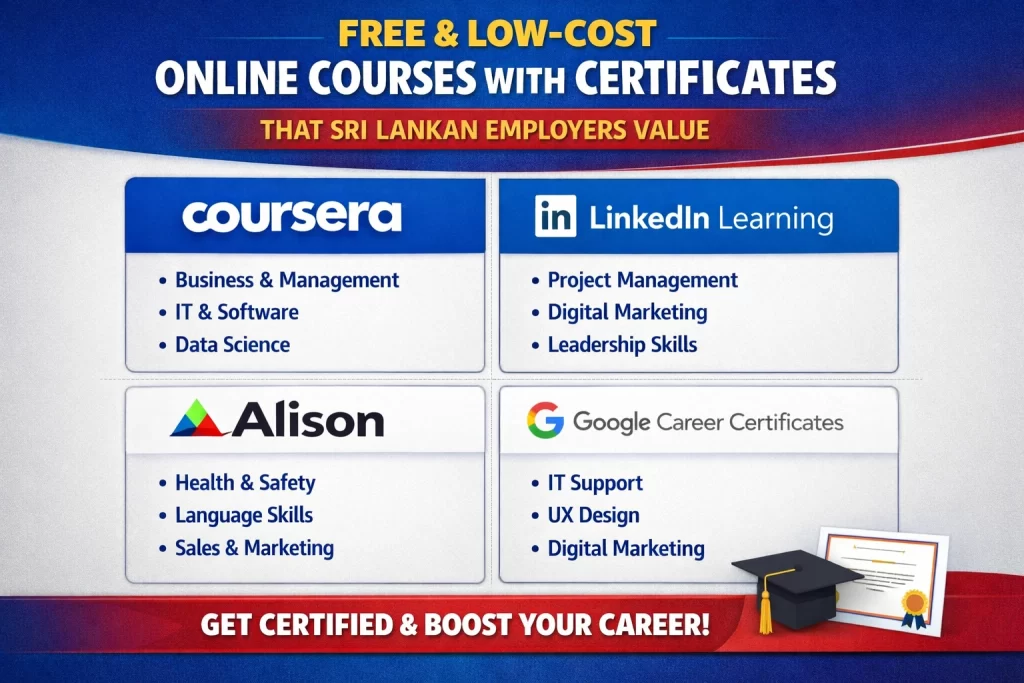
Platforms like Coursera and Udemy offer certificates rather than traditional degrees, although Coursera also partners with universities to deliver full online degrees and industry certificates.[1][5][6] Coursera hosts content from universities such as Stanford, Michigan, Penn, and others, and its certificates are intended to signal job‑ready skills and are increasingly recognised by employers when they come from reputable partners.[1][5][6]
In Sri Lanka, government-linked initiatives such as the Skills Online Sri Lanka Programme partner with Coursera and other global providers to offer free or subsidised courses with certificates aimed at boosting employability.[1][3] This official endorsement has improved the local perception of Coursera‑style credentials as credible add‑ons to a degree.
Udemy certificates are typically seen as non‑formal training: useful for skills, but less “weighty” than university or Coursera‑partner university credentials. They are rarely considered equivalent to a formal diploma or degree; instead, they demonstrate targeted skills (e.g., React, Node.js, Python scripting).
How Employers Usually Compare Them
In typical Sri Lankan and international IT hiring:
- Degree for screening: A recognised IT/engineering degree is often the main filter for junior/graduate roles, especially in larger or more traditional firms.[2][4]
- Online certificates as proof of initiative: Coursera/Udemy certificates are treated as evidence of self‑learning and current skills, especially in specific tools, frameworks, and domains.[1][3][5][6]
- Portfolio and experience: For software roles, a strong GitHub portfolio, internships, and real projects often matter more than the brand of course, especially in startups and international remote jobs.
2. Skills: Depth, Breadth, and Practical Ability
What Local IT/Engineering Degrees Typically Provide
A conventional Sri Lankan degree in IT or engineering is designed to give:
- Strong theoretical foundations: maths, algorithms, data structures, operating systems, networks, electronics, control systems, etc. This is crucial if you want to move into R&D, embedded systems, or postgraduate study.
- Structured progression: four years of progressively harder modules, labs, design projects, and sometimes industry placements.
- Assessment rigor: proctored exams, lab evaluations, and final-year projects that are harder to “game” than many online quizzes.
- Soft skills and teamwork: group projects, presentations, and on‑campus activities that help communication and leadership.
Some Sri Lankan universities now also deliver short online or blended engineering/IT courses aligned with industry needs (e.g., University of Moratuwa’s open learning platform for Python, web development, project management) and provide certificates that are locally recognised.[3]
What Coursera/Udemy and Similar Platforms Provide
Global online platforms excel at:
- Highly up‑to‑date technical skills: modern stacks, cloud, DevOps, data engineering, AI/ML, prompt engineering, etc.[5][6]
- Hands‑on, project-based learning: many engineering and IT specializations include practical projects, labs, or capstone work designed to build real portfolio pieces.[5][6]
- Speed and flexibility: you can quickly fill gaps (e.g., “React in 30 hours”, “Kubernetes basics”) without waiting for a semester.[5][6]
- Specialization: focused tracks such as IBM Data Engineering or AI Engineering Professional Certificates, cloud certificates, or security specializations that target niche roles.[5]
In Sri Lanka, programs like Skills Online Sri Lanka explicitly use Coursera courses to close skills gaps for in‑demand jobs, especially in IT and business, and link them to employer needs.[1][3] This indicates that these short, skills‑focused courses are seen as valuable complements to existing qualifications.
Udemy courses vary more in quality (instructors are individuals, not always universities), but they are often very practical and task‑oriented — good for learning specific tools quickly, less suitable as your only “structured curriculum.”
3. Career Value in the Sri Lankan and Global Job Market
Starting a Career (Entry-Level / Fresh Graduate)
For a typical Sri Lankan student aiming for a first role as a software engineer, network engineer, or junior data analyst:
- A local IT/engineering degree remains the safest baseline for maximizing options (local jobs, government roles, future masters, and migration pathways).[2][4]
- Online certificates from Coursera, especially those linked to recognised universities or major tech companies, strengthen your CV by signaling specific skills (e.g., cloud, Python, data analysis).[1][5][6]
- Udemy courses can help you build a strong project portfolio quickly, which is highly valued in software roles, but they usually cannot replace an accredited bachelor’s degree for formal HR screening.
Upskilling or Switching Fields (Early / Mid-Career)
If you already have a degree (even in a non‑IT field) and want to move into tech:
- Using Coursera, Skills Online Sri Lanka, DP Education Digital University, and similar platforms to build concrete IT/engineering skills is an effective, low‑cost route.[1][3][5][6]
- Govt‑backed programmes (e.g., Skills Online Sri Lanka) explicitly target employability and entrepreneurship with courses in IT and business, showing their relevance to the job market.[1][3]
- Combining your original degree with strong online certificates and a portfolio can be enough to enter many software or data roles, especially in startups and remote freelance work.
Postgraduate Study and Migration
For foreign master’s programs or immigration assessments:
- Universities and immigration bodies typically require a recognised bachelor’s degree in a relevant field.[2][4]
- Online non‑degree certificates (Coursera/Udemy) rarely substitute for a full bachelor’s, but they can strengthen applications and show preparedness for specialized programmes (e.g., AI, data science).[5][6]
- Some Coursera‑hosted fully online degrees are equivalent to on‑campus degrees from the same university, and these carry full academic recognition because the awarding institution is accredited.[5][6] Those are different from short courses and are evaluated much like any other foreign degree.
4. Cost–Benefit and Strategic Combinations
Cost and Access in the Sri Lankan Context
Sri Lankan state universities are highly affordable but competitive; private degrees are more expensive; online platforms can be relatively low‑cost, especially with scholarships or local initiatives.
- Skills Online Sri Lanka has offered free access to thousands of Coursera courses for selected learners, explicitly to improve employment prospects.[1][3]
- DP Education Digital University and other local platforms offer free or low‑cost online courses in engineering and computer science, with certificates.[3]
- Coursera offers financial aid and the Coursera Plus model for broad access to courses and professional certificates.[5][6][7]
Smart Combinations for Maximum Career Value
For many Sri Lankan students, the most effective strategy is not “local degree or online courses” but a combination:
- Local degree + targeted online specializations (e.g., AI, cloud, DevOps) to keep your skills current and aligned with global industry demand.[3][5][6]
- Online-heavy path + strong portfolio if you cannot access a traditional degree, focusing on:
– multiple high‑quality Coursera/Udemy tracks,
– government- or university-backed local online programs,
– visible projects (GitHub, freelance work, hackathons) to offset the lack of a formal degree.[1][3][5][6] - Degree in another field + online IT/engineering to pivot careers while keeping your original degree as a general academic credential.
5. When to Prefer Which Path
| Goal / Situation | Local IT/Engineering Degree (Sri Lanka) | Online Courses (Coursera/Udemy & local online) |
|---|---|---|
| Fresh school leaver, wants broad engineering/IT career, maybe migrate | Primary path: pursue accredited local degree for recognition and fundamentals.[2][4] | Use Coursera/Udemy to gain extra skills (web, mobile, cloud) and build portfolio. |
| Already have a non‑IT degree, want to enter tech | Optional: second degree or PG diploma if you need strong formal recognition. | High value: intensive online specializations, government‑linked programmes, plus projects and internships.[1][3][5][6] |
| Need a credential for postgraduate study abroad | Essential: recognised bachelor’s degree in IT/engineering.[2][4] | Online courses mainly strengthen application and skills; full online degrees from accredited universities can also work.[5][6] |
| Already employed in IT, need to upskill (AI, cloud, DevOps) | Degree still useful but not mandatory to switch roles. | Best tool for quick, focused skill upgrades and certifications tied to current technologies.[5][6] |
Cost, Time, and Learning Style: Choosing What Fits You
Once you know what you want to study (IT or engineering), the next question is how to study: a Sri Lankan university/ institute, or online platforms like Coursera/Udemy. This section helps you compare them on three practical axes: cost, time, and learning style.
1. Cost: Tuition, Hidden Expenses, and Value
Local universities & institutes (on‑campus / local online)
- Tuition fees:
- Public universities (e.g., University of Moratuwa, University of Colombo) are heavily subsidised for local students, so official tuition is very low, but entry is extremely competitive.
- Private institutes and private degrees (SLIIT, IIT, etc.) can be costly over 3–4 years, but you gain a structured degree that is widely recognised in Sri Lanka and often abroad.
- Other costs:
- Travel, accommodation (if you live outside the city), food, printing, textbooks, lab equipment, and exam fees.
- Opportunity cost: full‑time study can reduce your ability to work full‑time.
- Scholarships and government/NGO support:
- There are occasional programmes that give Sri Lankans sponsored access to online learning (for example, the “Skills Online Sri Lanka” initiative that provided access to thousands of Coursera courses via the National Library and World Bank support).[7]
- Some universities now offer free or low‑cost short courses via their own open learning platforms (e.g., University of Moratuwa’s open courses in Python, web development, and more).[3]
- Value proposition:
- Best if you want a formal degree or diploma that employers in Sri Lanka clearly understand.
- Better long‑term ROI if you aim for professional registration, government/regulated jobs, or migration paths that explicitly ask for accredited degrees.
International online platforms (Coursera, Udemy, etc.)
- Course pricing:
- Udemy often sells courses very cheaply during promotions (sometimes under the equivalent of a few thousand LKR).
- Coursera offers:
- Individual courses (some free to audit, paid if you want a certificate).
- Professional Certificates and Specializations that run for 3–6 months.[1][5][6]
- University‑level degrees and micro‑credentials at a fraction of on‑campus international fees, but still higher than short courses.[8]
- Financial aid & free options:
- Many Coursera IT and engineering courses allow you to audit for free (access to videos and some materials without a certificate).[1][5][6]
- Some global platforms (Coursera, edX, Udacity) offer financial aid or scholarships, and Sri Lankan learners have previously gained time‑limited free access through local initiatives.[2][3][7]
- Hidden costs:
- Need a reliable internet connection and a device capable of streaming video and coding (laptop or good smartphone).[1][5]
- No travel/accommodation expenses, so total cost can be much lower, especially if you keep working while studying.
- Value proposition:
- Excellent for building specific, job‑ready skills (e.g., web development, data engineering, cloud, DevOps) in months rather than years.[1][5][6]
- Certificates from big tech companies (Google, IBM, Microsoft) can impress employers who understand modern IT stacks, though they do not replace an accredited bachelor’s degree for certain roles.[1][5]
2. Time: How Long It Takes and How Flexible It Is
Local universities & institutes
- Degree duration:
- Bachelor’s degrees in IT/engineering typically take 3–4 years full‑time.
- Diplomas and Higher National Diplomas (HNDs) may take 1–2 years.
- Fixed schedules:
- Timetables are mostly fixed: lectures, labs, tutorials, and exams at specific times.
- Working full‑time alongside a full‑time degree is difficult; many students either work part‑time or not at all during semesters.
- Pace:
- The curriculum often moves at a moderate pace and covers theory in depth, which suits students who learn steadily over semesters.
Online platforms
- Short, focused programmes:
- Many IT and engineering courses on Coursera are designed to be completed in 1–3 months for individual courses and 3–6 months for Professional Certificates and Specializations at a part‑time pace.[1][5][6]
- Udemy courses are self‑paced; many can be completed in a few weeks if you study regularly.[2]
- Flexible scheduling:
- You can study whenever you have time (evenings, weekends), which is ideal if you already have a job or other commitments.[1][5]
- Deadlines on many Coursera courses are soft or adjustable; you can reset your schedule if you fall behind.[1][5]
- Stackable learning:
- You can start with a single course (e.g., networking, Python, cybersecurity) and later take additional courses that build towards a larger certificate or even a degree on some platforms.[1][5][6][8]
- Speed vs depth:
- Short online programmes can make you job‑ready faster for specific roles (e.g., help desk support, junior developer, data analyst), but they may not cover the full theoretical depth of a 4‑year engineering degree.[1][5][6]
3. Learning Style: Which Environment Suits You?
Local universities & institutes
- Structured, classroom‑style learning:
- Regular lectures, tutorials, labs, and exams; you are guided through a set curriculum step by step.
- Useful if you prefer clear instructions, fixed timetables, and face‑to‑face explanations.
- Hands‑on labs and campus resources:
- Physical labs for electronics, networking, and engineering experiments that are harder to replicate fully online.
- Access to campus libraries, student groups, hackathons, and competitions.
- Peer group and networking:
- You build long‑term connections with classmates, seniors, and lecturers, which can help you find internships and jobs.
- More opportunities for team projects, clubs, and leadership roles that develop soft skills.
- Assessment style:
- Heavier focus on written exams and graded assignments spread over semesters.
- Can be stressful during exam blocks but also pushes you to revise consistently.
Online platforms (Coursera, Udemy, etc.)
- Self‑paced, video‑based learning:
- Content is usually delivered through pre‑recorded video lectures, readings, and quizzes.[1][5][6]
- You need strong self‑discipline and motivation; nobody will chase you to finish.
- Project‑ and skills‑oriented:
- Many IT and engineering courses include hands‑on labs and projects: coding assignments, cloud deployments, networking labs, or data pipelines.[1][5][6]
- This suits learners who prefer to learn by doing rather than memorising theory.
- Global teaching styles and accents:
- You learn from international universities and companies, which exposes you to multiple approaches and real‑world case studies.[1][5][6][8]
- However, language and accent differences may be challenging at first for some Sri Lankan learners.
- Community & support:
- Interaction is mostly via discussion forums, peer reviews, and sometimes live sessions.[1][5]
- You do not get the same campus culture, but you join a global peer group and can network internationally.
- Assessment style:
- Frequent quizzes, auto‑graded coding exercises, and peer‑graded assignments; usually less emphasis on high‑pressure final exams.[1][5][6]
4. Matching Options to Your Situation
Use the questions below to decide which path (or mix of paths) fits you best.
- If you want a recognised degree and a classic campus experience:
- Prioritise local universities or reputable private institutes for a 3–4 year programme.
- Use free or low‑cost online courses (Coursera, Udemy, University of Moratuwa Open Learning, Skills Online Sri Lanka–type projects) as extra support or to explore new technologies beyond the syllabus.[1][3][5][6][7]
- If you are already working or cannot commit to full‑time study:
- Build skills through online, self‑paced courses on Coursera and Udemy; focus on Professional Certificates or job‑focused paths (IT support, cloud, data, programming).[1][2][5][6]
- Consider part‑time diplomas or evening programmes at local institutes to add formal credentials on top of your online learning.
- If your budget is very tight:
- Target highly subsidised local universities if your A/L results allow entry.
- Combine free/low‑cost online options (auditing Coursera courses, YouTube, Alison, open Sri Lankan platforms) to build a strong portfolio and GitHub profile.[1][2][3][5][6]
- If you learn best independently and love hands‑on practice:
- Lean heavily into online platforms with labs, coding projects, and real‑world assignments, and complement them with local meetups, hackathons, or part‑time courses for networking.[1][5][6]
Many Sri Lankan IT/engineering students end up using a hybrid approach: formal study at a local university or institute for the degree and recognition, plus targeted online courses on Coursera/Udemy to quickly learn emerging tools and technologies that are not yet in the syllabus.[1][3][5][6]

Practical Roadmaps: How to Combine Local Study and Online Platforms
Below are concrete study roadmaps that blend Sri Lankan IT/engineering pathways with Coursera/Udemy and local online platforms, so you get both a recognized qualification and job‑ready skills.
1. Classic Path: Local IT/Engineering Degree + Targeted Online Upskilling
Best for: Students who want a strong local degree plus modern skills (cloud, AI, DevOps, etc.).
-
Years 1–2: Build fundamentals at a local university
- Focus on core modules: programming, data structures, algorithms, basic electronics, engineering maths, physics.
- Use online platforms to reinforce weak areas:
- Take intro programming / Python / C++ courses on Coursera or DP Education Digital University to revise and get extra practice.[2][1]
- Use University of Moratuwa’s Open Learning platform (Python, web development, project management) to align with Sri Lankan curricula and earn extra certificates.[2]
-
Years 2–3: Add in‑demand specializations online
- Pick a direction based on your degree:
- Software / IT: web dev, mobile dev, databases, cloud, DevOps.[1]
- Electronics / Electrical: embedded systems, IoT, basic FPGA, control systems.
- Civil / Mechanical: CAD/CAE tools, structural analysis basics, project management, BIM‑related tools.[1]
- Enroll in 1–2 career‑oriented Coursera Professional Certificates or Specializations (e.g., software engineering, data engineering, DevOps, cloud, project management).[1][5][6]
- Use Udemy for tool‑specific skills (frameworks, libraries, IDEs) that change fast.
- Pick a direction based on your degree:
-
Years 3–4: Integrate online learning with final year projects
- Choose a project that matches an online specialization (e.g., cloud‑hosted web app if you did a cloud/DevOps track).
- Use online courses for:
- Architecture, design patterns, and documentation in software engineering.[1]
- Project planning and risk management from project management courses.[1]
- Finish with a portfolio: GitHub repos, mini‑projects from online courses, and your final year project.
2. Working Professional / Career Switcher Roadmap
Best for: Those already employed or changing fields who need flexibility and credentials.
-
Phase 1 (0–3 months): Foundations alongside your job
- Take free or low‑cost beginner courses on local platforms like DP Education Digital University and University of Moratuwa Open Learning for basic programming and IT concepts.[2]
- Use Udemy for fast, hands‑on introductions (e.g., “Complete Python Bootcamp”, “Web Development Bootcamp”).
-
Phase 2 (3–9 months): Structured specialization via Coursera
- Choose 1 track that matches your goals:
- Software / Web development
- Data / AI / ML
- Cloud / DevOps
- IT support / networking
- Commit to a Professional Certificate or Specialization (e.g., AI engineering, data engineering, DevOps, cloud engineer) and complete 1–2 modules per month.[1][5][6]
- Apply skills immediately at work or in freelance / personal projects.
- Choose 1 track that matches your goals:
-
Phase 3 (9–24 months): Add local recognition (optional)
- Consider a part‑time diploma or top‑up degree in IT/engineering at a Sri Lankan institution to strengthen formal credentials.
- Continue shorter Udemy/Coursera courses as needed when new tech or tools appear.
3. Budget‑Conscious Student Roadmap (Maximizing Free/Low‑Cost Options)
Best for: Students with financial constraints but strong self‑discipline.
-
Step 1: Build a free learning base locally
- Use DP Education Digital University for free courses in computer science and engineering, in Sinhala/Tamil/English, with certificates.[2]
- Use Skills Online Sri Lanka Programme if available to gain sponsored access to Coursera courses.[2][3]
- Take University of Moratuwa’s open courses (Python, web, project management) to get local university‑branded certificates.[2]
-
Step 2: Audit global courses, pay only for key certificates
- On Coursera, audit good engineering/IT courses for free to gain knowledge, then pay for certificates only in 1–2 strategic programs that align with your career goals.[1][5]
- Watch for Coursera Plus discounts or financial aid to reduce costs.[6]
-
Step 3: Combine with a local degree/diploma (if possible)
- Enroll in the most affordable local IT/engineering program you can access (public university, OUSL, or recognized institute), and let online courses fill skill gaps.
4. Specialized IT/Engineering Tracks: Concrete Blended Study Plans
4.1 Software Engineering / Web Development
- Local side: BSc in IT/Software Engineering / Computer Science; diploma in software engineering.
- Online side:
- Coursera: software engineering, web applications, application deployment, SDLC, design patterns, front‑ and back‑end development.[1]
- Udemy: up‑to‑date frameworks (React, Angular, Node.js, Laravel, Spring Boot), practical projects.
- Local: DP Education and UoM Open Learning for extra Python and web courses.[2]
4.2 Data / AI / Machine Learning
- Local side: Data Science/AI degrees or modules at Sri Lankan universities; statistics and linear algebra in your curriculum.[4]
- Online side:
- Coursera Professional Certificates: AI engineering, data engineering, data science, AI for business.[1][5]
- Udemy: hands‑on ML with Python, TensorFlow, PyTorch, SQL for data analysis.
4.3 Cloud / DevOps / Infrastructure
- Local side: Networking, operating systems, distributed systems modules in your degree or local diploma.
- Online side:
- Coursera: DevOps and software engineering, cloud engineer, CI/CD, Kubernetes, Linux, Git, OWASP, application deployment.[1]
- Udemy: vendor‑specific courses (AWS, Azure, GCP) and exam prep.
4.4 Traditional Engineering (Civil, Mechanical, Electrical)
- Local side: Accredited engineering degrees in Sri Lanka (core theory, labs, field work).
- Online side:
- Coursera: introductory engineering mechanics, structural analysis, civil engineering, design, environmental engineering, systems engineering, project management.[1]
- Udemy: CAD tools (AutoCAD, SolidWorks), simulation software basics, and short courses on safety, QA/QC.
5. Weekly Time‑Budget Templates for Blended Study
Use these as starting points and adjust around exams and workload.
5.1 Full‑Time University Student (IT/Engineering)
- 15–25 hrs/week – Lectures, labs, tutorials (local university).
- 5–7 hrs/week – Coursera specialization/Professional Certificate (2–3 sessions of 2–3 hours).[1][5]
- 3–5 hrs/week – Udemy or local online platform for tool‑specific skills and small projects.[2]
5.2 Working Professional (Full‑Time Job)
- 10–15 hrs/week – Job + commute (normal worktime not counted as “study”).
- 6–8 hrs/week – One main Coursera track (Professional Certificate or Specialization).[5][6]
- 2–3 hrs/week – Short Udemy courses for immediate work‑related tools.
6. How to Decide What to Study Where
| Topic Type | Best Learned Locally | Best Learned Online (Coursera/Udemy/local platforms) |
|---|---|---|
| Core theory (maths, physics, algorithms) | Local degree / diploma courses, tutorials, labs | Supplementary videos and practice problems on Coursera / DP Education / UoM Open Learning[1][2] |
| Fast‑changing tools (frameworks, libraries) | Only basics; universities often lag | Udemy and recent Coursera courses for latest versions and patterns[1] |
| Industry practices (DevOps, project management, systems engineering) | Capstone projects or industry training (if available) | Coursera Professional Certificates and Specializations in project management, systems engineering, DevOps[1][5][6] |
| Language & soft skills | University presentations, clubs, internships | Online courses in communication, presentations, and English skills from local/global platforms[2] |
7. Practical Tips to Make the Blend Work
- Align everything to a goal: pick 1–2 career targets (e.g., “junior web developer in Colombo” or “cloud engineer remote role”) and choose both local modules and online courses accordingly.
- Limit parallel courses: avoid doing more than 1 serious Coursera track plus 1 light Udemy course at a time to prevent burnout.[5][6]
- Turn online assignments into portfolio pieces: publish projects from Coursera/Udemy/DP Education/UoM courses to GitHub or as demos.[1][2]
- Use Sri Lankan programs/initiatives like Skills Online Sri Lanka when available to access premium Coursera content at low or zero cost.[2][3]