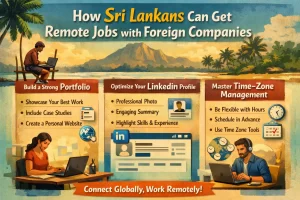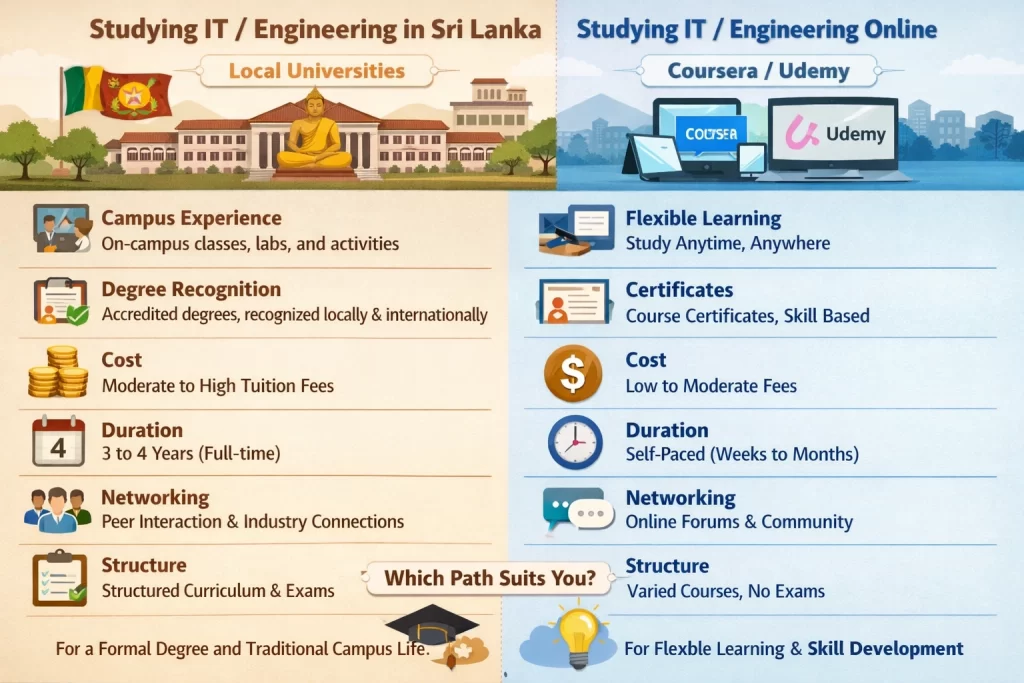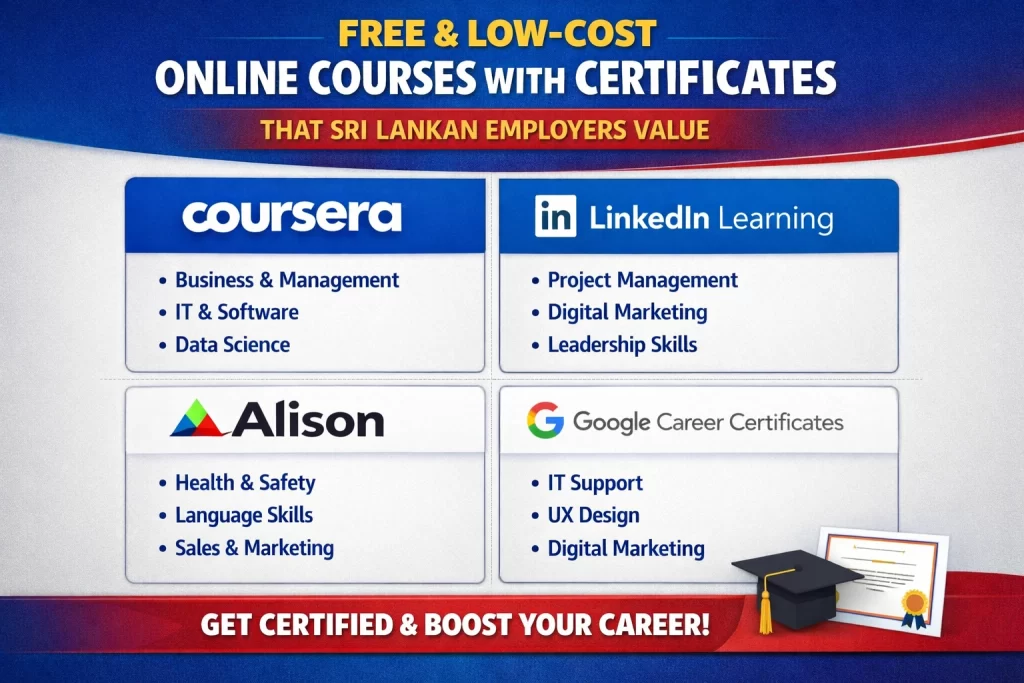
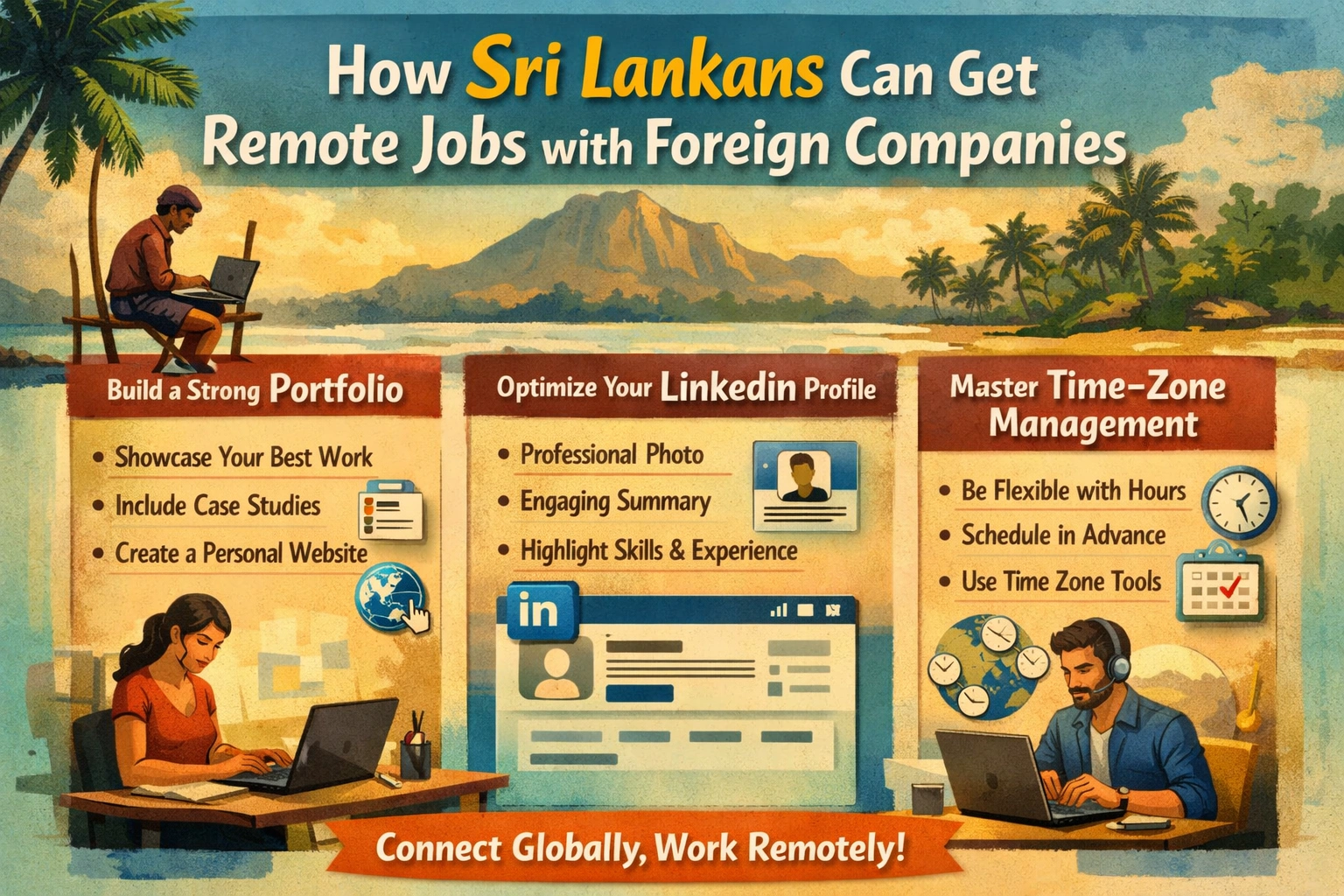
Why remote jobs are a big opportunity for Sri Lankans
Remote work lets Sri Lankans earn global-level salaries while living locally, often in USD, EUR, or other strong currencies. Platforms and job boards now list hundreds of fully remote roles that can be done from Sri Lanka across tech, marketing, customer support, design, and more.[1][2][3] This creates a powerful way to increase personal income and bring foreign currency into the country.
Several global job platforms actively advertise roles that can be done from Sri Lanka or “work from anywhere,” including full-time, freelance, and contractor positions.[1][2][3][6][7][8] Many of these jobs are with US, UK, and EU companies that are used to hiring remotely and paying competitive international rates.[1][2][6] As a result, a qualified Sri Lankan professional can often earn multiple times a typical local salary while staying close to family and avoiding relocation costs.[1][3][6]
The remote job market in Sri Lanka is also diversified, not limited to software engineering. In-demand remote roles include:
- Software development, DevOps, security, and data roles[2][3][6][7]
- Digital marketing, SEO, social media, and growth roles[1][3]
- Design, multimedia, and creative roles[1][3]
- Customer support, technical support, and customer success roles[2][3][8]
- Operations, project management, and product management roles[1][2][3]
For many of these positions, companies do not require relocation. They explicitly state “work from anywhere” or accept applicants from Sri Lanka alongside other countries in Asia.[2][3][8] This reduces visa barriers and opens doors for people who might never consider traditional migration.
Sri Lanka’s geographical position offers a practical time-zone advantage. Being close to Gulf, European, and some Asian time zones makes it easier to work overlapping hours with employers in the Middle East, Europe, and parts of Africa and Asia. At the same time, many fully remote companies serving US clients hire people willing to work adjusted or flexible schedules, which Sri Lankan professionals can often accommodate, especially for premium pay or leadership roles.[1][2][6]
The country’s improving digital infrastructure and growing familiarity with online collaboration tools also support long-term growth in remote work.[3] As more Sri Lankans successfully secure remote roles and build global portfolios, they create networks, referrals, and local know-how that make it easier for others to follow the same path. Over time, this can help:
- Increase inflows of foreign currency at the individual and family level
- Reduce dependency on local job markets and domestic economic cycles
- Encourage skills development in globally competitive fields like tech and digital services[3][6][7]
For anyone in Sri Lanka with marketable skills and a good internet connection, remote jobs are therefore a strategic opportunity: a way to earn more, learn faster, and build a truly international career without leaving home.
Building a portfolio that impresses foreign hiring managers
For most foreign companies, your portfolio is more important than your degree, and it must be easy to understand for someone who has never been to Sri Lanka or heard of your local employers. Focus on clarity, proof of skill, and international relevance.
1. Choose the right format for your field
- Tech (developers, data, DevOps, QA): GitHub/GitLab profile + a simple personal website or Notion page linking to key projects, case studies, and demos.
- Design (UI/UX, graphic, product): Behance/Dribbble or a personal portfolio site with project write‑ups, user flows, and before/after visuals.
- Marketing, content, SEO, social media: A one‑page site or Notion hub with campaign breakdowns, writing samples, metrics, and screenshots.
- Product, project, operations, customer success: Case‑study style portfolio (PDF or web page) showing problems, actions, and measurable results.
- Freelancers/consultants: A simple site with services, 3–6 detailed projects, testimonials, and clear calls to action.
2. Lead with outcomes, not responsibilities
Foreign hiring managers care less about your job title and more about what you changed or improved.
- Replace vague lines like “Responsible for social media marketing” with outcome‑focused bullets:
- “Grew LinkedIn followers from 1,200 to 7,500 in 6 months, increasing inbound leads by 40%.”
- “Reduced average support response time from 12 hours to under 2 hours by redesigning workflows.”
- Always include numbers: revenue, users, conversion rates, time saved, error reduction, response time, NPS, CSAT, etc.
- If you lack access to exact numbers, use safe ranges (“about 20% faster”, “around 30% fewer bugs”, “doubled sign‑ups”).
3. Make your work globally understandable
- Explain context briefly: A foreign manager does not know your local bank, telco, or startup.
- “Worked on a mobile banking app for a leading Sri Lankan bank (2M+ customers).”
- “Helped a Colombo‑based SaaS startup serving 150+ global e‑commerce stores.”
- Translate local terms: Use globally familiar words:
- “AL/OL” → “Advanced Level (equivalent to UK A‑Levels)”
- “Undergraduate internship” → “3‑month full‑time internship”
- Show tools and tech stack: Clearly list technologies and tools (e.g., React, Node.js, Figma, HubSpot, Jira, AWS, Python, SQL).
- Highlight international collaboration: Mention if you worked with clients or teammates in the US, UK, EU, Australia, or other regions, especially across time zones.
4. Curate 5–8 strong, relevant projects
A tighter portfolio with fewer but deeper projects is more impressive than 20 shallow items.
- Pick projects that:
- Match the roles you are targeting (e.g., B2B SaaS for SaaS companies, e‑commerce projects for DTC brands).
- Show modern tools and methods (e.g., CI/CD, cloud, responsive design, user research, experimentation).
- Demonstrate ownership: projects where you led, made key decisions, or drove the outcome.
- For each key project, include:
- Title & role: “Lead Frontend Engineer – E‑commerce Checkout Redesign”
- Client / company type: “US‑based DTC fashion brand”
- Problem: “High cart abandonment (78%) and slow load times.”
- Actions: What exactly you did, tools used, decisions made.
- Results: Concrete metrics, with time frames (e.g., “Cart abandonment reduced to 62% within 3 months”).
- Artifacts: Links to code, live sites, Figma files, dashboards, screenshots.
5. Add 1–3 “flagship” case studies
Many foreign managers skim portfolios but read case studies in detail to judge your thinking.
- Turn your best projects into 1–2 page case studies with:
- Background: brief context, business model, target users.
- Goal: clear, measurable objective (e.g., “increase trial‑to‑paid conversion”).
- Constraints: time, budget, team size, tech limitations.
- Process: how you approached research, planning, implementation, and testing.
- Impact: before vs after metrics, quotes from stakeholders if possible.
- Reflection: what you learned and what you would improve next time.
- Use simple English and clear headings so non‑native readers can follow easily.
6. Show real code, designs, and artifacts
- Developers / data / DevOps:
- Keep public repos with clean, readable code and clear README files.
- Include tests, documentation, and small utilities that demonstrate quality.
- Pin 4–6 repositories that match the job type you want (APIs, data pipelines, automation tools, etc.).
- Designers:
- Include mobile + desktop work, UX flows, wireframes, and UI screens.
- Show your process: sketches, experiments, usability testing notes.
- Marketers, writers, analysts:
- Link to live campaigns, blog posts, landing pages, dashboards, reports.
- Use anonymised screenshots if you cannot share full internal details.
7. Handle confidentiality and local clients correctly
- If NDAs prevent sharing:
- Remove logos and company names; describe the industry and size instead.
- Simplify or mask sensitive data but keep before/after comparisons.
- Ask for permission to use selected screenshots in your private portfolio when possible.
- For Sri Lankan clients that foreign managers don’t know, focus on:
- Scale: “serving 500+ retail outlets”, “top 3 insurer in the country”.
- Impact: growth, cost savings, customer satisfaction, reliability.
8. Make your portfolio “remote‑friendly”
- Accessibility: Fast to load, mobile‑friendly, simple navigation.
- Timezone transparency: Mention your location (“Based in Colombo, Sri Lanka – GMT+5:30”) and preferred overlaps (e.g., “Comfortable working with US/EU time zones”).
- Communication proof: Include:
- Links to talks, meetups, webinars, or recorded demos if you have them.
- Short explanations of how you handle async work (documentation, task tracking, status updates).
- Professional contact info: Use a professional email, and add links to your LinkedIn and GitHub/Behance at the top and bottom.
9. Localise your portfolio for foreign audiences
- Write everything in clear international English: avoid heavy slang, overly local expressions, and long, complex sentences.
- Use global metrics and currencies where possible:
- Translate LKR figures into USD as a reference (e.g., “LKR 3M (~USD 9,000) budget”).
- Use percentages to show growth and impact, which are language‑neutral.
- Clarify education and certifications with equivalents (e.g., “BSc in Computer Science (4‑year degree)”).
- Emphasise skills valued in remote teams:
- Self‑management and ownership.
- Written communication and documentation.
- Experience with tools like Slack, Zoom, Jira, Trello, Notion, GitHub.
10. Keep it updated and aligned with your LinkedIn
- Update your portfolio every 3–6 months with:
- New projects and improved metrics.
- New skills, tools, or certifications.
- Ensure consistency with your LinkedIn:
- Same job titles and dates.
- Same key projects and achievements (you can go deeper on the portfolio).
- Use your portfolio link in:
- LinkedIn “Featured” section.
- GitHub/Behance bios.
- Email signature and CV.
When your portfolio clearly shows measurable impact, real artifacts, and remote‑friendly habits, you signal to foreign hiring managers that you can plug into their teams quickly and deliver value from Sri Lanka, regardless of time zone.

Optimizing your LinkedIn profile for international visibility
If you are in Sri Lanka and want remote work with foreign companies, your LinkedIn profile must be written and structured for a global, not just local, audience. Here is how to make recruiters abroad actually find you, understand your value, and feel confident about hiring you remotely.
1. Set up the right “global” basics
- Use an international headline
Do not just write “Software Engineer at X” or “Accountant”. Make your headline searchable in global markets:- Include your role + key skills + “Remote” / “Open to Remote”.
- Example: “Senior Frontend Engineer | React, TypeScript, Next.js | Open to Remote (US/EU/UK/Asia)”
- Example: “ACCA-Qualified Accountant | FP&A & IFRS | Remote Finance Partner for SMEs”
- Location settings for remote roles
Many foreign recruiters search by location or “remote but within region”:- Set your location to your real city in Sri Lanka (e.g., “Colombo, Western Province, Sri Lanka”) so you are compliant and transparent.
- Then turn on “Open to work” and specify:
- Job locations: choose multiple regions (e.g., “United States (Remote)”, “United Kingdom (Remote)”, “Europe (Remote)”, “Asia-Pacific (Remote)”).
- Job types: tick “Remote” specifically.
- Use global English
- Write your entire profile in clear, neutral international English (avoid slang or Sri Lankan-specific abbreviations that outsiders may not know).
- Spell out local references once: e.g., “A/L (GCE Advanced Level)” or “Chartered Accountant (CA Sri Lanka)”.
2. Craft a “remote‑friendly” About section
- Lead with your value for foreign clients
In the first 2–3 lines (the part most people see without expanding), answer:- Who you are (profession, level)
- What problems you solve
- For which types of companies (SaaS, agencies, startups, e‑commerce, etc.)
- That you work remotely with global teams
Example opening:
I am a Senior Product Designer helping SaaS and e‑commerce teams increase conversions and reduce user friction. Based in Sri Lanka, I have 5+ years collaborating remotely with US, UK, and EU startups across B2B and B2C products.
- Show remote collaboration skills explicitly
Foreign employers worry about communication, accountability, and self‑management. In your About, mention:- Experience with remote tools: Slack, Zoom, Teams, Notion, Jira, GitHub, Figma, etc.
- Experience working with distributed teams (US, Europe, Australia, etc.).
- How you handle time zones (e.g., “Comfortable overlapping 3–5 hours with US or European time zones.”).
- Your English communication: calls, documentation, client-facing roles.
- Include hard evidence and niches
Add 3–6 short bullet points in your About section that show results:- “Increased organic traffic by 120% in 9 months for a UK e‑commerce brand.”
- “Built and maintained CI/CD for a US-based SaaS handling 1M+ monthly users.”
- “Managed bookkeeping and reporting for a portfolio of 12 US clients using QuickBooks Online and Xero.”
3. Make your Experience section “international‑friendly”
- Translate local roles into global language
Instead of only using internal titles like “Executive – IT” or “Associate Software Engineer”, add a globally understood version:- “Software Engineer (Full‑Stack, Node.js/React)”
- “Digital Marketing Specialist (Paid Ads & SEO)”
- Highlight remote and cross‑border work
Under each relevant role, add:- “Fully remote role, collaborating with teams/clients in [countries]”.
- “Asynchronous communication with stakeholders across [time zones, e.g., PST, EST, CET, AEST].”
- Any international clients you worked with (industries + countries, if you cannot name companies).
- Use measurable impact, not only task lists
Instead of just responsibilities, show results that international recruiters understand:- “Reduced AWS hosting costs by 25% while improving uptime from 98.5% to 99.9%.”
- “Improved support CSAT from 4.1 to 4.7 while handling 40+ tickets/day.”
- “Managed $20,000/month Google Ads budget for a US SaaS, improving ROAS from 2.1x to 3.4x.”
4. Skills, keywords, and endorsements for global search
- Prioritize skills used in remote job descriptions
Go through several remote job postings (US, UK, EU, Australia) in your field and note recurring terms. Then:- Add 30–50 relevant Skills that match those keywords.
- Order your top 3 skills to match your target roles (e.g., “React.js”, “Node.js”, “TypeScript” for a full‑stack developer).
- Include remote‑work and communication skills
These improve trust in you as a remote hire:- Remote collaboration tools (Slack, Zoom, Jira, Trello, Asana, Notion, etc.).
- “Distributed teams”, “Asynchronous communication”, “Client communication”, “Stakeholder management”.
- Actively collect endorsements and recommendations
- Ask foreign clients or teammates to endorse skills that matter for your target roles.
- Request short Recommendations that mention:
- Your technical or functional strength.
- Your reliability in a remote setting.
- Your communication and time‑zone flexibility.
5. Showcase your portfolio directly on LinkedIn
- Use the Featured section strategically
Add links or uploads that show your work:- Portfolio site, GitHub, Dribbble, Behance, Notion case study, Medium article, Upwork profile with strong reviews.
- For non‑tech roles: sample reports, dashboards, content pieces, pitch decks, or process docs (with sensitive data removed).
- Connect Experience with concrete work
For each major role:- Link to specific projects you completed for international clients.
- Write 1–2 lines of context in the project description: client region, problem, your contribution, outcome.
- Adapt your portfolio for global expectations
Make sure portfolio items are described in a way foreign clients understand:- Focus on business outcomes, not only technical details.
- Translate local brand or sector references (e.g., “largest telco in Sri Lanka (similar scale to a national carrier in the EU)” if appropriate).
6. Communicate time‑zone and availability clearly
- State your time zone and overlap
Sri Lanka is usually GMT+5:30. Make this easy for foreign recruiters:- Add to About or Headline: “Based in Sri Lanka (GMT+5:30) | 3–5 hours overlap with EU/UK | 2–4 hours overlap with US (EST/PST) on request.”
- Clarify your preferred working windows
Without oversharing personal details, indicate flexibility:- “Available for meetings between 6:00–11:00 UTC and 13:00–16:00 UTC.”
- “Comfortable adjusting schedule for key weekly calls with US/European teams.”
- Mention experience across time zones
If you have it, explicitly state:- “Have collaborated with teams in EST, PST, CET, and AEST time zones.”
- “Used async tools (Loom, detailed documentation, ticketing systems) to ensure smooth handovers between time zones.”
7. Optimize for recruiter search and credibility
- Mirror language from target job posts
Take 5–10 remote job ads from your target markets and:- Re-use their most important phrases (skills, tools, responsibilities) naturally in your Headline, About, Experience, and Skills.
- Example: if many roles mention “B2B SaaS”, “PLG”, or “microservices”, use these exact terms where accurate.
- Complete every relevant LinkedIn section
Profiles with more sections completed rank and convert better:- Profile photo: clear, professional, neutral background.
- Banner image: optionally use something that signals your field (code, analytics, design, remote work, etc.).
- Education: add degrees, but also global certifications (AWS, Azure, Google, HubSpot, Scrum, ACCA, CFA, etc.).
- Licenses & Certifications: especially those recognized internationally.
- Languages: list English level honestly; if you use English daily at work, mention “Full professional proficiency”.
- Clean up anything that confuses foreigners
- Expand acronyms for local institutions and exams.
- Remove very local jargon and unexplained abbreviations from job descriptions.
- Keep dates and formats in a standard style (e.g., “Jan 2020 – Dec 2023”).
8. Use activity to signal you are engaged with global markets
- Post about topics that matter to foreign companies
Once or twice a week, share:- Short case studies from your portfolio (before/after, lessons learned).
- Breakdowns of tools or processes you use for remote work.
- Comments on global trends in your niche (AI, e‑commerce, devops, UX, etc.).
- Engage with international communities
- Connect with people working at companies that hire remotely from Sri Lanka or “work from anywhere”.
- Comment thoughtfully on posts by hiring managers, founders, and senior professionals in your target market.
- Show consistency
Recruiters often check your recent activity:- A steady stream of professional, English content builds trust.
- It also keeps you higher in feeds and more visible when opportunities arise.
9. Sri Lanka–specific tweaks that help
- Turn your location into an advantage
Briefly frame Sri Lanka as a strength:- “Based in Sri Lanka (GMT+5:30), offering convenient overlap for teams in Europe, the Middle East, and Asia-Pacific.”
- “Have worked with clients in [list regions]; used to delivering high‑quality work across borders.”
- Be transparent about employment type
Many foreign companies will hire you as a contractor:- Mention if you are comfortable working as a remote contractor / freelancer.
- If you have experience billing internationally (Upwork, direct clients, agencies), include it in your About or Experience.
- Align with remote‑first employers
Follow and engage with:- Companies that advertise “work from anywhere”, “fully remote”, or hire across Asia including Sri Lanka.
- Remote job boards and communities—share wins or case studies related to remote work.
When your LinkedIn profile speaks the language of foreign recruiters, shows proof of your work through a visible portfolio, and clearly addresses time‑zone and communication concerns, you become a much more attractive candidate for remote roles with international companies—no matter that you are based in Sri Lanka.
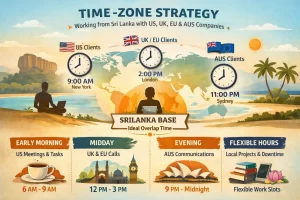
Time‑zone strategy: working from Sri Lanka with US, UK, EU, and AUS companies
Sri Lanka’s time zone (IST, UTC+5:30) is surprisingly flexible: with the right schedule design and communication habits, you can collaborate smoothly with teams in the US, UK, EU, and Australia while still protecting your health and productivity.
1. Understand your overlap windows
First map out realistic overlap hours with each region so you can choose roles and companies whose expectations match your lifestyle.
- UK & Western Europe
• UK (UTC / UTC+1): 4.5–5.5 hours behind Sri Lanka.
• Typical UK workday 9:00–17:00 → 14:30–22:30 (winter) or 13:30–21:30 (summer) in Sri Lanka.
Practical overlap: A normal Sri Lankan day (12:00–21:00) easily covers most of the UK workday. This is one of the easiest regions for Sri Lankans to work with full‑time.
- Central & Western Europe
• Central Europe (UTC+1 / +2): 4.5–3.5 hours behind.
• 9:00–17:00 CET → 13:30–21:30 in Sri Lanka (winter).
Practical overlap: Great for late‑morning to evening schedules in Sri Lanka, with full‑time remote roles being very realistic.
- Australia (especially East Coast)
• Sydney/Melbourne (UTC+10 / +11): 4.5–5.5 hours ahead of Sri Lanka.
• 9:00–17:00 AEST → 3:30–11:30 in Sri Lanka.
Practical overlap: Early‑morning Sri Lanka schedule (6:00–14:00) covers almost the entire Australian day. Ideal if you like starting early and finishing early.
- US East Coast
• US Eastern (UTC‑5 / ‑4): 10.5–9.5 hours behind Sri Lanka.
• 9:00–17:00 ET → 19:30–3:30 or 18:30–2:30 in Sri Lanka.
Practical overlap: Evening–late‑night in Sri Lanka. Sustainable if you:
– Work hybrid hours (some overlap at night, deep work in Sri Lanka daytime).
– Or prefer a shifted “night‑owl” schedule.
- US West Coast
• US Pacific (UTC‑8 / ‑7): 13.5–12.5 hours behind.
• 9:00–17:00 PT → 22:30–6:30 or 21:30–5:30 in Sri Lanka.
Practical overlap: Mostly night shift. Best for:
– Roles that are explicitly “async‑first” and do not require heavy meeting time.
– Short, well‑defined overlap (e.g., 2–3 hours of calls) rather than full‑shift alignment.
When you evaluate a remote job description, look specifically for phrases like “async‑first”, “work from anywhere”, or explicit mention that they hire in South Asia, as these often signal more flexible time expectations.[2][5][7]
2. Choose a sustainable core schedule
Before applying aggressively, decide in advance what you can realistically maintain for 12–24 months.
- If you prefer normal daytime work in Sri Lanka
• Target: UK, EU, Middle East, parts of Africa.
• Ideal core hours: 10:00–18:00 or 11:00–19:00 Sri Lanka time.
• You still catch several hours of overlap with UK/EU while keeping evenings free.
- If you don’t mind working early mornings
• Target: Australia and some East/Southeast Asian roles (they often advertise “APAC time zone” or list Sri Lanka as eligible).[2][7]
• Ideal core hours: 6:00–14:00 or 7:00–15:00 Sri Lanka time.
- If you’re open to evenings or late nights
• Target: US & Canada, especially companies that already hire across Asia and allow flexible schedules.[2]
• Ideal core hours: 14:00–22:00 (for partial US overlap) or a split shift (e.g., 11:00–16:00 and 22:00–01:00) if the role demands more overlap.
Aligning your target regions with a pre‑decided schedule helps you avoid burnout and makes your applications more credible, because you can clearly explain your availability.
3. How to present your time‑zone advantage on your portfolio
Your portfolio and personal site should show that you have already thought through time‑zone logistics and are easy to work with globally.
- Add a “Time‑zone & availability” block on your homepage or “About” page:
• “Based in Sri Lanka (UTC+5:30), comfortably overlapping with UK/EU and APAC workdays.”
• “Typical availability: 09:00–18:00 IST, with flexibility for 2–3 hours overlap with US Eastern when required.”
This reassures hiring managers that you understand remote collaboration constraints.
- Highlight past cross‑time‑zone experience:
• Short case studies that explicitly mention regions:
“Led a 4‑person engineering squad across Sri Lanka, Germany, and New York, coordinating weekly stand‑ups at overlapping hours and using async documentation for everything else.”• Add bullet points like: “Used async‑first workflows (Loom, Notion, detailed PRs) to reduce meeting load across a 10‑hour time difference.”
- Specify preferred regions in your “Work with me” section:
• “Best aligned with teams in UK, EU, and Australia; open to async‑first roles in North America.”
• This filters in the right opportunities while signalling that you’ve done the time‑zone thinking already.
4. Time‑zone positioning on LinkedIn
Many global recruiters search specifically for candidates who can overlap with certain regions, so your LinkedIn profile should make your time‑zone compatibility explicit.
- Headline examples (adapt these to your role):
• “Senior Frontend Engineer · React/TypeScript · Based in Sri Lanka (UTC+5:30) · Overlaps UK/EU & APAC.”
• “Customer Success Manager | Supporting US & UK clients from Sri Lanka | Evening & weekend availability.”
- About section:
• Add a short paragraph on remote readiness:
“I work from Sri Lanka (UTC+5:30) and have 4+ years collaborating with US, UK, and Australian teams. Comfortable with early‑morning and late‑evening meetings and heavily async workflows.”• Mention the tools and habits you use: Slack etiquette, overlapping “office hours,” thorough written updates, recorded Loom walkthroughs, etc.
- Featured & Experience sections:
• In each remote role, include a bullet about time‑zones:
“Supported enterprise customers in North America and Europe from Sri Lanka, maintaining a 2–4 hour daily overlap while handling the rest asynchronously.”• Attach portfolio links or case studies that demonstrate reliable cross‑time‑zone delivery.
- Open to work & job preferences:
• Under “Job preferences,” select locations like “Remote – Worldwide” and also specify regions (e.g., Europe, Asia‑Pacific) where most of your day aligns naturally.
• Use the “Add a note to recruiters” field to write:
“Based in Sri Lanka (UTC+5:30). Ideal for roles needing overlap with UK/EU or APAC; open to async‑first US teams.”
5. Applying strategically by region
Use job boards and filters intelligently so you apply mostly to roles that already accept Sri Lanka–based talent and understand global time zones.[1][2][5][7]
- Look for “work from anywhere” or “Sri Lanka” in the eligibility list
Many platforms and postings explicitly mention Sri Lanka among acceptable countries, especially for tech and customer‑facing roles.[2][5][7]
If Sri Lanka is listed alongside other APAC countries, it usually means the team is already used to APAC time zones.
- Match your time‑zone to the job’s stated requirements
• If a posting says “Must work US Eastern hours,” be honest: this is effectively an evening/night role in Sri Lanka. Apply only if you are willing to commit long‑term.
• If it says “4 hours overlap with CET,” you can easily offer that from a standard Sri Lankan afternoon.
- Use your cover letter or introductory note to pre‑empt time‑zone concerns
• Explicit sentence to include:
“I am based in Sri Lanka (UTC+5:30). Your team’s core hours of 9:00–17:00 CET correspond to 13:30–21:30 for me, so I can attend all key meetings and still maintain a healthy schedule.”• For US roles:
“I typically work 11:00–19:00 IST, with an additional 2–3 hours of overlap in your morning Eastern time as needed for calls.”
6. Communicating availability across multiple regions
If you freelance or work with clients from different continents, you must be very clear and consistent about your availability to avoid confusion.
- Always state times with time‑zones
Instead of “Let’s meet at 5 pm,” write “Let’s meet at 5:00 pm IST (11:30 am UTC / 6:30 am ET).”
Use tools (Google Calendar, calendaring apps) that automatically convert time‑zones for invitees.
- Define “core hours” and “response windows”
• Core hours: when you attend meetings and are usually online (e.g., 11:00–19:00 IST).
• Response window: how fast you usually reply async (e.g., within 12–24 hours on weekdays).
Share this once in writing (e.g., onboarding doc, pinned Slack message) so everyone knows what to expect.
- Use async‑first habits to reduce time‑zone friction
• Write detailed updates and decisions in documents or project tools.
• Record Loom/ScreenRec videos instead of scheduling unnecessary meetings.
• Propose agendas and decisions in advance so colleagues in distant time‑zones can react while you sleep.
7. Protecting your health while working odd hours
Remote work across continents can pay very well, but only if you avoid destroying your sleep and health in the process.
- Set a maximum number of late nights per week
Decide, for example, that you will only have late‑night calls 2–3 times per week and protect your other evenings.
- Use split shifts instead of full‑night shifts when possible
For US roles, a pattern like “Daytime deep work + 2–3 hours overlap at night” is usually more sustainable than mirroring the entire US workday.
- Periodically renegotiate meeting times
If you are always the one sacrificing sleep, propose rotating meeting times so the burden is shared across regions.
8. Turning your Sri Lanka location into a selling point
Instead of treating your time‑zone as a disadvantage, frame it as a benefit for global teams.
- Offer near‑24/7 coverage
For support, operations, DevOps, and reliability roles, you can position yourself as the person who keeps systems running while US/Europe teams are asleep.
Example line for LinkedIn/portfolio:
“From Sri Lanka (UTC+5:30), I provide off‑hours coverage for US/EU teams, ensuring issues are addressed while local teams are offline.” - Stress continuity and follow‑the‑sun workflows
In distributed teams, handing off work between time zones can accelerate delivery.
Example: “Our team used a follow‑the‑sun model between San Francisco, Berlin, and Colombo, cutting cycle time by 30% thanks to continuous progress across time‑zones.”
- Combine time‑zone benefits with cost‑effectiveness
Many companies hire from Sri Lanka because of strong skills, good English, and cost‑effective rates compared to Western markets.[1]
If you are a freelancer or consultant, being able to offer extended coverage at a competitive rate is a strong selling point.
By deliberately choosing your target regions, clearly stating your availability on your portfolio and LinkedIn, and using async‑first habits, you can turn Sri Lanka’s time zone into a genuine advantage when applying for remote roles with US, UK, EU, and Australian companies.
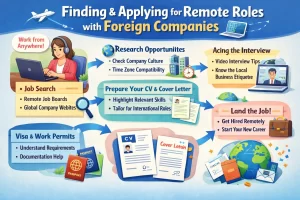
Finding and applying for remote roles with foreign companies
Once your skills and basic profile are ready, the next step is to systematically find, filter and apply for remote roles that genuinely fit a Sri Lanka–based candidate. This section focuses on three pillars that matter most with foreign employers: your portfolio, LinkedIn, and time‑zone strategy.
1. Where to find remote roles that accept Sri Lanka
Many foreign companies now hire fully remote across Asia, including Sri Lanka, especially for software, data, design, customer support, translation, and marketing roles.[2][3] Use job boards and filters strategically:
- Global remote job boards
Use sites that explicitly list Sri Lanka as an eligible country or “Work from anywhere”:- Remote‑first marketplaces and job boards that show “Sri Lanka” in the eligible countries list.
- Platforms that tag jobs as “Work from anywhere” or “Global contractor”, which often include Sri Lanka.[3][7]
- Traditional job boards with remote filters
Many large boards let you search “Remote” and filter by location or “Sri Lanka” for eligibility.[2][3][4][5] - Company career pages
Some fully remote companies explicitly accept Sri Lanka‑based applicants as contractors or employees via an Employer of Record.[1][3][6][9] - Freelance platforms
Even if you prefer full‑time later, starting with freelance work for foreign clients helps you build a track record and references that convert into remote offers.
When reviewing any role, always confirm:
- Whether they hire in your country/region (Asia, “Anywhere”, “Sri Lanka”).
- Their expectations around time‑zone overlap (e.g., “4 hours overlap with EST”).
- Whether they work with contractors or only direct employees; many foreign companies use Employer‑of‑Record partners for Sri Lanka.[1]
2. Portfolio: prove you can do the work, remotely
Foreign hiring managers rarely know your university, former employers, or local brands. They trust what they can see and verify. Your portfolio should answer three questions fast: “Can you do the work?”, “Can you work independently?”, and “Can you communicate clearly in English?”.
2.1 What to include in a strong portfolio
- 3–8 high‑quality, relevant projects
Focus on work that is:- Directly related to the jobs you apply for (e.g., SaaS UI design if you target product design roles).
- Recent (last 2–3 years) and shows impact (metrics, outcomes, user or business value).
- Clear case studies, not just screenshots
For each project, briefly show:- Context: client/company, problem, your role.
- Process: steps you took, tools used, collaboration style.
- Result: numbers or qualitative outcomes (e.g., “Cut support tickets by 30%”, “Increased sign‑ups by 18%”).
- Evidence of remote collaboration
Highlight projects where you:- Worked with international clients or cross‑border teams.
- Used async tools (Slack, Jira, Notion, GitHub, Figma comments, Loom etc.).
- Handled different time zones successfully.
- English communication samples
Include:- Short write‑ups and project summaries in clear English.
- Optional: a short Loom/video walkthrough of a project to show spoken communication and structure.
- Social proof
Add:- Testimonials from foreign clients or managers.
- Links to live products, GitHub repos, Behance/Dribbble/CodePen, app stores or marketing campaigns.
2.2 Tailoring your portfolio to foreign remote roles
- Mirror the job description
If a posting emphasises “autonomy”, “async communication”, “ownership”, ensure your case studies explicitly show:- How you managed tasks without constant supervision.
- How you documented decisions and kept stakeholders updated.
- Emphasise tools and stacks common abroad
Mention globally recognised tools and frameworks (e.g., React, Node, Python, Figma, HubSpot, Salesforce, Zendesk, AWS) so hiring teams can quickly understand your environment familiarity. - Provide quick, scannable summaries
Busy foreign recruiters may only give you 30–60 seconds initially. Use:- A 2–3 line summary under each project title.
- Bullet points and bolding for key metrics and technologies.
2.3 Hosting and accessibility
- Simple, fast, public
Host your portfolio on:- A simple personal site (e.g., yourname.com).
- Or a well‑known platform (GitHub Pages, Notion, Behance, Dribbble, Medium for writers, etc.).
- No logins, no heavy downloads
Foreign hiring teams will not download 200 MB ZIP files or request access; ensure your work is visible with a click.
3. LinkedIn: your public CV for the global market
LinkedIn is often the first place foreign recruiters look when hiring from Sri Lanka, especially for IT, BPO, and knowledge‑work roles.[1][2][3] Treat it as your primary global profile, not just an online CV.
3.1 Optimise your headline and about section
- Headline that matches target roles
Avoid generic titles like “Software Engineer”. Use:- “Senior Frontend Engineer | React & TypeScript | Building B2B SaaS dashboards”
- “Customer Support Specialist | SaaS & E‑commerce | US & EU time zones”
- About section that sells “remote‑readiness”
In 3–6 short paragraphs or bullet points:- State your role, niche, and years of experience.
- Mention remote experience and time‑zone flexibility (e.g., “Worked with US‑based teams from Sri Lanka for 3+ years, overlapping 4–5 hours daily”).
- Highlight key achievements with numbers.
- List main tools, stacks, and industries you know.
3.2 Experience, skills, and keywords
- Experience descriptions
For each role:- Use 3–6 bullets focused on impact, not tasks.
- Note if the work was remote, hybrid, or with foreign clients (e.g., “Remote, collaborating with US/UK clients”).
- Include tools and tech (Jira, GitHub, Figma, Salesforce, HubSpot etc.).
- Skills and endorsements
Pin the skills that match foreign job descriptions you’re targeting, such as:- “Remote team collaboration”, “Asynchronous communication”, “Customer success”, “JavaScript”, “AWS”, “SEO”, depending on your field.
3.3 Location, openness, and branding
- Location settings
Keep your location as Sri Lanka but you can mention preferred markets in your headline or About section (e.g., “Open to remote roles with US/EU/UK companies”). This maintains honesty while signalling your target market. - Open to work
Use “Open to work” with:- Job titles that match foreign postings (e.g., “Product Designer (Remote)”, “Customer Success Manager (Remote)”).
- Location preference set to “Remote” or specific countries where companies often hire globally.
- Visuals
Use:- A clean, professional headshot.
- A banner that hints at your role (e.g., code, products, design, analytics, or even a simple gradient with your tagline).
3.4 Building international visibility on LinkedIn
- Connect with people, not just companies
Add:- Hiring managers, team leads, and engineers/designers/marketers from companies you admire.
- Alumni from your university who work abroad.
- Content that showcases expertise
Once or twice a week:- Share short posts about problems you solved, case studies from your portfolio, or tools you use.
- Comment thoughtfully on posts by foreign founders, recruiters, and leaders in your niche.
- Targeted outreach
When you see a role:- Apply normally, then send a concise LinkedIn message to the hiring manager or recruiter with:
- 1–2 lines on who you are and your experience.
- 1–2 lines connecting your skills to their role.
- Link to your portfolio/GitHub and mention your time‑zone overlap.
- Apply normally, then send a concise LinkedIn message to the hiring manager or recruiter with:
4. Time‑zone strategy: turn Sri Lanka’s location into an advantage
Sri Lanka’s time zone (UTC+5:30) gives partial overlap with Europe, the Middle East, and parts of Asia‑Pacific, and limited but workable overlap with the US if you adjust your schedule.
4.1 Understanding overlap with major markets
- Europe (UK, EU)
You generally have several hours of business‑hours overlap without extreme shifts, making these markets very friendly for Sri Lanka‑based remote work. - Middle East & Asia‑Pacific
Time zones are close; collaboration is straightforward. - US & Canada
Overlap is smaller, but:- Early‑morning Sri Lanka can match late‑evening US time (and vice versa).
- Many US companies expect only 3–4 hours of daily overlap for async‑friendly roles.
4.2 How to present your time‑zone flexibility
- In your LinkedIn headline/About
Add a simple line:- “Based in Sri Lanka (UTC+5:30) | 3–5 hours overlap with EU/UK, 2–4 hours with US time zones available.”
- In your CV and portfolio
Include a short “Availability” or “Remote work” note:- “Comfortable working partial US/EU hours and async with clear documentation.”
- In outreach messages and interviews
Be proactive:- State the exact overlap you can commit to (e.g., “I can overlap 4 hours daily with CET” or “I can work 6–10 AM ET comfortably”).
- Mention prior success working across time zones, if you have it.
4.3 Working async: what foreign companies want to hear
Many foreign remote‑first companies are comfortable with minimal overlap if you can work effectively asynchronously. Demonstrate that you:
- Write clear updates (daily/weekly status, blockers, next steps).
- Use tools for documentation (wikis, tickets, well‑written pull requests, design specs).
- Record short loom/video explanations instead of waiting for meetings.
- Can self‑manage tasks and deadlines without continuous supervision.
5. Putting it all together when applying
- Shortlist roles where:
- Sri Lanka (or “Asia”, “Work from anywhere”) is allowed.
- They mention remote or hybrid with remote‑friendly culture.
- Customise your CV and LinkedIn to mirror that specific job’s skills and language.
- Attach or link your portfolio with 2–3 projects most relevant to the role.
- Mention time‑zone alignment briefly in your cover letter/email:
- “I am based in Sri Lanka (UTC+5:30) and can ensure 4 hours of overlap with your core working hours in CET/EST.”
- Follow up via LinkedIn with a concise, professional message to the recruiter or hiring manager linking your portfolio and reiterating your fit and availability.
With a focused portfolio, an internationally optimised LinkedIn profile, and a clear time‑zone narrative, Sri Lankan professionals can compete strongly for remote roles with foreign companies across IT, BPO, marketing, design, and many other knowledge‑work fields.[1][2][3]

Standing out in interviews and building a long‑term remote career
Once your portfolio and LinkedIn start generating interest, the next challenge is acing interviews and turning one remote offer into a sustainable, long‑term international career.
1. Preparing for remote interviews (Sri Lanka–specific)
1.1. Get your tech and environment perfect
- Internet & power backup: Have a stable connection, mobile data hotspot as backup, and a plan for power cuts (charged laptop, UPS if possible). Mention briefly at the start of the interview that you have backup connectivity to reassure employers.
- Quiet, neutral background: Use a clean wall or simple background and good lighting (window in front of you). Test your camera angle so your face and upper torso are visible.
- Audio quality: Use wired earphones or a decent headset and test for echo/background noise. Do a 5‑minute test call with a friend before the real interview.
1.2. Master common remote‑hiring questions
Foreign companies recruiting from Sri Lanka care about communication, reliability, and time‑zone fit as much as raw skills. Prepare concise answers with specific examples for questions like:
- “Have you worked remotely before?”
Even if you have not, talk about university projects, freelance work, or open‑source contributions where you collaborated online, used Git, Trello, Slack, or similar tools. - “How do you manage your time and stay productive?”
Mention a simple system: time‑blocking, to‑do lists, using tools like Google Calendar, Notion, or ClickUp, and how you handle distractions at home. - “How do you communicate with a distributed team?”
Highlight that you write clear updates, ask clarifying questions early, summarise decisions in writing, and are comfortable with tools like email, Slack, Zoom, Jira, etc. - “How do you handle overlapping working hours?”
Show flexibility (within reason) and link it to Sri Lanka’s time‑zone advantages (see section 3 below).
1.3. Turn your portfolio and LinkedIn into “interview ammo”
- Walkthroughs: Be ready to share your screen and walk through 2–3 key projects from your portfolio:
- What was the problem?
- What did you specifically do?
- What tools/tech did you use?
- What was the outcome or impact?
Practice these explanations so you can do them in 3–5 minutes each.
- LinkedIn proof: Use your profile to back up claims:
- Point to recommendations from clients/colleagues.
- Show posts where you shared work, articles, or open‑source contributions.
- Show your “Featured” section with portfolio links, GitHub, or case studies.
- Quantify results: Wherever possible, add numbers:
- “Improved page load speed from 5s to 1.8s.”
- “Increased organic traffic by 40% in 6 months.”
- “Handled 50+ customer tickets per day with 95% CSAT.”
1.4. Show strong English and cross‑cultural communication
- Clarity over perfection: Employers hiring in Sri Lanka already know English is strong, but you still need to speak slowly, clearly, and avoid very local idioms.
- Structured answers: Use simple structures like STAR (Situation, Task, Action, Result) to keep answers focused and easy to follow.
- Check understanding: Say things like “Let me repeat to be sure I understood” and summarise what you heard. This signals reliability to remote managers.
2. Proving you can thrive in a remote setup
2.1. Demonstrate autonomy and ownership
- Share examples where you:
- Identified a problem without being told.
- Researched solutions on your own.
- Proposed a plan and executed it.
- Show initiative: Talk about courses you took independently, side projects you built, or communities you joined to stay updated.
2.2. Highlight your documentation habits
Documentation is a core remote skill. Emphasise that you:
- Write clear task updates and meeting notes.
- Document code, processes, or SOPs so others can follow without calling you.
- Use tools like Google Docs, Confluence, Notion, GitHub README files, or Loom videos.
2.3. Show reliability from Sri Lanka
- Consistency: Mention that you keep consistent working hours and update your team if your schedule changes.
- Risk management: Briefly explain how you handle potential disruptions (weather, power cuts, etc.) so they don’t affect deadlines.
3. Turning the time‑zone into an advantage
3.1. Know your overlaps
Sri Lanka (IST, UTC+5:30) aligns well with many regions. You can use this as a selling point:
- Europe/UK: Large overlap with standard working hours; you can cover early‑morning or late‑afternoon tasks for them.
- Middle East: Very close time zones; collaboration is straightforward.
- US/Canada: Limited overlap, but:
- You can offer a few hours in the US morning or evening.
- You can provide “follow‑the‑sun” coverage – tasks are done while they sleep.
- Australia/Asia‑Pacific: Good overlap with many cities (Singapore, Hong Kong, Sydney, Melbourne, etc.).
3.2. How to talk about time‑zones in interviews
- Be specific: Instead of “I’m flexible,” say “I’m in Sri Lanka (UTC+5:30). I can overlap 4–5 hours with your team in London / Berlin / New York on weekdays, for example 2 PM–7 PM your time.”
- Offer options: Propose 2–3 possible schedules that balance your life and their needs. This shows you’ve done your homework.
- Set boundaries professionally: It’s okay to say you cannot work overnight every day. Frame it as wanting a sustainable schedule so you can perform at your best long‑term.
3.3. Use time‑zone strategically for career growth
- Asynchronous “deep work”: Emphasise that when your teammates are offline, you can focus without meetings and deliver high‑quality work by their morning.
- Extended support hours: For support, DevOps, or security roles, show how you can extend coverage beyond their normal day.
4. Building a long‑term remote career (not just one job)
4.1. Use each role to strengthen your portfolio
- After big projects, turn them into case studies for your portfolio and LinkedIn (with client permission).
- Ask for LinkedIn recommendations from managers and colleagues while the project is fresh.
- Track outcomes (metrics, before/after screenshots, testimonials) so you can show real impact to future employers.
4.2. Keep your LinkedIn “alive”
- Post short updates about what you are learning or building (without sharing confidential info).
- Comment intelligently on posts by leaders in your field and by people at companies you want to join.
- Join and participate in remote‑work and tech/industry groups relevant to your niche.
4.3. Network globally from Sri Lanka
- Attend virtual meetups, webinars, and conferences in your domain.
- Reach out on LinkedIn with personalised messages (e.g., “I enjoyed your talk on X; I’m a Sri Lanka‑based Y working on similar problems.”).
- Collaborate on open‑source or community projects; these often lead to referrals.
4.4. Plan your skill growth around remote‑friendly roles
- Focus on skills that are in demand for remote work (e.g., software development, data, design, marketing, customer success, cybersecurity, translation, etc.).
- Continuously upskill through online courses, certifications, and personal projects that you can showcase publicly.
- Align your learning with the types of jobs you see listed for “remote – Sri Lanka” so you always match market demand.
4.5. Protect your reputation and reliability
- Never miss deadlines or meetings without early communication and a clear reason.
- Be transparent about obstacles and proactive in proposing solutions.
- Maintain professionalism in all written communication (email, Slack, Jira, etc.). Remote teams judge you heavily based on what you write.
By combining a strong portfolio, a strategic LinkedIn presence, and smart use of Sri Lanka’s time‑zone advantages, you can stand out in interviews and steadily build a resilient, long‑term remote career with international companies.