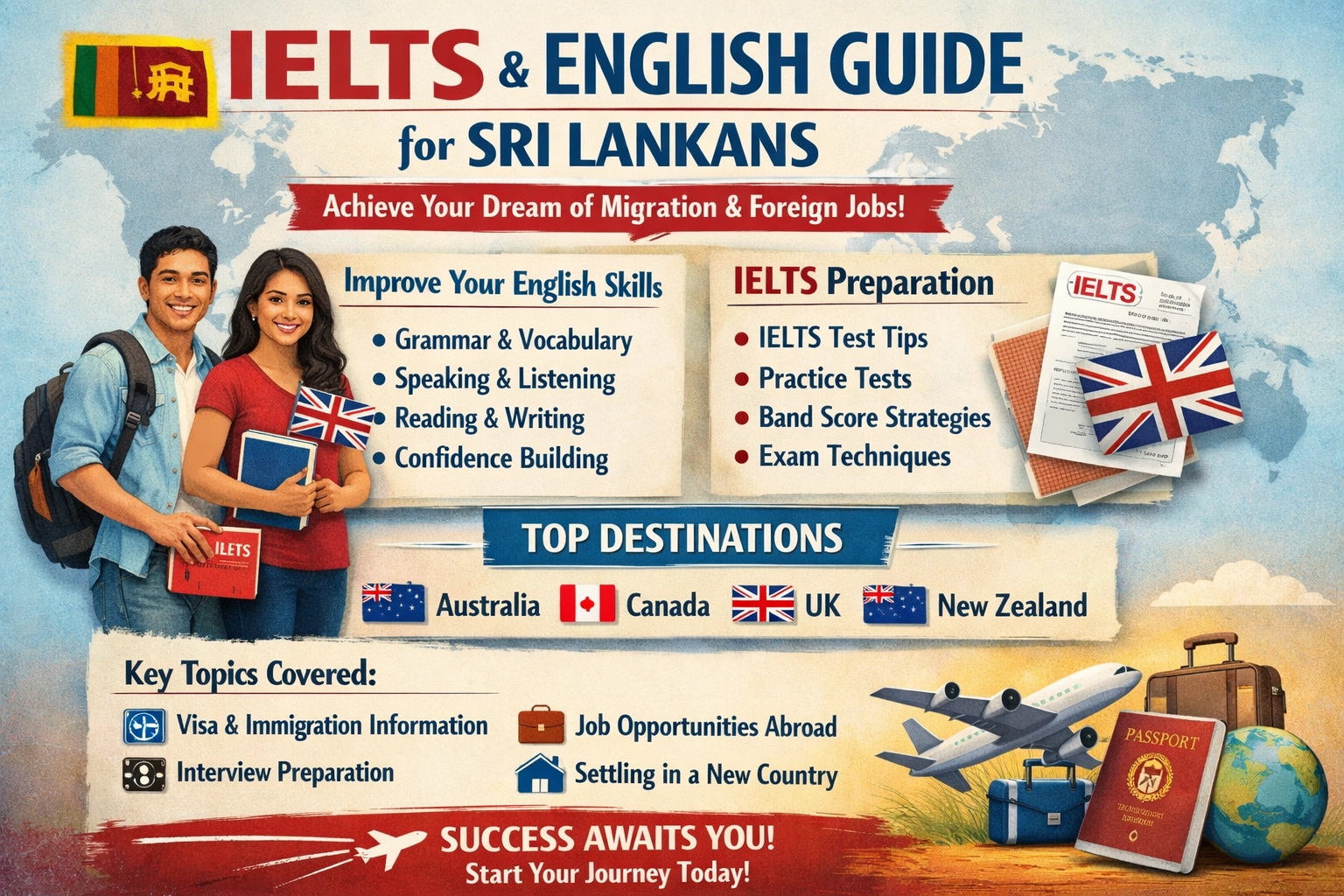
Understanding IELTS and Migration Pathways for Sri Lankans
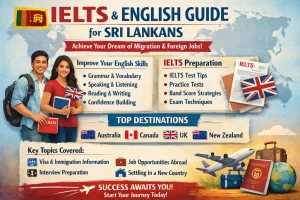
For Sri Lankans planning to migrate or work abroad, IELTS is often a key requirement for visas, professional registration, and job applications in countries such as the UK, Australia, New Zealand, Canada, and the United States.[1][3] Immigration authorities and employers use IELTS as proof that you can live and work effectively in an English-speaking environment.[1][3][4][6]
Why IELTS Matters for Migration and Foreign Jobs
Most English-speaking destination countries set minimum IELTS scores for:
- Skilled migration and permanent residency visas[3][4]
- Work visas and professional registration (e.g., nurses, engineers, accountants)[3][4][5]
- Study pathways that lead to post‑study work and PR options[1][4]
A higher IELTS score can:
- Improve your visa success rate[3][5]
- Increase points in points‑based systems like Australia[4][5]
- Open access to better jobs, higher salaries, and more competitive immigration programs[3][4]
IELTS Test Types and Which One You Need
There are several IELTS versions relevant to Sri Lankans; choosing the correct one is critical for your migration or job plan.
1. IELTS Academic
Purpose: Study and some types of migration or professional registration.[1][2][3]
- Required for university entry (undergraduate and postgraduate) in most English‑speaking countries.[1][2][4]
- Often used for professional registration (e.g., medical, health, and regulated professions).[2][3]
- Accepted for certain migration categories where academic or professional English must be demonstrated.[3][4][8]
2. IELTS General Training
Purpose: Migration, work, and training below degree level.[1][2][3][7]
- Commonly required for skilled migration and PR (e.g., Australia, New Zealand, Canada, UK visa categories).[1][3][4][5][7]
- Used for work visas and many employer‑based applications.[2][3][7]
- Relevant for vocational training and secondary‑level study abroad.[1][2]
3. IELTS for UKVI (Academic & General)
Purpose: UK visas where the UK Home Office requires a Secure English Language Test (SELT).[2][4][5]
- IELTS for UKVI (Academic): For university study and some professional registration in the UK.[2][4]
- IELTS for UKVI (General Training): For certain work, training, and migration routes to the UK.[2][5]
- Meets the UK government’s specific requirements for visa applications.[2][5]
4. IELTS Life Skills (UK)
Purpose: UK family, spouse, partner and some citizenship routes.[2][5]
- Tests only speaking and listening at CEFR levels A1 or B1.[2][5]
- Used for UK visas where basic communicative English, not full academic/work English, is required.[2][5]
Typical IELTS Score Requirements for Popular Destinations
Exact requirements vary by visa type, occupation, and institution, but the following band ranges are common benchmarks for Sri Lankans.[3][4][5]
| Country | Study (UG/PG) | Work / Job | Migration / PR |
|---|---|---|---|
| Australia | 6.0–6.5 (UG & PG, university dependent)[4] | 5.0–7.0 depending on visa & profession (e.g. 7.0 for many health roles)[4][5] | Minimum 6.0 for “Competent English”; 7.0 or 8.0 gives more PR points.[4][5] |
| Canada | 6.5 for UG, 6.5–7.0 for many PG programs.[4][8] | Often 6.0 (CLB 7) for post‑graduation work routes.[3][4] | Express Entry commonly needs 6.0 (CLB 7) or above; some programs require higher.[3][4] |
| New Zealand | 6.0 (UG), 6.5 (PG).[4] | Post‑study work visa may not always require IELTS, but employers may ask for proof of English.[4] | Skilled migration pathways often require 6.5 overall.[4] |
| United Kingdom | 6.0–6.5 (UG), 6.5–7.0 (PG).[4] | Skilled Worker visa typically B2 level, around 5.5–6.5 IELTS equivalent; Health & Care roles sometimes from 4.0–5.0 depending on category.[4][5] | English usually proven through earlier work/study visas; separate Life in the UK and English requirements may apply.[4][5] |
| Ireland & others | Generally 6.0–6.5.[4] | Employers may ask for minimum bands (often 5.0–6.0+) as proof of workplace English.[4] | Basic migration entry can start from around 5.0, but higher is advantageous.[4] |
For many migration or PR routes, an overall band of 6.0–7.0 with minimum sub‑scores is a common threshold, but competitive programs and regulated professions may demand 7.0+.[3][4][5][8]
IELTS Format and What It Tests
IELTS, whether Academic or General Training, has four sections and lasts about 2 hours 45 minutes.[1]
- Listening: Same for Academic and General; everyday and academic listening tasks.[1]
- Reading: Academic uses more formal, academic texts; General focuses on everyday and workplace reading.[1]
- Writing: Academic includes graphs/reports and essays; General focuses on letters and essays.[1]
- Speaking: Face‑to‑face interview; same for both Academic and General.[1][2]
You can take IELTS as a computer-delivered or paper‑based test in Sri Lanka; the format and scoring are the same.[1][2][9]
How IELTS Fits into Your Migration Strategy as a Sri Lankan
When planning migration or foreign employment, Sri Lankans should align IELTS with their long‑term pathway:
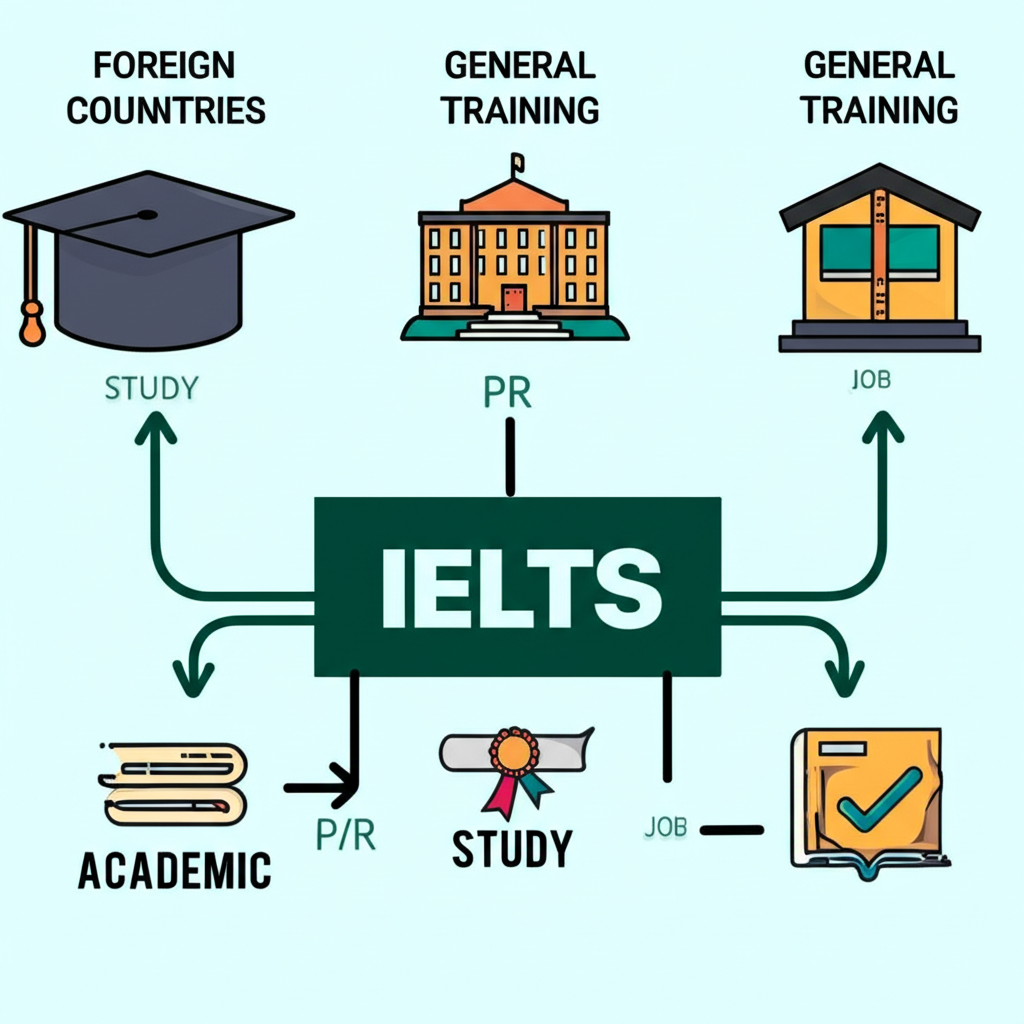
- Study → Post‑study Work → PR: Take IELTS Academic to enter university, then later meet General Training or PR‑specific score requirements.[1][2][4]
- Direct Skilled Migration / Work Visa: Focus on IELTS General Training at the band level required for your occupation and visa stream.[1][3][4][7]
- UK Family or Spouse Visas: Use IELTS Life Skills or IELTS for UKVI depending on the specific category.[2][5]
For Sri Lankan candidates, understanding which IELTS version and which target band score match your chosen country, visa type, and profession is the first step before starting serious English improvement and exam preparation.[1][2][3][4][5]
Common English Challenges Sri Lankans Face
Sri Lankans aiming for migration or foreign jobs often have a solid basic knowledge of English, but specific patterns in school education, exam-focused learning, and limited real-life exposure create repeatable weaknesses in IELTS and workplace communication. Addressing these typical Sri Lankan challenges directly can significantly improve both band scores and job readiness abroad.
1. Over‑reliance on Grammar, Under‑use of English in Real Life
Many Sri Lankan students study grammar rules for years but rarely use English for real communication outside the classroom. This leads to:
- Good knowledge of rules but difficulty speaking fluently and naturally in real situations.
- Slow writing and reading because every sentence is mentally “translated” from Sinhala or Tamil.
- Fear of making mistakes, which stops learners from speaking at all.
For IELTS and foreign jobs, exam boards and employers care more about clear, confident communication than “perfect” textbook grammar. Regular reading, writing, listening and speaking practice in English is essential, not just grammar exercises.[1][3]
2. Sinhala/Tamil Interference in Grammar and Sentence Structure
Direct translation from Sinhala or Tamil to English causes frequent errors in IELTS Writing and Speaking:
- Word order problems (putting verbs and objects in a Sinhala/Tamil pattern).
- Missing subjects (“Is raining now” instead of “It is raining now”).
- Tense inconsistency (jumping between past and present in the same sentence.
- Articles (“a”, “an”, “the”) often omitted or misused, which lowers grammatical range and accuracy scores.
In IELTS, these errors reduce your Grammar score even if your ideas are strong. Focused practice with model answers, feedback from tutors, and repeated rewriting of the same paragraph in correct English structure can gradually change these habits.[1][3][6]
3. Limited Vocabulary for Formal and Academic Topics
Many Sri Lankan candidates can manage everyday English, but IELTS and professional environments require broader vocabulary:
- Formal words for education, environment, health, economics, technology, law, and migration.
- Topic‑specific language for graphs, charts, and processes (e.g., “fluctuate”, “decline”, “proportion”, “trend”) in Writing Task 1.[1][3][6]
- Paraphrasing skills – using synonyms and different structures instead of repeating the same basic words.
Weak vocabulary makes essays repetitive and ideas unclear, reducing your Lexical Resource score in IELTS and your effectiveness in job interviews or workplace emails abroad.
4. Pronunciation, Accent, and Intonation Issues
A Sri Lankan accent is not a problem by itself; IELTS accepts all accents. The challenge is when pronunciation affects understanding:
- Confusing long and short vowels (“ship” vs “sheep”).
- Adding extra vowels to English words (e.g., saying “iskool” for “school”).
- Incorrect word stress, which makes speech difficult to follow.
- Flat intonation, making it hard to hear emphasis or emotion.
In IELTS Speaking, this reduces the Pronunciation band and can also affect Listening if you’re not used to different international accents (British, Australian, Canadian, etc.). Regular listening to diverse accents and recording your own speech for self‑correction are key strategies recommended by IELTS providers.[1][4][5]
5. Difficulty Understanding Different English Accents
In Sri Lanka, most learners hear a limited range of accents (often local teachers or specific British/American media). The IELTS Listening test and many foreign workplaces involve:
- British, Australian, New Zealand, North American, and mixed international accents.
- Fast, natural speech with connected words and reduced sounds.
- Background noise and multiple speakers in conversations.[1][4][5]
Without deliberate exposure, Sri Lankan test‑takers often miss important details in Listening sections, lowering their band score and making it hard to follow meetings or instructions abroad.
6. Reading Speed and Comprehension Challenges
Many students are used to slow, careful textbook reading, not fast reading under pressure. For IELTS Reading and foreign workplaces, the main problems are:
- Slow reading speed and running out of time in IELTS Reading.[3]
- Difficulty with long, academic texts from journals and newspapers, which IELTS commonly uses.[3]
- Weak scanning and skimming skills – not knowing how to quickly locate specific information or the main idea.[1][3]
- Confusion with question types like True/False/Not Given, Matching Headings, and Multiple Choice.[2][3]
For migration and jobs, similar skills are needed to understand contracts, emails, policies, and technical documents efficiently.
7. Writing for Exams vs. Writing for Real‑World Communication
Sri Lankan school writing often focuses on memorised essays and stories. However, IELTS and foreign employers expect:
- Clear structure – introduction, well‑organised body paragraphs, and conclusion.[1][3][6]
- Task achievement – answering the exact question, not giving a “prepared” essay.[1][3]
- Formal tone in letters, reports, and emails, instead of informal or overly poetic language.[3][6]
- Logical linking with connectors such as “however”, “therefore”, “on the other hand”, “consequently”.
Common Sri Lankan issues include memorised templates that don’t match the question, weak paragraphing, and mixing casual and formal styles in the same answer, all of which reduce IELTS Writing bands and look unprofessional in job applications abroad.
8. Speaking Anxiety and Lack of Confidence
Culturally, many Sri Lankans are shy to speak English in front of others, especially with a foreign examiner or interviewer. This leads to:
- Very short answers in IELTS Speaking, which limits the examiner’s ability to judge fluency.[1][6]
- Long pauses while translating from Sinhala/Tamil in the mind.
- Over‑memorised answers that sound unnatural and may be penalised in IELTS.
- Fear of mistakes, reducing practice opportunities at work or in social situations abroad.
IELTS providers strongly recommend regular speaking practice with real people, mock tests, and feedback to overcome this fear before test day.[1][2][4]
9. Time Management Across All Four Skills
Another pattern among Sri Lankan test‑takers is weak time management, both in the exam and in real‑life tasks:
- Spending too long on a single reading or listening question and missing others.[1][3]
- Over‑writing in Task 1 and having too little time for Task 2, even though Task 2 is worth more marks.[1]
- Not practising under timed conditions before the actual exam.[3]
For foreign jobs, similar issues appear when writing emails, completing reports, or following deadlines in English; slow processing in English can affect performance and promotions.
10. Limited Access to Quality Feedback and Resources
While Sri Lanka has many tuition classes, not all learners get accurate, exam‑focused feedback. Common problems include:
- Relying on unofficial tips and “shortcuts” instead of official IELTS guidelines.[1][3][5]
- Lack of personalised correction on essays and speaking, so mistakes are repeated.
- Not using free official materials from IDP, British Council and Cambridge, which are designed to match the real test.[1][3][4][5]
For migration or foreign jobs, this means candidates may sit the test multiple times, spend extra money, or miss opportunities because they never systematically fix their specific weaknesses.
11. Cultural and Communication Style Differences
Sri Lankan communication style is often indirect and very polite. In English‑speaking countries, expectations can be different:
- IELTS Speaking and job interviews reward clear, direct answers with opinions and examples, not just “Yes/No” or very short replies.
- Workplaces abroad may expect you to ask questions, clarify instructions, and speak up in meetings, which can feel uncomfortable at first.
- Writing requires clear, explicit statements instead of assuming the reader “understands” your background or context.
Learning to be politely direct in English is crucial for both higher band scores and successful integration into foreign workplaces.
How Overcoming These Challenges Helps Migration and Job Goals
When Sri Lankan learners consciously target these common problem areas with the right preparation strategy (mock tests, official materials, structured courses, and consistent self‑study), they are more likely to:
- Reach the IELTS band requirements set by immigration authorities and employers.[1][3][4][5][9]
- Perform strongly in job interviews and workplace communication abroad.
- Adapt faster to professional and social life in English‑speaking countries.
The rest of this guide will show how to design an improvement plan specifically for Sri Lankans that systematically addresses these challenges and builds real‑world English skills, not just exam tricks.

Building Strong Everyday English for Work and Life Abroad
IELTS is only one step in your migration journey. To succeed in a foreign job and daily life abroad, you need confident, practical English that goes far beyond exam strategies. As a Sri Lankan planning to migrate or work overseas, aim to build English you can use naturally at work, at home, and in your community.
1. Focus on Real-Life English, Not Only IELTS Tricks
IELTS preparation is useful because it forces you to practise reading, writing, listening and speaking in a structured way.[1][3] But do not limit yourself to only past papers and exam books.
- Use IELTS to understand your current level and exam format, then extend the same skills into real-life situations: emails, meetings, phone calls, and social conversations.[1][3]
- When you do IELTS practice, always ask: “How would I say this in a real office or in my everyday life abroad?”
- Balance your study time: for every hour of pure “IELTS practice”, add at least an hour of real-life English activities (news, podcasts, conversations, work-related materials).
2. Everyday Listening: Training Your Ear for Different Accents
Abroad, you will hear many accents—British, Australian, American, Canadian, European, and non-native accents.[1] Your goal is to understand the main message even when pronunciation, speed, or slang are different.
- Listen daily to English news (BBC, ABC, etc.), YouTube channels, and podcasts that use different accents.[1]
- Watch English movies and series with English subtitles first, then re-watch parts without subtitles to test yourself.[1]
- Practise “active listening”: pause and repeat phrases, imitate the speaker’s rhythm, and write down new expressions.
- Use short audio clips (1–3 minutes) and summarise in your own words, as if you are reporting to a manager.
3. Speaking Confidence: From “Book English” to Natural Conversation
To live and work abroad, you must be able to speak clearly, politely, and confidently in everyday situations—not only in a test room.
- Create or join an English-speaking group with friends or colleagues and agree to speak only English during meetups.[1]
- Practise common workplace situations:
- Introducing yourself in a new team
- Explaining your job role and experience
- Asking for clarification: “Could you please repeat that more slowly?”
- Disagreeing politely: “I see your point, but I’m not sure that will work because…”
- Record yourself answering typical IELTS Speaking topics—family, work, studies, plans—and then adjust your answers to sound more natural and less memorised.[2]
- Focus on fluency and clarity first; perfect grammar can come later. Being understood is more important than sounding “fancy.”
4. Reading Skills You Will Actually Use Abroad
Overseas life involves constant reading: emails, contracts, instructions, websites, forms, safety notices, and more. IELTS reading practice helps build speed and comprehension for such tasks.[1][3]
- Read English newspapers, job portals, and professional articles daily to increase your reading speed and vocabulary.[1][3]
- Practise scanning for specific information (dates, rules, numbers, names) and skimming for the main idea—exactly what you do in IELTS reading.[1][3]
- Read documents similar to what you will face abroad:
- Employment contracts and job descriptions
- Accommodation rental agreements
- University or college guidelines
- Government or visa instructions
- Keep a notebook (or digital note) for new words, with a short definition and a sentence you create yourself.
5. Writing for Work: Emails, Reports, and Everyday Messages
IELTS writing trains you to organise ideas, use paragraphs, and stay within a word limit—skills that are critical for professional communication abroad.[1][3]
- Practise writing:
- Formal emails to HR, managers, and clients
- Short reports or updates on tasks
- Complaint and request letters similar to IELTS General Training Task 1[1][3]
- Use clear structures:
- Greeting → Purpose → Details → Closing
- For reports: Introduction → Main points → Recommendation
- Check grammar, spelling, and tone. Aim for polite but direct language—especially important in English-speaking workplaces.
- Ask a teacher, mentor, or experienced colleague for feedback on your writing and rewrite your work to correct mistakes.[1][3]
6. Vocabulary for Migration, Work, and Daily Life
You need two broad types of vocabulary: general everyday English and job-specific English.
- Build everyday vocabulary for:
- Banking, shopping, transport, healthcare
- Renting a house, dealing with landlords and agents
- Schools, childcare, and community services
- Learn work-related terminology in your field (healthcare, IT, hospitality, construction, etc.), using job ads, training manuals, and professional websites.
- Do not try to memorise long word lists. Instead, learn in phrases:
- “meet the deadline,” “raise an issue,” “follow up on this”
- “check in with the client,” “comply with regulations”
- Recycle new words in your speaking and writing within 24 hours so they move from passive to active vocabulary.
7. Building Daily English Habits in Sri Lanka
Strong everyday English is built through consistent, long-term habits, not last-minute cramming before the test.[1][3]
- Set a realistic daily plan, for example:
- 15–20 minutes reading (news, articles)
- 15 minutes listening (podcast, video)
- 15 minutes speaking (self-recording or partner)
- 10–15 minutes writing (short email, journal entry)
- Use your commute or free time for English audio instead of only music in your first language.
- Change your phone and main apps to English to see common phrases repeatedly.
- Whenever possible, choose English in real life—order food in English, speak to customer service in English, and attend English-medium events or workshops.
8. Using Sri Lankan IELTS Resources Strategically
Sri Lanka has many IELTS preparation options—IDP, British Council, and private institutes offer classes, practice materials, and mock tests.[1][3][4][7][8] Use them not only to chase a band score, but also to build solid everyday English.
- Join a reputable IELTS or English course that emphasises all four skills and gives personalised feedback, not just tips and tricks.[1][3][7][8]
- Take mock tests regularly to measure progress and identify weaknesses, then focus your self-study on those areas.[1][3][8]
- Use free resources (practice tests, videos, and sample questions) from official providers to get familiar with authentic language and tasks.[1][3][4][8]
- If you are already upper-intermediate, consider intensive or express IELTS courses that target band 7+ while upgrading your academic and professional English.[2]
9. Cultural Communication: More Than Just Language
Working and living abroad also requires understanding communication style, not just grammar and vocabulary.
- Observe how English speakers:
- Give feedback and criticism
- Ask for help or clarification
- Express disagreement politely
- Use small talk at work (weekend, hobbies, weather, sports)
- Practise being clear and direct but polite, especially in professional emails and meetings.
- Learn key phrases for:
- Clarifying: “Do you mean…?”, “Just to confirm, you’d like me to…”
- Softening: “Perhaps we could…”, “Would it be possible to…”
- Closing: “Thank you for your time,” “I appreciate your help on this.”
10. Long-Term Perspective: English for a Better Life Abroad
For Sri Lankans targeting migration or foreign jobs, think of English as a life skill, not a one-time exam requirement. IELTS helps you prove your level to immigration and employers, but the English you build now will determine:
- How confidently you work in international teams
- How well you understand your rights, contracts, and responsibilities
- How easily you integrate into your new community and support your family
Start treating every English interaction in Sri Lanka—at work, online, or in class—as practice for the life you want to live abroad. Combine targeted IELTS preparation with real-world English habits, and you will arrive in your new country ready not only to pass tests, but to thrive in work and everyday life.

IELTS Module-by-Module Strategy for Higher Band Scores
IELTS has four modules – Listening, Reading, Writing and Speaking – in both Academic and General Training versions.[1][3][4][5][9] For Sri Lankans targeting migration or foreign jobs, you usually need IELTS General Training, but many professional registrations and study pathways require Academic.[3][5][8][9] The strategies below highlight what is common to both, and where General vs Academic differ.
1. Listening: Training Your Ear for Different Accents
The Listening module has 4 parts, about 30 minutes of audio + 10 minutes to transfer answers, with 40 questions in total.[1][3][4][5] Task types include multiple choice, matching, labelling maps/diagrams, and different completion questions.[1][2][4][6]
1.1 Common challenges for Sri Lankan candidates
- Difficulty catching British, Australian and New Zealand accents.
- Missing answers because of spelling and not following word limits (e.g. “NO MORE THAN TWO WORDS”).
- Losing focus during long recordings and getting confused when answers change (self‑correction in the recording).
1.2 Core exam strategy
- Always read the questions first during the short pauses before each part to predict what you will hear (names, numbers, locations, reasons, etc.).
- Look for keywords and paraphrases, not exact words; the recording rarely copies the question exactly.
- Be ready for self‑correction in the audio (e.g. “Thursday… no, actually Friday the 12th”). The last version is usually correct.
- Use the question type to guide listening:
- For maps/diagrams, quickly identify directions (left, right, opposite, next to).
- For form/table completion, anticipate what type of word fits (number, noun, verb).
- In the last 10 minutes, transfer answers carefully, checking spelling and word limits.
1.3 English & accent improvement (Sri Lanka–friendly)
- Listen daily (15–30 minutes) to news and podcasts in British/Australian English; mimic short phrases to copy rhythm and word stress.
- Use Sri Lankan context: listen to travel, university, and work-related conversations, similar to Parts 1 and 2 (social and training situations).[4][5]
- Write down what you hear (short dictation) to train your ear + spelling together.
2. Reading: Fast, Accurate, and Band‑Friendly
The Reading test has 3 sections, 40 questions, and 60 minutes with no extra time to transfer answers.[1][2][3][4][7] Both Academic and General Training include multiple question types like multiple choice, True/False/Not Given (or Yes/No/Not Given), matching headings, and various completion tasks.[1][2][4][6]
2.1 Academic vs General Training
- Academic: 3 longer passages from journals, newspapers, magazines and books; language and ideas are more scholarly.[1][3][4]
- General Training: texts about social survival (notices, advertisements, timetables), workplace survival (job descriptions, contracts, staff materials), and a longer general text (magazine, newspaper, book extract).[2][3][4]
2.2 Core exam strategy
- Time management: roughly 18–20 minutes per section; do not get stuck on one question.
- Use skimming for the main idea: read headings, first and last paragraphs, and first sentences of paragraphs.
- Use scanning for specific information: names, dates, numbers, and technical terms.
- For True/False/Not Given / Yes/No/Not Given, base answers only on the passage, not on your general knowledge.
- In matching headings, identify the paragraph’s main idea, not small details.
- Pay attention to paraphrasing – the question and passage will express the same idea using different words.
2.3 English reading improvement for Sri Lankans
- Read short English pieces daily on topics like migration, jobs, health, and education (similar to General Training Section 2 and 3 sources).[2][3][4]
- Learn to guess meaning of new words from context instead of translating into Sinhala/Tamil every time.
- Create a vocabulary notebook: record collocations (e.g. “apply for a visa”, “meet the requirements”) and use them in your writing and speaking.
3. Writing: Meeting Band Descriptors, Not Just “Good English”
The Writing test is 60 minutes with 2 tasks in both Academic and General Training.[1][3][4][5] Task 2 is always an essay and is worth more than Task 1, so it deserves about 40 minutes of your time.[5]
3.1 Academic vs General Training
- Academic Task 1: describe and compare information from a graph, chart, table, map or process.[1][3][4]
- General Training Task 1: write a letter or email (formal, semi‑formal or informal) for everyday or work situations.[1][3][5]
- Task 2 (both versions): a discursive essay where you must present and support an opinion, discuss problems and solutions, or evaluate arguments.[1][3][4][5]
3.2 How your writing is scored
Examiners use four main criteria:[4]
- Task achievement / Task response: Did you answer all parts of the question and develop ideas with clear examples?
- Coherence and cohesion: Are your ideas logically organised and connected with appropriate linking words?
- Lexical resource: Range and accuracy of vocabulary, including collocations and less common words.
- Grammatical range and accuracy: Variety and correctness of sentence structures, tenses, and punctuation.
3.3 Task‑specific strategy
Task 1
- Spend about 20 minutes; never sacrifice Task 2 time for Task 1.
- Academic: focus on overall trends, main comparisons and significant changes, not every number.
- General Training: identify the purpose and tone (complaint, request, information, apology, etc.) and include all bullet points in the prompt.
Task 2 (both Academic and General)
- Plan 5 minutes to brainstorm ideas and decide your position before writing.
- Use a clear structure: introduction, 2–3 body paragraphs, and a short conclusion.
- Support each main idea with a specific example, ideally linked to work, community, or Sri Lankan society.
- Avoid memorised templates; examiners can recognise unnatural, over‑rehearsed language.
3.4 English writing improvement in Sri Lankan context
- Write short texts often: emails, complaint letters, explanations (e.g. to HR, landlords, banks) to practise General Training style.
- Shadow real workplace English: use typical phrases such as “I am writing to enquire about…”, “I would like to draw your attention to…”, “I strongly believe that…”.
- Get feedback (teacher, online tutor, or peer) focused on grammar patterns Sri Lankans often misuse (articles, prepositions, verb tenses).
4. Speaking: Confident, Clear and Natural
The Speaking test is a face‑to‑face interview of about 11–14 minutes in 3 parts and is the same for Academic and General Training.[1][3][4][5][8][9]
4.1 Format overview
- Part 1 (Interview): questions about you, family, work, studies, home town, hobbies, etc.[1][4][5]
- Part 2 (Cue card): you get a topic and 1 minute to prepare, then speak for 90–120 seconds (up to 2 minutes).[1][4][5]
- Part 3 (Discussion): deeper questions related to the topic in Part 2; more abstract and analytical.[1][4][5]
4.2 What examiners look for
- Fluency and coherence: ability to speak at a natural pace, with logical organisation.
- Lexical resource: variety of vocabulary, ability to paraphrase if you do not know a word.
- Grammatical range and accuracy: mix of simple and complex sentences with reasonable accuracy.
- Pronunciation: clarity and intelligibility, not a “foreign” accent; Sri Lankan accent is acceptable if you are easy to understand.
4.3 Core exam strategy
- In Part 1, give answers slightly longer than one sentence; show natural conversation, not memorised mini‑speeches.
- In Part 2, use your 1 minute to write 5–6 bullet points; in your talk, follow them rather than reading.
- For Part 3, use signposting language like “In my opinion…”, “On the other hand…”, “The main reason is…”.
- Do not worry about making occasional mistakes; correct yourself naturally and keep going.
4.4 English speaking improvement in Sri Lanka
- Build a habit of daily speaking practice with friends, colleagues, or study partners fully in English, especially about work, travel, and migration topics.
- Record yourself answering sample IELTS questions and listen critically to identify pronunciation and grammar issues.
- Practise code‑switching control: during practice, avoid shifting back to Sinhala or Tamil; force yourself to find English paraphrases.

5. Combining Modules for Overall Band Improvement
- Set a target band based on the requirements of your migration program or employer (e.g. overall 7.0 with 7.0 in each band).
- Use one practice test every 1–2 weeks to check progress across all four modules rather than only your strongest skill.
- Let stronger skills (e.g. Reading) support weaker ones: use reading to collect vocabulary for Writing and Speaking, listening to improve pronunciation, etc.
- Plan study time around your work schedule in Sri Lanka (e.g. shorter daily sessions on weekdays, longer practice tests on weekends).
Study Plans, Resources and Classes Available in Sri Lanka
This section focuses on practical, Sri Lanka–specific ways to improve your English and IELTS score, especially if you are targeting migration or foreign jobs. It combines self-study plans, online tools, and local class options so you can choose a path that fits your budget, time, and current level.
1. Structuring Your Study Plan in a Sri Lankan Context
1.1. Decide your timeline and target band
- Band target: Most migration and foreign job pathways require at least IELTS 6.5–7.0 overall, and sometimes 7.0 or above in each skill. Check your visa or job requirement first, then set a clear band target.
- Realistic timeframe:
- Current level around 5.0: Plan for about 4–6 months of serious study.
- Current level around 6.0: Plan for 2–3 months of focused IELTS preparation.
- Below 5.0: Spend at least 3–6 months on general English improvement first, then 2–3 months on exam techniques.
- Study load for working adults: Aim for 1–2 hours on weekdays and 3–4 hours on weekends. If you work shifts in hospitals, factories or BPOs, block out fixed “English time” directly after or before your shift.
1.2. Weekly skill‑balanced plan
Use this as a base and adjust according to your weaknesses:
- Listening (4–5 hours/week): 2 full IELTS practice tests + daily short listening (news, podcasts, YouTube in English).
- Reading (4–5 hours/week): 2–3 full Academic/General modules + 20–30 minutes of daily reading (articles, reports, job-related texts).
- Writing (4–5 hours/week): 3–4 Task 1 answers + 3–4 Task 2 essays per week, with feedback if possible.
- Speaking (3–4 hours/week): 3–4 mock tests (Part 1–3) with a partner or teacher + daily 10–15 minutes of speaking aloud on any topic.
- Vocabulary & grammar (3 hours/week): Topic-based vocabulary (migration, health, technology, business) + correcting errors from your own writing and speaking.
1.3. Short study plans by time available
- If you have 1 month only (urgent intake/job deadline):
- Take at least one diagnostic test in test conditions.
- Focus almost entirely on exam technique and practice tests, not general English.
- Book intensive classes or 1–1 coaching if you can afford it.
- If you have 3 months:
- Month 1: Fix grammar, build vocabulary, familiarise with all question types.
- Month 2: Timed practice for all skills, start getting regular feedback on writing and speaking.
- Month 3: Full mock tests twice a week, fine-tune weak skills.
- If you have 6+ months:
- First half: Strong focus on general English (reading, listening, speaking) and correcting fossilised mistakes common among Sri Lankan learners.
- Second half: Structured IELTS course + test practice.
2. Local IELTS Classes and English Courses in Sri Lanka
Sri Lanka has a range of IELTS preparation and English improvement options, from British Council and IDP to private academies and regional institutes.
2.1. British Council courses and test centres
The British Council Sri Lanka offers IELTS tests and related preparation courses in Colombo, Kandy, Jaffna and other major cities, with both paper‑based and computer‑delivered options.[3] The main computer‑delivered test centres include:
- Colombo: British Council Colombo and Australian College of Business and Technology (ACBT).[3]
- Kandy: British Council Kandy and ACBT Kandy.[3]
- Other cities: Batticaloa (Headway School of Languages), Malabe, Negombo, Gampaha, Kurunegala, Jaffna, Matara host British Council computer‑delivered venues.[3]
British Council also has IELTS registration centres where you can register and pay exam fees in person, which is useful if you do not want to use online payments.[8]
2.2. IDP Education IELTS test centres and services
IDP Education is another official IELTS partner operating multiple test centres across Sri Lanka.[5][7]
- IDP Battaramulla office (Colombo area) is an official IELTS test centre.[7]
- Other IDP centres include Colombo, Kandy (IELTS on Computer), Jaffna and more, providing both test bookings and preparation support.[5]
Both British Council and IDP offer official preparation materials, advice sessions, and online resources that align directly with the test format.[3][5]
2.3. Private IELTS institutes and academies
Many Sri Lankan students choose private institutes that specialise in IELTS, often with flexible schedules and lower fees than large international organisations.
- Unex College of Higher Education (Kurunegala)[1]
- Offers a range of IELTS preparation courses (online and on‑campus) tailored to students’ current English proficiency.[1]
- Has prepared more than 5000 students since 2006, claiming a 96% success rate.[1]
- Acts as an award‑winning partner of the British Council and is associated with Cambridge ESOL and Trinity College London exams.[1]
- Useful for students in Kurunegala and surrounding districts who need local or hybrid classes.[1]
- Master IELTS (online‑focused)[4]
- Runs an IELTS Express course designed to prepare upper‑intermediate to advanced students in about 5 weeks, targeting an average score around band 7.0.[4]
- Uses international trainers and interactive lessons (quizzes, discussions, multimedia) and positions itself as affordable for Sri Lankan learners.[4]
- Suitable if you already have good English and want a short, intensive course.
- The British English IELTS Academy (The Wave Training Sri Lanka)[9]
- Acts as the language wing of The Wave Training Sri Lanka, which focuses on corporate and soft skills training.[9]
- Provides IELTS and general English training with an emphasis on workplace and communication skills, useful for foreign job preparation.[9]
In addition, there are many smaller institutes in cities like Gampaha, Negombo, Matara, Batticaloa and Jaffna that offer IELTS and spoken English classes. When choosing, check:
- Teacher qualifications and experience with Sri Lankan candidates.
- Past band score results of students, especially those targeting migration and nursing/IT/hospitality jobs.
- Class size (smaller classes generally give better speaking and writing feedback).
- Access to mock tests under exam conditions.
3. Test Centres and How to Use Them in Your Plan
3.1. Locating a nearby IELTS test centre
Sri Lanka has multiple official IELTS centres run by British Council and IDP.[2][3][5]
- According to one listing, there are around 14 centres offering paper‑based or computer‑delivered IELTS tests in Sri Lanka, including Colombo, Kandy, Negombo, Jaffna, Batticaloa and more.[2]
- British Council lists nine test centres for IELTS on computer across cities such as Colombo, Kandy, Batticaloa, Malabe, Negombo, Gampaha, Kurunegala, Jaffna and Matara.[3]
- IDP also shows multiple locations (Battaramulla, Colombo, Kandy, Jaffna, etc.) where you can take IELTS, often with computer‑delivered options.[5][7]
3.2. Integrating test centre access into your study plan
- Choose test mode: If you type faster than you write by hand, consider IELTS on computer in centres like Colombo, Kandy, Batticaloa, Kurunegala, etc.[3]
- Book early: Test dates can fill quickly, especially near major migration deadlines. Book a test date that is at least 4–8 weeks after you start intensive preparation.
- Visit the centre (if nearby): If possible, visit once before test day to understand location, travel time and environment, reducing anxiety on the actual day.
- Use centre resources: Both British Council and IDP provide free or low‑cost workshops, sample tests and online practice materials linked to their test centres.[3][5]
4. Self‑Study Resources for Sri Lankan Learners
4.1. Official IELTS practice materials
- British Council and IDP offer free practice tests and sample questions online that match the real exam format.[2][3][5]
- Use these for:
- Initial diagnostic testing to find your current band.
- Weekly timed practice under exam‑like conditions.
- Learning the exact instructions and answer formats used on test day.
4.2. General English improvement resources
To move from “Sri Lankan classroom English” to the level needed for migration and foreign employment, combine IELTS‑specific practice with general English exposure:
- Listening & speaking: International news channels, English interviews, podcasts, and YouTube channels focusing on IELTS or professional English.
- Reading: News articles, opinion pieces, health/IT/business magazines, and online reports similar in length and style to IELTS texts.
- Writing: Keep a daily English journal and rewrite your own essays based on teacher or model answer feedback.
- Pronunciation: Record yourself speaking and compare with native or near‑native examples; pay attention to clarity rather than copying an accent.
4.3. Using Sri Lankan context to your advantage
- Local study groups: Form WhatsApp or Telegram groups with friends or colleagues preparing for migration (nurses, IT professionals, mechanics, etc.) to share resources and practise speaking.
- Work‑related English: If you are a nurse, hotel worker, IT engineer, driver, or construction worker, collect English terms and expressions relevant to your field and practise explaining your job in English.
- Budgeting: Combine free online resources + a short intensive paid course (for feedback on writing/speaking) instead of paying for long, expensive programs if money is tight.
5. Choosing Between Classes and Self‑Study
5.1. When classes are strongly recommended
- You have attempted IELTS before and are stuck at the same band.
- You struggle with task achievement and coherence in writing, or get low speaking scores.
- You need specific scores for visas such as UK, Canada, Australia, New Zealand, where half‑band differences matter.
- You prefer structured guidance and accountability.
5.2. When self‑study may be enough
- Your current level is already around 6.5 or higher and you are familiar with English in your job or studies.
- You mainly need to learn exam strategy and timing, not basic grammar or vocabulary.
- You can access reliable practice materials and are disciplined with a schedule.
6. Practical Steps to Start Today
- Check your required band score for your target country and job.
- Take a full practice test from British Council or IDP to estimate your current band.[2][3][5]
- Select a test centre and target date (British Council or IDP; city closest to you).[2][3][5]
- Choose a suitable course or academy (e.g. British Council, IDP support classes, Unex in Kurunegala, Master IELTS online, The British English IELTS Academy, or another reputable local institute).[1][3][4][9]
- Set a weekly timetable balancing listening, reading, writing, speaking and vocabulary.
- Review progress every 2–3 weeks and adjust: if writing or speaking bands are lower, shift more time and seek personalised feedback.
Test-Day Tactics, After-Results Plan and Long-Term English Growth
1. Test-Day Tactics: How to Maximise Your Band in One Critical Day
1.1 The 24 Hours Before the Test
The day before your IELTS, do not try to “cram” new English. Focus on light review (sample questions, key structures, common essay plans) and go to bed early so you arrive mentally fresh and calm.[1]
Prepare your documents and logistics in advance:
- Keep your passport or NIC (the ID you used for registration) ready and in your bag.
- Confirm your test venue, reporting time, and transport (bus/train schedule, or taxi).
- Plan to arrive at least 30–45 minutes early to handle registration and security checks without stress.[1]
- Sleep 7–8 hours, drink enough water, and eat light but filling meals (avoid heavy, oily food that might make you sleepy).
1.2 At the Test Centre: Mindset and Focus
As soon as you sit down, remind yourself of two key points:
- You are not aiming for perfection – you are aiming for your target band. If you make a mistake, keep going; do not panic or look back repeatedly.
- Time management is as important as English level. Many Sri Lankan candidates lose bands simply because they leave questions blank.[1]
1.3 Listening: Tactics for Different Accents and No Second Chance
The Listening recording is played once only, so every second counts.[1]
- Before each section starts, quickly read the questions so you know what information to listen for (names, numbers, reasons, advantages, etc.).[1]
- Use the question paper for short, clear notes – note only key words, not full sentences.[1]
- If you miss an answer, do not freeze; move to the next one immediately and try to re‑focus. Guess later if needed.
- Watch for paraphrasing – the speaker rarely uses the exact words from the question.
- Be careful with spelling and word limits (“NO MORE THAN TWO WORDS AND/OR A NUMBER”). One extra word can make the whole answer wrong.
1.4 Reading: Speed, Strategy and Question Order
Reading is where many candidates in Sri Lanka struggle with time. Use a clear, repeatable system:[1][2]
- Skim first: In 1–2 minutes, read headings, first and last lines of paragraphs to understand the general topic and structure.[1]
- Then read questions and underline keywords (names, dates, specific terms).
- Use scanning to locate where the answer is, then read that part carefully for detail.[1]
- Do not get stuck on one tough question – mark it, move on, and come back if you have time.
- For True/False/Not Given or Yes/No/Not Given:
- False / No: passage contradicts the statement.
- Not Given: passage does not fully support or contradict – the information is incomplete.
- Keep an eye on the clock; aim to finish each passage in roughly one third of the total time.
1.5 Writing: Band-Saving Time and Structure Discipline
Writing is critical for migrants and foreign job seekers because immigration and employers often focus on writing band. Use a strict plan:[1]
- Spend 20 minutes on Task 1 and 40 minutes on Task 2. Task 2 has more weight; never sacrifice Task 2 to “perfect” Task 1.
- Plan before writing (3–5 minutes):
- Task 1: Identify main trends or key features; group information logically.
- Task 2: Decide your clear position and 2–3 main ideas with examples.
- Use a clear paragraph structure:
- Task 1: Introduction, overview (main features), then details paragraphs.
- Task 2: Introduction, 2–3 body paragraphs, short conclusion.
- Check the task requirements:
- Do not write below the word limit (at least 150 for Task 1, 250 for Task 2).
- Answer the question directly – no memorised essays; examiners can recognise them.
- Use the final 3–5 minutes to check grammar, spelling, and linking (and correct obvious mistakes).
1.6 Speaking: Confidence, Fluency and Cultural Nuances
Many Sri Lankans are shy or afraid of “wrong English”, but the Speaking test rewards communication, not perfection.[1][2]
- Greet the examiner politely and relax; they are not trying to fail you.
- In Part 1, keep answers short but not “yes/no” only – give 1–2 sentences extra information.
- In Part 2 (long turn):
- Use the 1 minute to write 6–8 keywords (not full sentences).
- Speak for the full 1–2 minutes; if you stop early, you limit your band for fluency.
- In Part 3, show higher-level thinking:
- Compare Sri Lanka and other countries.
- Discuss causes, effects, and solutions.
- Do not worry about your accent; focus on clarity, correct grammar ranges, and natural linking words (“however”, “on the other hand”, “for example”).[2]
1.7 Managing Stress During the Test
- If you feel panic, take 3 deep breaths and re‑focus on the question in front of you.
- Do not compare yourself with others in the room – you all have different goals and backgrounds.
- Remember: one difficult section does not destroy your whole score; keep giving your best in every section.
2. After-Results Plan: What to Do With Your Score
2.1 Understanding Your Band Scores
Your Test Report Form shows a band for each skill (Listening, Reading, Writing, Speaking) and an overall band.[1]
For migration and foreign jobs, typical targets are:
- Band 6.0–6.5: entry level for many jobs and some study pathways.
- Band 7.0+: often required for skilled migration, professional registration (e.g. healthcare), or competitive positions.
Check the exact requirement of:
- Immigration authority (e.g. country’s official website).
- Professional body (nursing council, engineering board, etc.).
- Employer or recruitment agency.
2.2 If You Achieved or Exceeded Your Target
- Secure your documents:
- Keep original Test Report Form safe.
- Scan a clear copy for digital use.
- Immediately update your CV and LinkedIn with your IELTS band (e.g. “IELTS Academic Overall 7.5, L8.0 R7.5 W7.0 S7.0”).
- Start or continue your visa / job application process while the result is valid (usually 2 years – confirm for your target country).
- Do not stop practising English – higher English can help you adapt faster when you move abroad.
2.3 If You Missed Your Target (e.g. 6.5 Instead of 7.0)
This is common and fixable. Treat the result as data, not a failure.
- Identify your weakest skill. For example, many Sri Lankans score lower in Writing or Speaking.
- Analyse why:
- Did you run out of time?
- Did you misunderstand question types?
- Do you lack vocabulary or grammar range?
- Consider an Enquiry on Results (EOR) if:
- Your Writing or Speaking is much lower than other skills.
- You are confident your performance was much better than the band given.
Remember there is a fee, and the band can go up, down, or remain the same. Only choose this if you have a strong reason.
- Create a focused improvement plan of 6–12 weeks targeting your weak skill(s), then book a new test when your mock tests consistently reach your target band.[1][2]
2.4 Designing a 4–12 Week “Gap Plan” Before Retaking
Instead of immediately rebooking, use the gap wisely:
- Weeks 1–2: Diagnose and learn.
- Do full mock tests for each skill, review answers, and note patterns of errors.[1][6]
- Study official band descriptors and task types, especially for Writing and Speaking.[2][5][6]
- Weeks 3–8: Targeted practice.
- Focus 60–70% of your time on your weakest skill.
- Use timed practice to simulate test conditions.[1][2]
- Get feedback from a teacher, experienced friend, or IELTS preparation course.[3][5]
- Weeks 9–12: Test simulation and polishing.
- Do full practice tests under real timing once a week.[1][6]
- Fine‑tune exam strategies and work mainly on reducing common errors.
2.5 When to Invest in Coaching or Courses
Self-study is effective, but some candidates benefit from professional guidance, especially if they are stuck at the same band.[1][2]
- If Writing or Speaking is your weak area, consider:
- IELTS preparation courses or workshops in Sri Lanka that offer targeted training and feedback.[3][5]
- Online coaching or correction services that review your essays and speaking recordings.
- Choose providers who use official criteria, give detailed feedback, and have experience with Sri Lankan learners.
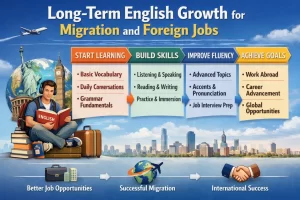
3. Long-Term English Growth for Migration and Foreign Jobs
3.1 Thinking Beyond IELTS: Why Long-Term English Matters
For migration or foreign employment, English is not only for the test; it is essential for:
- Passing professional exams and training courses abroad.
- Communicating with colleagues, clients, and supervisors.
- Understanding contracts, safety instructions, and legal documents.
- Building social networks, adjusting to a new culture, and supporting your family overseas.
Long-term growth requires a shift from “IELTS only” to continuous language development in real-life situations.[1][2]
3.2 Building Daily English Habits in Sri Lanka
You do not need to be abroad to immerse yourself in English. You can create an English environment at home and in your community.[1][2]
- Listening:
- Watch English news, documentaries, and TV shows regularly.
- Use podcasts and YouTube channels with different accents (British, Australian, Canadian, American) – useful for both IELTS and real life.[1]
- Reading:
- Read English newspapers (local or international), articles, and blogs on topics you enjoy.
- Include serious topics like environment, economy, technology to match IELTS and workplace vocabulary.[2]
- Writing:
- Keep a short daily journal in English.
- Write emails, reports, or essays related to your profession in English and ask for feedback when possible.
- Speaking:
- Use English intentionally with friends or family members who are also preparing for migration.
- Join local or online English conversation clubs or IELTS study groups.[2]
3.3 Profession-Specific English for Sri Lankans
Different migration and job pathways require different English strengths:
- Healthcare professionals (nurses, doctors, caregivers):
- Focus on medical vocabulary, patient communication, and report writing.
- Practise role-plays of patient interviews and explaining procedures.
- Engineers and IT professionals:
- Read technical articles and documentation in English.
- Practise explaining complex ideas in simple English for meetings and presentations.
- Hospitality and customer service workers:
- Practise common phrases for greeting customers, handling complaints, and giving information.
- Watch videos of real customer service situations abroad.
- Skilled trades (electricians, mechanics, construction):
- Learn safety vocabulary and instructions in English.
- Practise describing tools, processes, and problems.
3.4 Using Free and Low-Cost Resources Effectively
Many useful resources are free or affordable if used consistently.[1][2][5][6]
- Official IELTS platforms:
- Practice tests, videos, webinars, and sample questions for continuous improvement – even after your exam.[1][2][5][6]
- Apps and websites:
- Vocabulary apps for daily new words and spaced repetition.
- Grammar practice apps for strengthening weak areas.
- Local resources in Sri Lanka:
- British Council and IDP materials, workshops, and seminars.[1][3][5]
- Public libraries with English books, newspapers, and magazines.
3.5 Long-Term Progress Tracking
To keep improving over months and years:
- Set clear, realistic goals (e.g. “Increase overall from 6.0 to 7.0 in 12 months”).
- Review your progress monthly:
- Check if your reading speed has improved.
- Record short speaking clips every month and compare fluency and accuracy.
- Collect your writing pieces and see if common errors are decreasing.
- Adjust your learning plan when progress is slow – add new methods like group classes or 1‑to‑1 coaching.[2][3]
3.6 Preparing for Life Abroad: Culture and Communication
Strong English also includes understanding how people communicate in different cultures:
- Watch content created in your target country to understand politeness, humour, and typical phrases.
- Practise polite but direct communication (important in many Western workplaces).
- Learn how to ask for clarification (“Could you please repeat that?”) and how to say when you don’t understand – this is respected, not judged.
3.7 Keeping Motivation High
Migration is a long journey, and English improvement is a marathon, not a sprint.[1]
- Celebrate small wins: higher mock scores, successful presentations, compliments on your English.
- Connect with other Sri Lankans who are successfully working or studying abroad and learn from their experiences.
- Remember: every hour of serious English practice now will make your life easier and more successful when you move overseas.