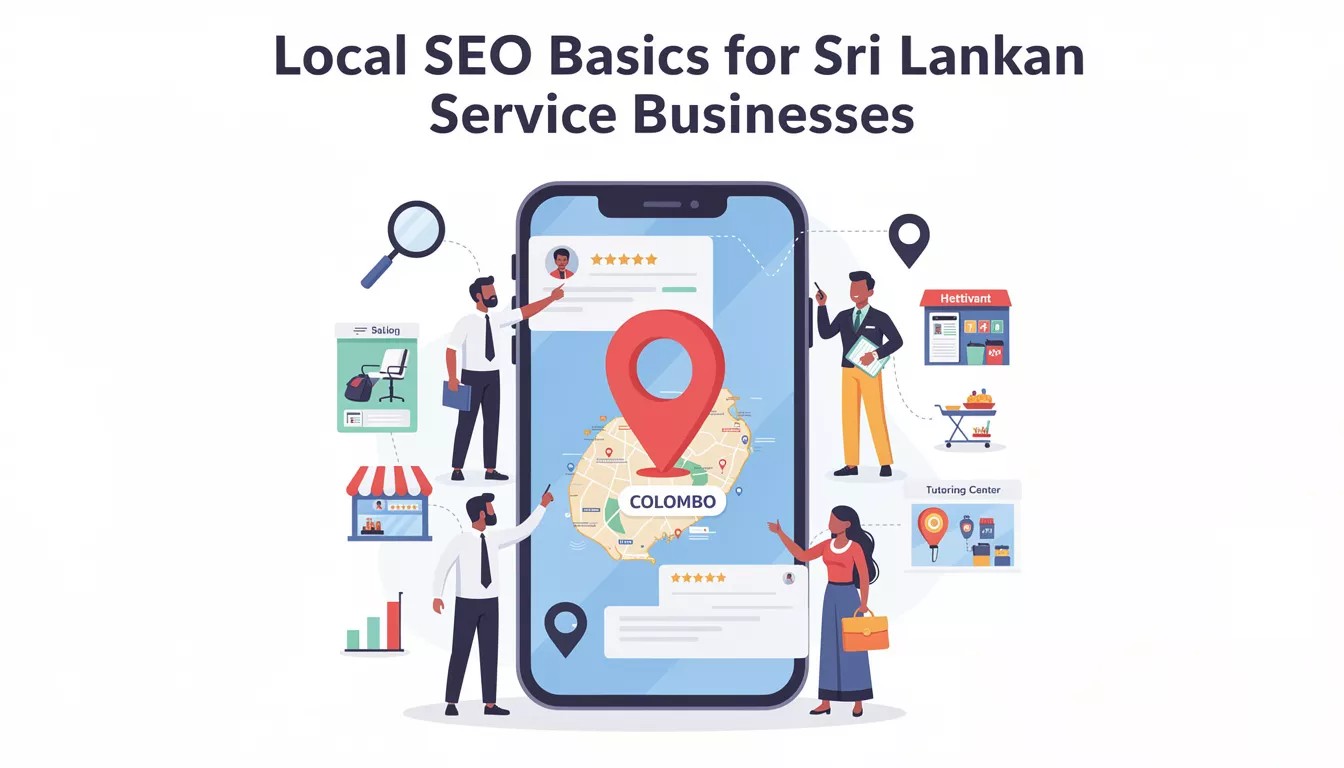
Local SEO Basics for Sri Lankan Service Businesses
Local SEO helps Sri Lankan businesses appear when customers search “near me” or “[service] in [city]”. For plumbers, clinics, tuition classes, salons, garages and agencies, this can be the highest‑converting source of leads. A few structured actions can dramatically improve local visibility.joomlasrilanka
Step 1: Optimise Your Google Business Profile
Your Google Business Profile is often seen before your website. It powers map results, knowledge panels and “Call” buttons on mobile.
Essentials:
- Use your exact business name (no keyword stuffing).
- Add primary and secondary categories (e.g., “Web designer”, “Marketing agency”).
- Verify your address or service area.
- Add phone number, WhatsApp, website and business hours.
- Upload high‑quality photos of your office, team and work.
Regular updates (posts, offers, events) show Google that your business is active.joomlasrilanka
Step 2: Ensure NAP Consistency and Local Citations
NAP stands for Name, Address, Phone. These details must be consistent across your website, Google profile, directories and social media bios.
Local citation actions:
- Update info on popular Sri Lankan directories, marketplaces and classified sites.
- Fix old or duplicate entries with outdated addresses or phone numbers.
- Use the same formatting everywhere (no random variations).
Consistency builds trust and helps search engines confidently associate your business with a specific location.joomlasrilanka
Step 3: Create Location‑Optimised Landing Pages
Service businesses serving multiple areas should avoid stuffing all locations on one page. Instead, create specific location pages.
Example structure:
- “Web design company in Colombo”
- “Web design company in Gampaha”
- “Web design services in Kandy”
Each page should include:
- Localised headline and intro text.
- Mention of specific neighbourhoods or landmarks.
- Local testimonials or clients if available.
- Embedded map or area coverage section.
This helps you rank for “[service] + [city]” searches and converts better because visitors see you understand their area.joomlasrilanka
Step 4: Use Reviews as a Local Ranking and Conversion Signal
Reviews not only influence rankings but heavily impact user trust. A few strong reviews in Sinhala and English can outperform a high number of weak or generic reviews.
Best practices:
- Ask happy customers to leave reviews (after successful project or visit).
- Reply to all reviews, positive or negative, professionally.
- Use keywords naturally in responses (e.g., “Thank you for choosing us for your web design project in Gampaha”).
Show review snippets on your website to reinforce credibility.joomlasrilanka
Step 5: Add Local SEO Elements to Your Website
Your site should support the same local signals as your profiles and citations.
Elements to include:
- Full address and phone number in the footer and contact page.
- Schema markup for Local Business, including geo and contact info.
- Driving directions or embedded map on the contact page.
- Clear mentions of service areas on relevant pages.
These signals make it easier for search engines to match your business with local queries.joomlasrilanka
Step 6: Track Local Performance and Adjust
Use analytics and built‑in insights to track whether your local SEO is working.
Watch:
- Calls and website visits from Google Business Profile.
- Organic traffic to your location landing pages.
- Number of “near me” and “[service] + [city]” keywords sending traffic.
If some locations underperform, improve content, add more local photos/testimonials and get a few more reviews from that area.joomlasrilanka
Partnering with a web design company in Sri Lanka such as Mobiz International – Web Design Company in Sri Lanka helps ensure your technical SEO, design and local optimisation are aligned instead of treated as separate projects.joomlasrilanka
Suggested references (non‑Sri Lankan agency sources)
- Google Business Profile guidelines
- General local SEO resources from global SEO blogs (Moz, BrightLocal, etc.)
If you like, the next step can be to pick one of these guides and expand it to a 1,000–1,200 word fully polished article with more examples and internal‑link anchor suggestions tuned to your existing content.