
For many Sri Lankans, the journey to Australia isn’t just about a career—it’s about reuniting with a loved one. Whether you have married an Australian citizen, are in a long-term de facto relationship, or are planning to wed your fiancé(e), the Australian Partner Visa is the specialized pathway designed to bring you together. In 2026, this program remains one of the most significant routes for migration, offering a multi-stage process that leads directly to Permanent Residency (PR).
However, the Australian Department of Home Affairs is meticulous when it comes to relationship-based visas. It isn’t enough to simply have a marriage certificate from a registrar in Colombo or Kandy; you must provide “Decision-Ready” evidence that your commitment is genuine and continuing to the exclusion of all others. With application fees now exceeding AUD 9,000, the stakes are high, and a refusal can lead to long-term legal complications and emotional stress.
This 1,500-word guide details the different subclasses (309/100, 820/801, and 300), the “four pillars” of relationship evidence required by case officers, and the specific challenges faced by Sri Lankan couples during the 2026 processing cycle.
The Three Main Pathways
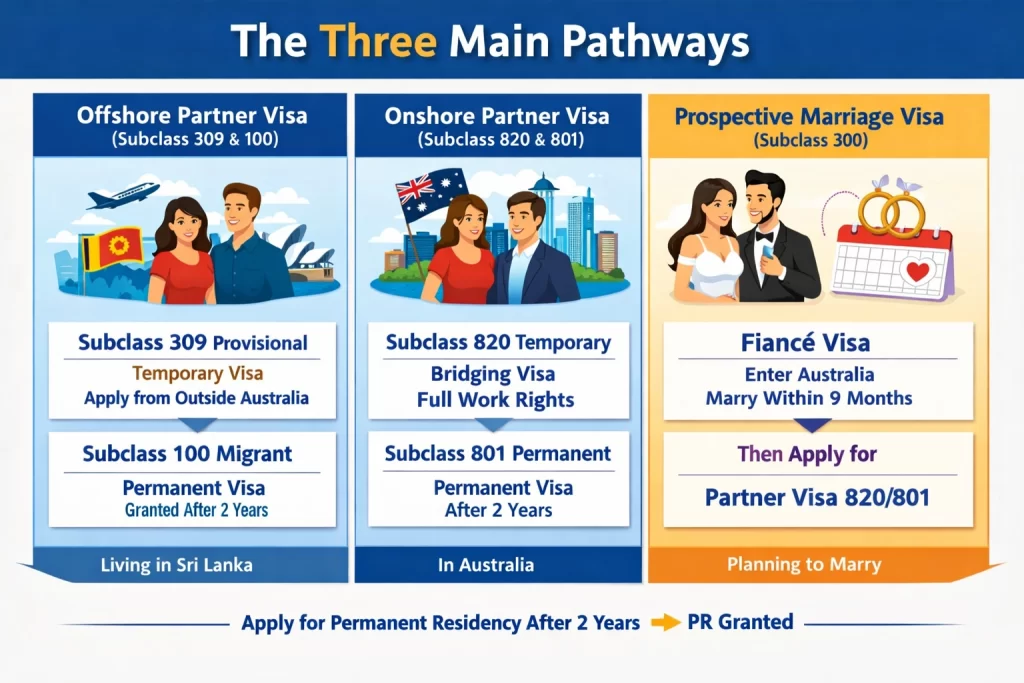
Depending on where you are located and your current marital status, you will fall into one of three primary visa categories. In all cases, you apply for the temporary and permanent stages at the same time.
1. Offshore Partner Visa (Subclass 309 & 100)
This is the most common route for Sri Lankans currently living in Sri Lanka. You apply while outside Australia. Subclass 309 (Provisional): This is the first stage. It allows you to move to Australia, work, and study while you wait for the permanent stage. Subclass 100 (Migrant): This is the permanent stage, usually granted two years after you first applied if the relationship is still ongoing.
2. Onshore Partner Visa (Subclass 820 & 801)
If you are already in Australia on another valid visa (like a Student or Graduate visa) and you are in a relationship with an Australian, you apply onshore. Subclass 820 (Temporary): This allows you to stay in Australia legally while your application is processed. You are usually granted a Bridging Visa with full work rights during this period. Subclass 801 (Permanent): The final PR stage, assessed two years after the initial lodgement.
3. Prospective Marriage Visa (Subclass 300)
Commonly known as the “Fiancé Visa,” this is for couples who are not yet married but intend to marry in Australia. The Condition: You must enter Australia and marry your partner within 9 months of the visa grant. Once married, you then apply for the Onshore Partner Visa (820/801).
The “Four Pillars” of Relationship Evidence
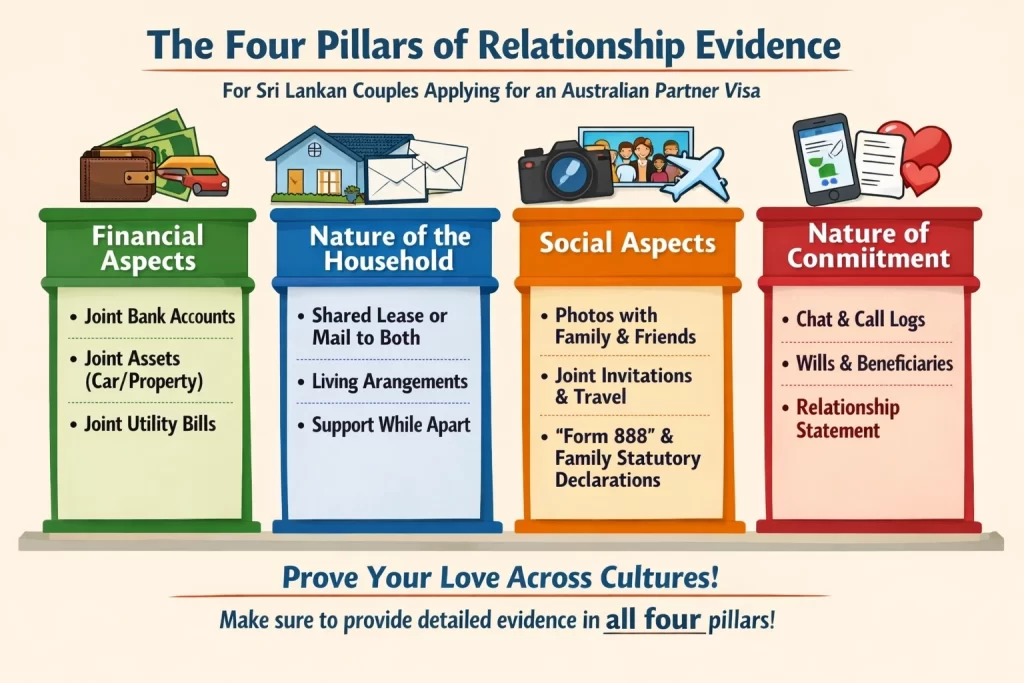
Australian case officers assess your relationship based on four distinct categories. For Sri Lankan couples, providing “social evidence” often requires extra effort to translate cultural norms into the format Australia expects.
1. Financial Aspects
You must show that you share financial responsibilities. Even in cultures where one partner typically handles the finances, Australia wants to see “jointness.” Evidence includes: Joint bank account statements showing regular household transactions, joint ownership of major assets (like a car or land in Sri Lanka), or joint utility bills (electricity/water) in both names.
2. Nature of the Household
How do you organize your daily life together? Evidence includes: A shared lease or mortgage, mail addressed to both of you at the same address, and statements explaining how you share housework and childcare. If you are living apart (offshore), you must show how you support each other from a distance.
3. Social Aspects
Does the world know you are a couple? Evidence includes: Photos of you together with friends and family (especially from the wedding or family gatherings), joint invitations to events, and evidence of joint travel. The “Form 888”: You must provide at least two statutory declarations from Australian citizens or PR holders who can vouch for your relationship. For offshore Sri Lankan applicants, additional statements from family in Colombo are highly recommended.
4. Nature of Commitment
This is about the long term. Evidence includes: Proof of regular contact during periods of separation (WhatsApp logs, call history), wills naming each other as beneficiaries, and a detailed “Relationship Statement” describing how you met, your shared future plans, and significant milestones.
The 2026 Processing Reality
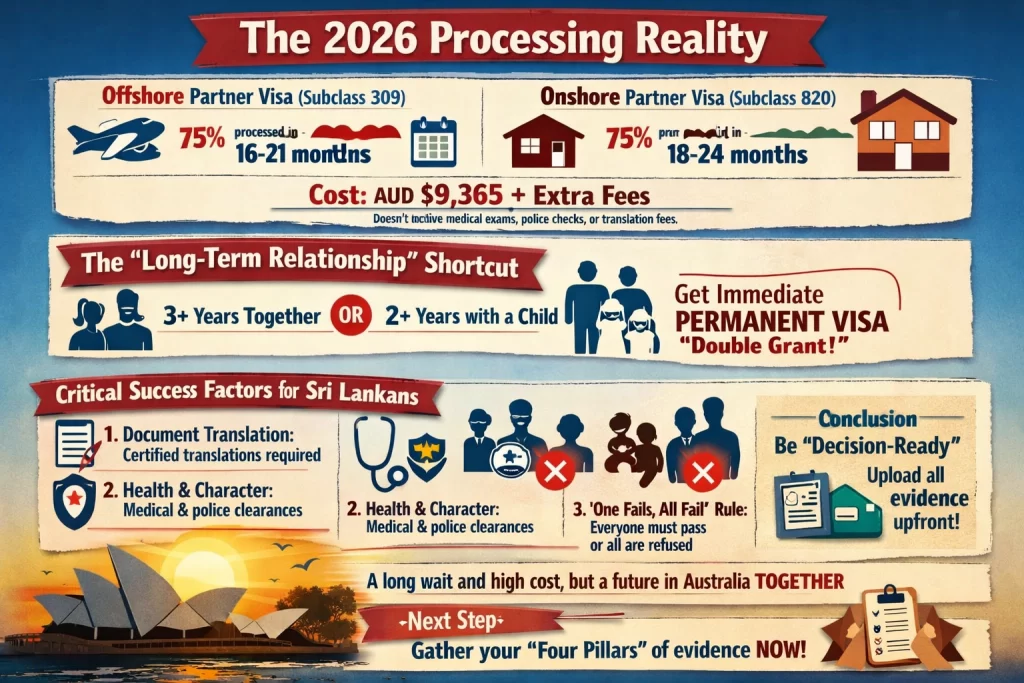
As of early 2026, processing times for Partner Visas are a major pain point. Offshore (309): 75% of applications are processed within 16 to 21 months. Onshore (820): 75% are processed within 18 to 24 months. Cost: The base application charge is approximately AUD 9,365. This does not include medical exams, police clearances, or professional translation fees for Sinhala/Tamil documents.
The “Long-Term Relationship” Shortcut
There is a significant benefit for couples who have been together for a long time. If you can prove that you have been in a de facto relationship or married for 3 years or more (or 2 years if there is a child of the relationship), the Department may grant the Permanent Visa (Subclass 100 or 801) immediately, skipping the two-year waiting period. This is known as a “Double Grant.”
Critical Success Factors for Sri Lankans
1. Document Translation: Every document not in English (Birth Certificates, NICs, Marriage Certificates) must be translated by an accredited translator. Do not use informal translations. 2. Health and Character: All applicants must pass a medical exam and provide a Police Clearance from Sri Lanka. If you have lived in another country (like Dubai or the UK) for more than 12 months, you need a clearance from there too. 3. The “One Fails, All Fail” Rule: If you are including children in the application and one person fails the health or character check, the entire application—including yours—will be refused.
Conclusion
A Partner Visa application is more than just paperwork; it is the story of your life together. In 2026, the key to success is being “Decision-Ready.” This means uploading all your evidence, including your medicals and police checks, at the time of application to avoid unnecessary delays. While the cost is high and the wait is long, the end result—a permanent life together in Australia—is a foundation worth building correctly.
Next Step: Start gathering your “Four Pillars” of evidence. If you are applying offshore, ensure your Sri Lankan marriage is legally registered and that you have high-quality digital copies of all joint financial records from the last 12 months.
References
- Department of Home Affairs. (2026). Subclass 309/100 Partner (Provisional/Migrant) Visa.
- Department of Home Affairs. (2026). Subclass 820/801 Partner (Temporary/Permanent) Visa.
- Australian High Commission, Sri Lanka. (2026). Partner Migration Checklists.
- Agape Henry Crux. (2025). Partner Visa Processing Times & Direct PR Strategy.