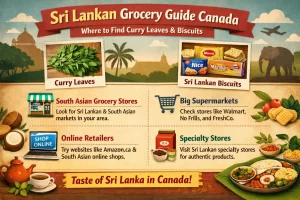
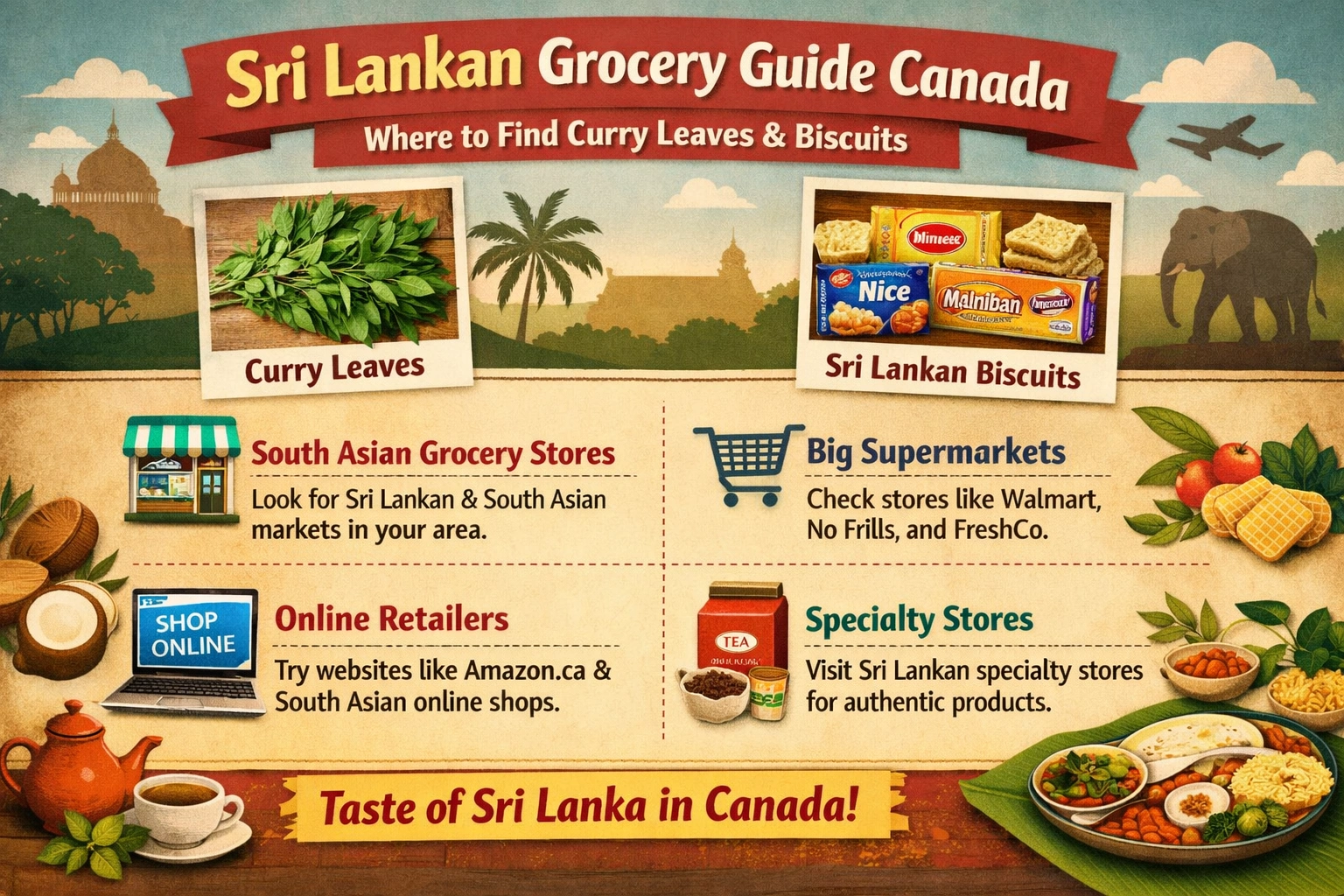
There is a specific moment of panic that hits every Sri Lankan immigrant about two weeks after landing in Canada. You have eaten enough pizza and burgers. You are craving rice and curry, but not just any curry—you want the deep, roasted aroma of Jaffna curry powder, the bite of a proper pol sambol, and a cup of tea that actually tastes like tea.
The fear is that you left these flavors behind at Bandaranaike International Airport. I have good news for you: you didn’t. Canada has one of the most robust Sri Lankan supply chains in the world. Whether you need frozen gotukola, a jar of MD mixed fruit jam, or a packet of Lemon Puffs, you can find it here. You just need to know where to look.
This guide isn’t just a list of stores; it is a breakdown of how the “ethnic grocery” ecosystem works in Canada, where to find the authentic goods, and why you might pay $4 for a coconut that would cost you fifty rupees back home.
The Holy Grail: Scarborough (and the GTA)
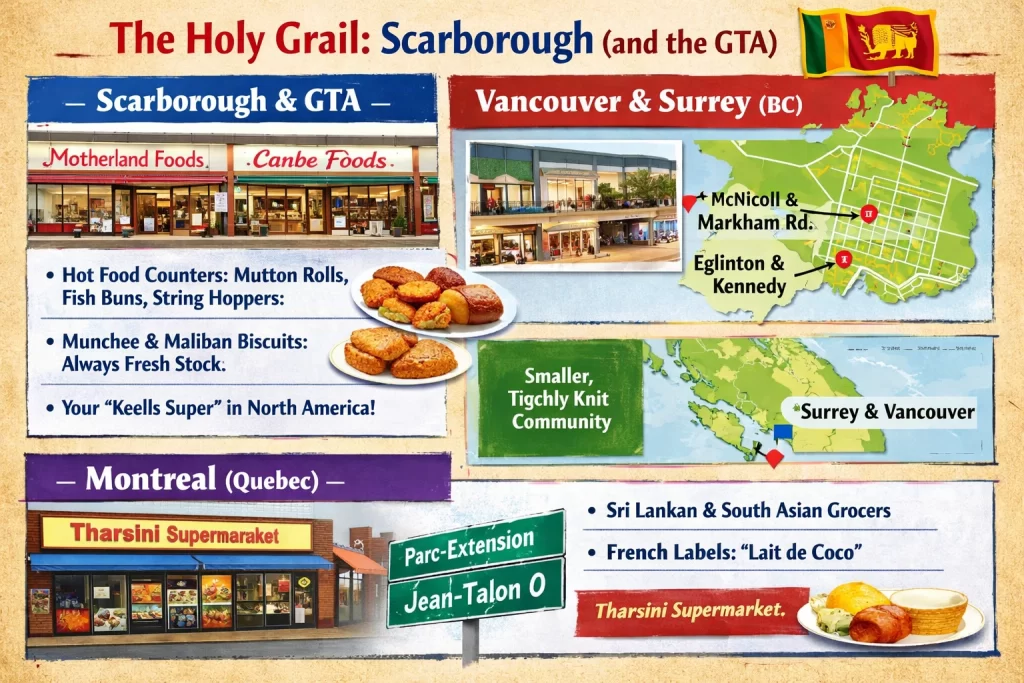
If you live in the Greater Toronto Area (GTA), specifically Scarborough or Markham, you are in the center of the universe for Sri Lankan expatriates. This area has the highest concentration of Sri Lankan Tamils and Sinhalese outside of the island itself.
The “Plaza” Culture
Unlike Sri Lanka, where you might go to a “boutique” or a bustling market, here you look for strip malls (plazas).
In Scarborough, intersections like McNicoll & Markham Road or Eglinton & Kennedy are dotted with specialty shops. Stores like Motherland Foods or Canbe Foods don’t just stock dry goods; they have hot food counters selling mutton rolls, fish buns (maalu paan), and string hoppers made fresh daily.
Insider Tip: If you are looking for specific brands like Munchee or Maliban biscuits, these stores import them by the container load. You will rarely find them stale because the turnover is so high. It is as close to a Keells Super as you will get in North America.
Beyond Toronto: Vancouver and Montreal
If you are moving outside Ontario, the hunt becomes a bit more strategic, but certainly not impossible.
Vancouver & Surrey (British Columbia)
The Sri Lankan community here is smaller but tightly knit, often overlapping with the massive Punjabi community in Surrey.
Where to go: Look for The Colombo Store in Surrey or Thurga Store on Fraser Street in Vancouver. These spots are lifelines. They stock the essentials: red rice (Samba), frozen pandan leaves (rampe), and Maldive fish.
The Challenge: Fresh produce is harder to come by than in Toronto. You might have to rely on frozen packets for things like cassava (manioc) or drumsticks (murunga).
Montreal (Quebec)
Head to the Parc-Extension neighborhood. Streets like Jean-Talon West are lined with South Asian grocers. Tharsini Supermarket is a well-known spot where you can find Sri Lankan spices amidst the Indian grocery selection.
Note: In Montreal, labeling is often in French (“Lait de Coco” instead of Coconut Milk), but the brands inside the can are often the Aroy-D or Chaokoh you recognize.
The Mainstream Shift: “No Frills” and “FreshCo”
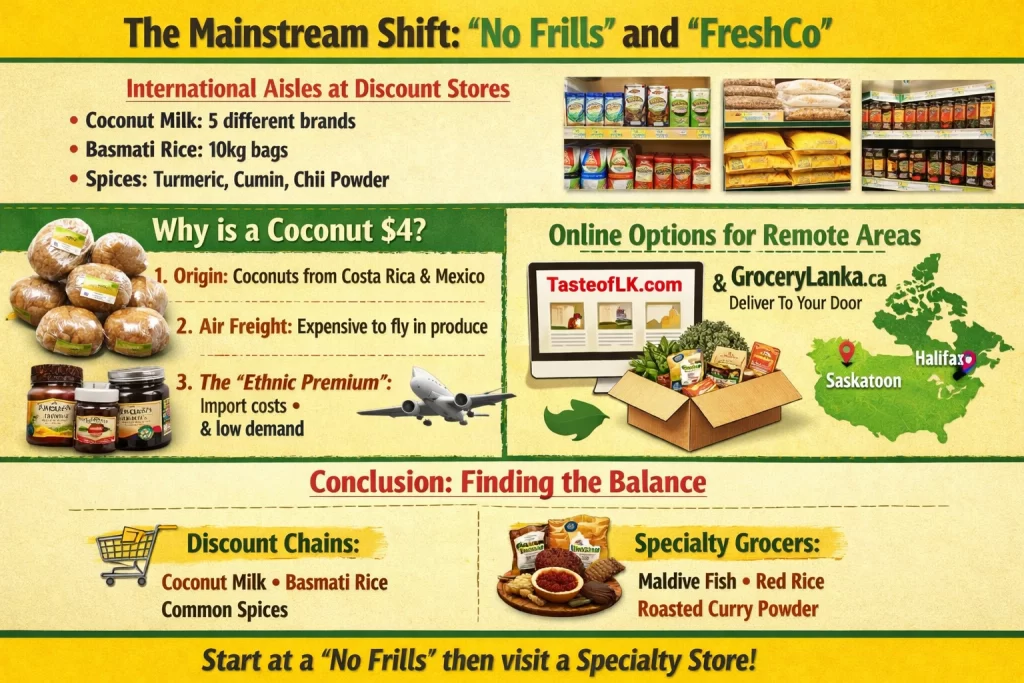
Here is a secret that saves you money: you don’t always need a specialty store. Major Canadian discount chains like No Frills, FreshCo, and Superstore have realized that Canada is changing.
They now have massive “International” aisles. You will easily find:
• Coconut Milk: usually 5 different brands.
• Basmati Rice: 10kg bags are standard.
• Spices: Turmeric, cumin, and chili powder are staples.
When to skip the big store: Do not buy your “Roasted Curry Powder” here. The generic “Curry Powder” sold in Canadian supermarkets is usually a yellow, mild mix (like Madras curry) that tastes nothing like the dark, aromatic Sri Lankan blend. for that, you must go to a Sri Lankan or Indian grocer.
The Supply Chain: Why is a Coconut $4?
Newcomers often stand in the produce aisle staring at a coconut in shock. “This is 1000 rupees!”
You are paying for the logistics.
1. Origin: Most “fresh” coconuts in Canada don’t come from Sri Lanka (it’s too far for fresh produce). They come from Costa Rica, the Dominican Republic, or Mexico. They are trimmed, wrapped in plastic, and shipped cold.
2. Seasonality: Vegetables like Karawila (Bitter Gourd) or Pathola (Snake Gourd) are flown in. Air freight is expensive.
3. The “Ethnic Premium”: Specialty items like Kithul Treacle or Watalappan kits are low-volume imports. The importer has to cover shipping, tariffs, and spoilage, passing that cost to you.
The Online Option for Remote Areas
What if you land a job in Saskatoon or Halifax? You likely won’t have a Sri Lankan shop down the street.
This is where the digital supply chain saves you. Services like Taste of LK or GroceryLanka ship nationwide. You can order a monthly “care package” of curry leaves, spices, and biscuits. The shipping might cost $20, but the mental comfort of having a proper cup of tea with a Ginger Biscuit during a snowstorm is priceless.
Conclusion
You can survive in Canada on pizza and pasta, but you don’t have to. The supply chains are established, deep, and surprisingly fresh. Whether you are in Scarborough walking through a plaza that smells like frying rolls, or in Calgary ordering a box of spices online, the taste of home is accessible.
Your first mission? Go to a local “No Frills” to see what staples you can get cheap. Then, find your nearest specialty grocer for the “soul food”—the Maldive fish, the red rice, and the dark roasted curry powder. Stock up, invite some friends over, and make a curry that warms you up from the inside out.
References
- Motherland Foods. (2025). Kerala & Sri Lankan Grocery in Toronto.
- Sri Lankan Roots. (2025). Online Sri Lankan Grocery Store Canada.
- Time Out Montreal. (2020). Best International Grocery Stores in Montreal.
- Taste of LK. (2025). Canada-wide Sri Lankan Grocery Delivery.
- Delta Market. (2025). Fresh South Indian & Sri Lankan Groceries.