There is a distinct fear that hits many immigrants before they board the flight to Canada: “Will I lose who I am?” You worry that in a few years, your children won’t speak Sinhala or Tamil, the taste of a proper pol sambol will be a distant memory, and your cultural identity will be washed away by a generic North American lifestyle.
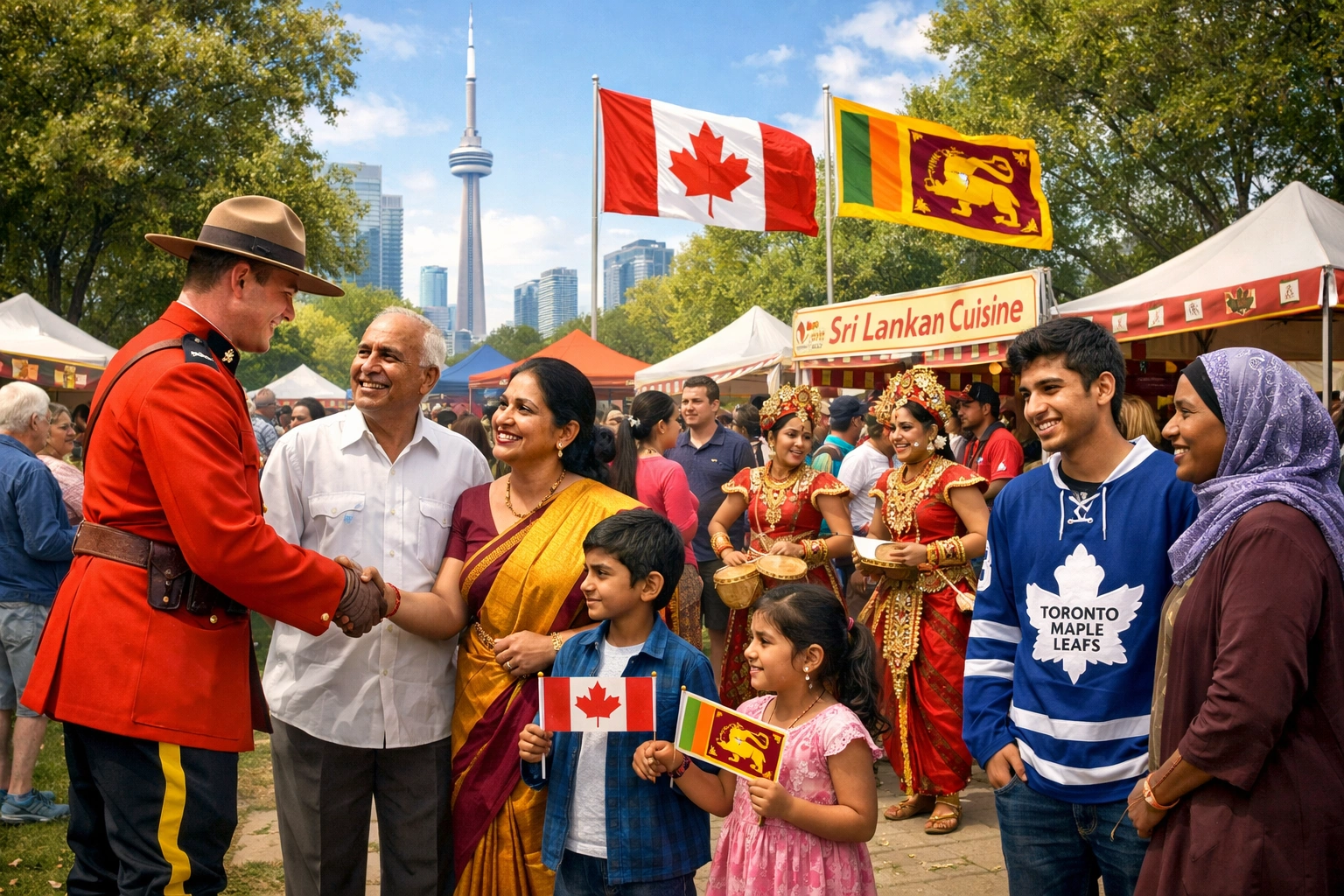
Here is the reality: Canada doesn’t want you to become a generic North American. Unlike our neighbors to the south who famously promote a “Melting Pot” (where everyone blends into one), Canada officially champions a “Mosaic.” The philosophy is that you can be fully Canadian and fully Sri Lankan at the same time.
But how does this work in practice? From the bustling Sri Lankan plazas of Scarborough to the quiet temples in British Columbia, integration is a balancing act. It’s about building a new life without bulldozing the old one. Here is how the Sri Lankan community has carved out its space in the Great White North.
The “Mosaic” vs. The “Melting Pot”
To understand your place here, you need to understand the policy. In 1971, Canada became the first country in the world to adopt multiculturalism as an official policy. This isn’t just a nice sentiment; it’s law.
In the US (the Melting Pot), the expectation has historically been assimilation—E pluribus unum (Out of many, one). In Canada (the Mosaic), the government funds heritage language classes, supports cultural festivals, and encourages you to keep your traditions alive. You are not expected to change your name to “Smith” or stop eating rice and curry to fit in.
The result? You will find second-generation Sri Lankan-Canadians who play ice hockey on Saturday mornings and attend Kandyan dance classes or Carnatic music lessons on Sunday afternoons. They don’t choose one side; they inhabit both.
Little Sri Lanka: Where We Live
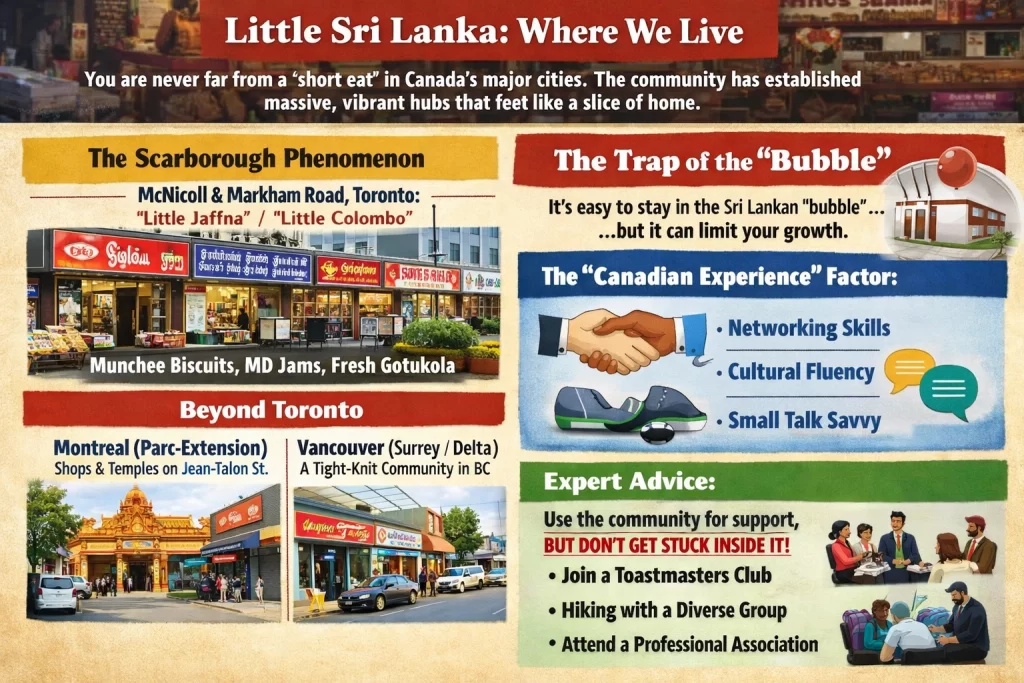
You are never far from a “short eat” in Canada’s major cities. The community has established massive, vibrant hubs that feel like a slice of home.
The Scarborough Phenomenon
If you drive through the intersection of McNicoll and Markham Road in Toronto (often jokingly called “Little Jaffna” or “Little Colombo”), you will see signage in Tamil and Sinhala. This is the heart of the diaspora. You can walk into a grocery store and find Munchee biscuits, MD jams, and fresh gotukola.
Beyond Toronto
- Montreal (Parc-Extension): A historic hub for the Tamil community, with bustling shops and temples along Jean-Talon Street.
- Vancouver (Surrey/Delta): A smaller but tight-knit community, often integrated with the larger South Asian population in BC.
The Trap of the “Bubble”
While having a strong community is a blessing, it can also be a professional trap. We call it “The Bubble.”
It is entirely possible to live in Scarborough, work for a Sri Lankan accountant, shop at Sri Lankan stores, and socialize only with Sri Lankan friends. While this feels safe, it limits your growth.
The “Canadian Experience” Factor:
To advance in your career—whether in banking, engineering, or IT—you need to network outside your ethnic enclave. Employers look for “soft skills” and cultural fluency. If you only interact with your own community, you miss out on the subtle cues of Canadian workplace culture (like the importance of “small talk” about the weather or hockey).
Expert Advice: Use the community for support, but don’t let it be your perimeter. Join a mixed Toastmasters club, a local hiking group, or a professional association where you are the only Sri Lankan in the room.
Faith and Festivals: Celebrating in Public
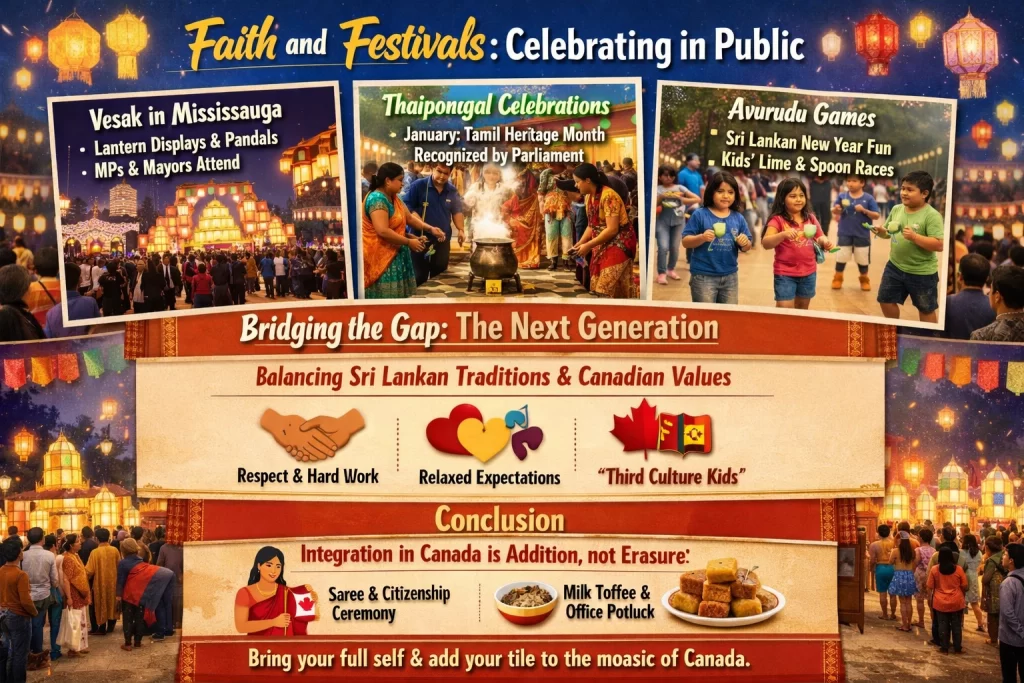
One of the most beautiful aspects of Canadian multiculturalism is seeing Sri Lankan festivals go mainstream.
- Vesak: In cities like Mississauga and Ottawa, Vesak is celebrated with massive lantern displays and pandals, often attended by local mayors and MPs.
- Thaipongal: January is Tamil Heritage Month in Canada. It’s not just a community event; it’s recognized by the Parliament.
- Avurudu: In April, community halls across the country host New Year games. You will see kids in snow boots running races with limes on spoons (indoors, of course).
Bridging the Gap: The Next Generation
The biggest challenge for immigrant parents is the “Culture Clash” with their teenagers. Your kids will grow up with Canadian values—independence, questioning authority, and liberal social views.
This can cause friction with traditional Sri Lankan parenting styles that emphasize obedience and academic pressure. The successful families are the ones who adapt. They enforce the core values (respect, hard work) but relax on the rigid expectations (allowing dating, supporting careers in the arts). They realize that their children are “Third Culture Kids”—creating a new identity that is a hybrid of both worlds.
Conclusion
Integration in Canada is not about erasure; it is about addition. You are adding “Canadian” to your identity, not subtracting “Sri Lankan.”
You can wear a saree to your citizenship ceremony. You can bring milk toffee to your office potluck. The country invites you to bring your full self. The only requirement is that you also open yourself up to the cultures around you, contributing your tile to the mosaic rather than just living in a separate frame.
References
- Government of Canada. (2025). Multiculturalism Policy and Programs.
- Statistics Canada. (2024). Ethnic or cultural origin: Canada, provinces and territories.
- The Canadian Encyclopedia. (2025). South Asians in Canada.
- National Council of Canadian Tamils. (2025). Tamil Heritage Month.
- Sri Lanka Canada Association. (2025). Community Resources and Events.