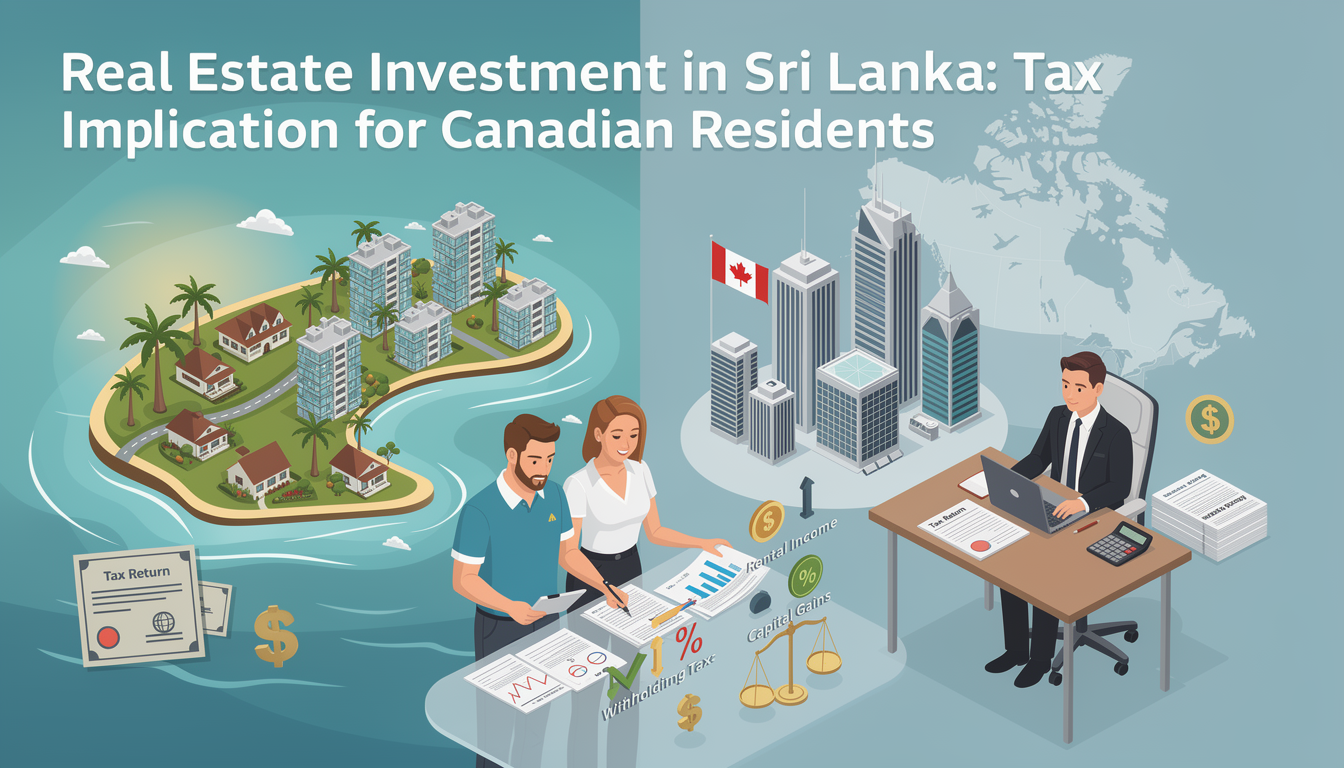
There is a strong emotional pull to buy a piece of “home.” For many Sri Lankan-Canadians, purchasing land in Colombo, a villa in Galle, or an apartment in Kandy isn’t just an investment—it’s a connection to heritage, a retirement plan, or a place for family to stay. Plus, with the exchange rate between the CAD and LKR, your Canadian dollar often stretches significantly further in the local property market.
But while the dream is romantic, the tax reality is strict. The Canada Revenue Agency (CRA) requires you to report worldwide income, and owning foreign property opens up a specific set of compliance doors that you cannot afford to ignore. If you get this wrong, you could face double taxation or stiff penalties that wipe out your investment gains.
You don’t need to be a tax lawyer to understand the basics, but you do need to know the rules of the game. Here is exactly how to handle your Sri Lankan real estate from a Canadian tax perspective, ensuring you keep more of what you earn.
The “Big Brother” Form: T1135
Before we even talk about taxes on profit, we need to talk about reporting. This is the most common trap for Canadians owning foreign property.
If the total cost of your “specified foreign property” (which includes real estate) exceeds CAD $100,000 at any point in the year, you must file Form T1135 (Foreign Income Verification Statement) with your tax return.
Crucial details to remember:
- Cost, not Value: The threshold is based on the adjusted cost base (what you paid), not the current market value. If you bought a land plot in 2010 for $80,000 and it’s now worth $300,000, you generally do not need to file (unless you made other foreign investments).
- Personal Use Exception: If you use the property primarily (more than 50% of the time) for personal use—like a vacation home for your family—you might be exempt from this form. However, if you rent it out for profit for the majority of the year, you must file.
The Penalty Warning: The penalty for failing to file this form is $25 per day, up to a maximum of $2,500 per year, plus interest. I have seen clients hit with years of back-penalties simply because they didn’t know this form existed.
Earning Rental Income: The Double Reporting Rule
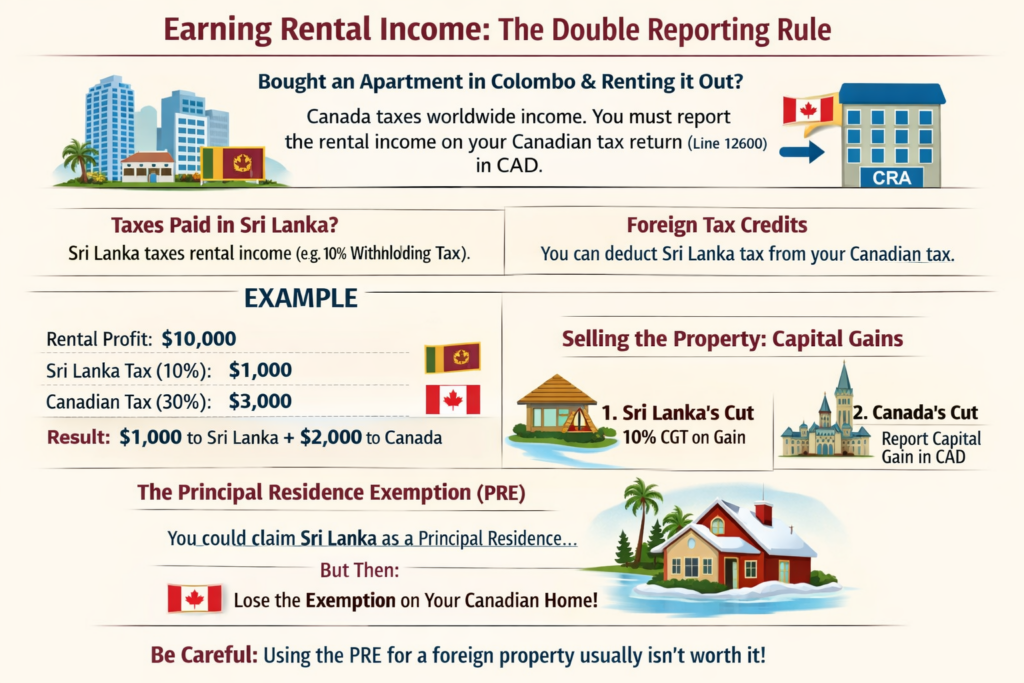
If you buy an apartment in Colombo and rent it out, you have income. Canada taxes its residents on worldwide income. This means you must report that rental income on your Canadian tax return (Line 12600), converted to Canadian dollars using the average exchange rate for the year.
What About Taxes Paid in Sri Lanka?
Sri Lanka also taxes income generated within its borders. Currently, non-residents renting out property in Sri Lanka may be subject to a Withholding Tax (often 10% on amounts over certain thresholds) or standard income tax rates.
The Good News (Foreign Tax Credits): Canada and Sri Lanka have a tax treaty designed to prevent double taxation. If you pay tax on your rental income in Sri Lanka, you can claim a Foreign Tax Credit on your Canadian return. Essentially, you subtract the tax paid to the Sri Lankan Inland Revenue Department (IRD) from the tax you owe the CRA.
Example: You earn $10,000 in rental profit. Sri Lanka tax (hypothetical 10%): $1,000. Canadian tax (hypothetical 30%): $3,000. Result: You pay $1,000 to Sri Lanka and the remaining $2,000 to Canada. You don’t pay $4,000 total.
Selling the Property: Capital Gains
When you eventually sell the property, both countries will want a piece of the profit.
1. Sri Lanka’s Cut
As of recent tax amendments (Inland Revenue Act No. 24 of 2017 and subsequent changes), Sri Lanka imposes a Capital Gains Tax (CGT) on the realization of investment assets. For individuals, this has typically been a flat rate (often 10%) on the gain, calculated as Selling Price minus Cost.
2. Canada’s Cut
You must report the capital gain on your Canadian tax return. The Calculation: (Proceeds of Sale in CAD) – (Original Cost in CAD) = Capital Gain. Note: You must use the exchange rate on the day you bought it for the cost, and the exchange rate on the day you sold it for the proceeds. Currency fluctuation can create a “gain” even if the property value in Rupees stayed flat!
The Principal Residence Exemption (PRE)
Technically, a property outside Canada can qualify as your Principal Residence for tax purposes if you “ordinarily inhabited” it (e.g., during vacations). However, you can only designate one principal residence per year for your family unit.
The Trap: If you designate your Sri Lankan villa as your principal residence to avoid tax on that gain, you lose the exemption for your Canadian home for those same years. Since Canadian real estate generally has a much higher value (and tax burden), “wasting” your exemption on a foreign property is almost always a bad financial move.
Inheritance and Gifting
In Sri Lankan culture, it is common to gift land to children upon marriage or as an early inheritance. Be very careful here.
- Deemed Disposition: If you gift a property to your child, the CRA treats it as if you sold it at fair market value. You will owe capital gains tax on the appreciation, even though no cash changed hands.
- Sri Lankan Stamp Duty: Sri Lanka charges Stamp Duty on deeds of gift (often around 3-4%).
If you plan to pass property down, consult a cross-border estate planner. Sometimes, using a life interest (retention of usufruct) can manage the timing of these taxes, but it requires precise legal wording.
Key Takeaways
Investing in Sri Lanka can be financially rewarding and emotionally fulfilling, provided you stay compliant.
- File the T1135: If your cost base is over CAD $100,000, file this form every year. No exceptions.
- Keep Receipts: Renovations in Sri Lanka increase your “cost base,” lowering your future capital gains tax. Keep every receipt for construction or major improvements.
- Report Worldwide Income: Declare rent and capital gains in Canada, then claim the Foreign Tax Credit for whatever you paid in Sri Lanka.