

If you are a software engineer in Colombo, you have likely heard the stories. A batchmate from Moratuwa University moves to Toronto and suddenly posts pictures of a new Tesla. A former colleague at WSO2 or Virtusa lands a job at Amazon Vancouver and is earning in a month what they used to earn in a year.
The hype is real. Canada is aggressively recruiting tech talent, and Sri Lankan developers—known for strong technical fundamentals and English proficiency—are in high demand. But the transition isn’t just about changing your location setting on LinkedIn. It is a completely different ball game.
From the “Toronto vs. Vancouver” debate to the shock of high taxes, here is the honest breakdown of the Canadian tech scene for the Sri Lankan professional. We will look at what pays, where to live, and how to survive the infamous “Canadian Experience” barrier.
The Landscape: Toronto vs. Vancouver
Canada isn’t one big tech hub; it has two distinct capitals, and they have very different vibes.
Toronto (The Financial Fortress)
Toronto (and the nearby Waterloo region) is the Silicon Valley of the North. It is massive, diverse, and fast-paced.
The Industry: It is heavy on Fintech (banking software), Enterprise SaaS, and AI (thanks to the Vector Institute). If you work with Java, .NET, or Python data stacks, this is your playground.
The Vibe: “Bay Street” suits meet hoodies. It is the corporate center of Canada.
Vancouver (The West Coast Chill)
Vancouver is beautiful, rainy, and sits in the same time zone as Seattle and San Francisco.
The Industry: Major US giants (Amazon, Microsoft, Tableau) have massive offices here to tap into talent that can’t get US H1-B visas. There is also a thriving startup scene focused on Web3, gaming, and visual effects.
The Vibe: You go hiking or skiing after work. It is more laid back than Toronto but notoriously expensive for housing.
The Numbers: Salary Expectations
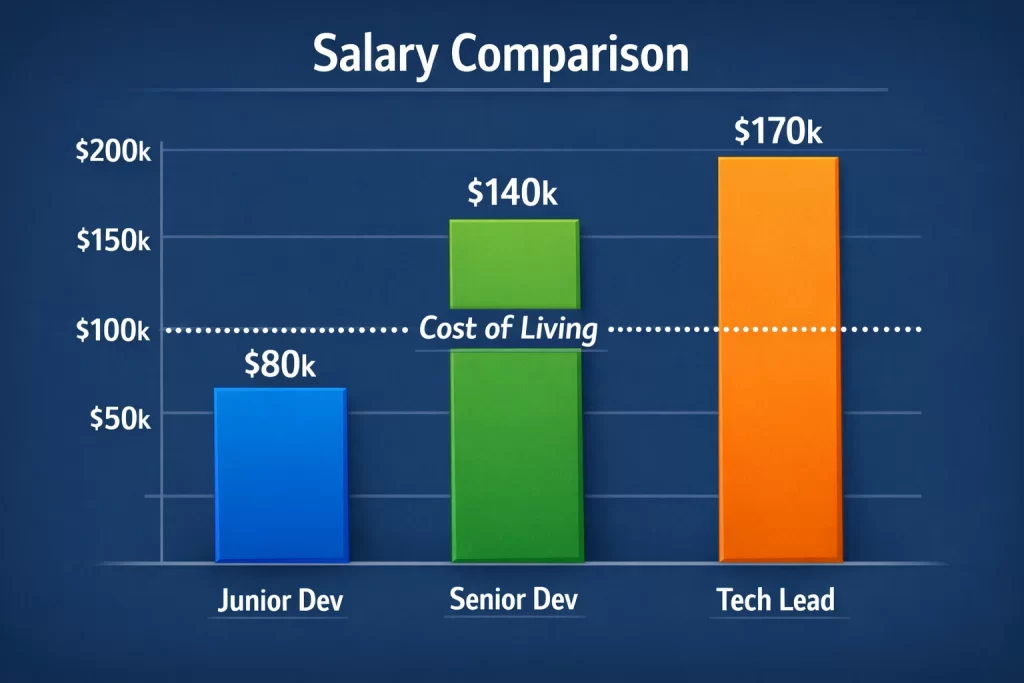
Let’s talk money. In Sri Lanka, a senior dev might hit Rs. 400,000 – 600,000 a month. In Canada, the scale shifts dramatically.
Junior/Intermediate Dev: $70,000 – $95,000 CAD/year.
Senior Software Engineer: $110,000 – $160,000+ CAD/year.
Specialized Roles (AI/Machine Learning): $180,000+ CAD/year.
The Tax Reality Check: Before you start converting CAD to LKR and dreaming of a mansion, remember the deductions. On a $100,000 salary in Ontario, you will take home roughly $73,000 after tax. Rent for a one-bedroom apartment in Toronto is around $2,500/month. You will live comfortably, but you won’t be a millionaire overnight.
The “Canadian Experience” Hurdle
This is the most frustrating feedback you will hear: “Your skills are great, but you don’t have Canadian experience.”
Employers aren’t doubting your coding ability; code is universal. They are worried about your “Soft Skills.” Can you disagree with a product manager politely? Can you present to a client?
How to hack this:
1. The Resume Rewrite: Sri Lankan CVs often list every technology you have ever touched. Canadian resumes are 2 pages max, focused on achievements (“Reduced API latency by 40%”) rather than duties.
2. Don’t Call Him “Sir”: In Sri Lankan work culture, hierarchy is rigid. You call the boss “Sir.” In Canada, you call the CEO “Dave.” Being too deferential can actually hurt you in interviews; they want a peer, not a subordinate.
3. Get Certified: If you are an AWS or Azure cloud architect, get the official certification. It is a globally recognized stamp of approval that bypasses the geography bias.

The Hot Stacks: What Are They Hiring?
If you are still in Sri Lanka, looking to upskill before you fly, focus here:
- Full Stack JavaScript: React.js on the front, Node.js on the back. This is the bread and butter of Canadian startups.
- Cloud Native: Experience with AWS, Docker, and Kubernetes is almost mandatory for senior roles now.
- Python/Data: With Toronto’s AI boom, Python developers who know PyTorch or TensorFlow are nameding their price.
The Visa Path: Global Talent Stream
You don’t always need to come as a Permanent Resident (PR) first. The Global Talent Stream (GTS) is a program where Canadian companies can hire foreign tech workers and get their work permits approved in just two weeks.
Strategy: If you are a high-performer at a multinational in Colombo, look for internal transfers or apply directly to Canadian tech companies that explicitly state they offer “Visa Sponsorship.” It is competitive, but it happens every day.
Conclusion
The Canadian tech industry is hungry. They need thousands of developers to keep up with growth. For a Sri Lankan engineer, the opportunity is life-changing, not just financially, but in terms of exposure to world-class projects.
Polish your LinkedIn profile, contribute to open source (it proves your code quality to anyone, anywhere), and practice your soft skills. The code will get you the interview, but your ability to fit into the culture will get you the job.