If you grew up in Sri Lanka, you know the drill: the Grade 5 Scholarship exam, the O-Levels, and the intense pressure of the A-Levels. The entire system is built around high-stakes exams that determine your fate. If you are moving to Canada with children, get ready for a culture shock—in the best way possible.
The Canadian education system is consistently ranked among the top in the world, but it operates very differently. There are no national ranking exams that publish your child’s name in the newspaper. There is no frantic tuition culture where kids spend their weekends in cram schools. instead, the focus is on critical thinking, holistic development, and practical skills.
However, “relaxed” doesn’t mean “simple.” The system has its own quirks—like how your rental address determines your child’s school, or why “College” in Canada is completely different from “College” in the US. Here is the insider guide to navigating education from kindergarten to graduation.
The Structure: Elementary to Secondary (K-12)
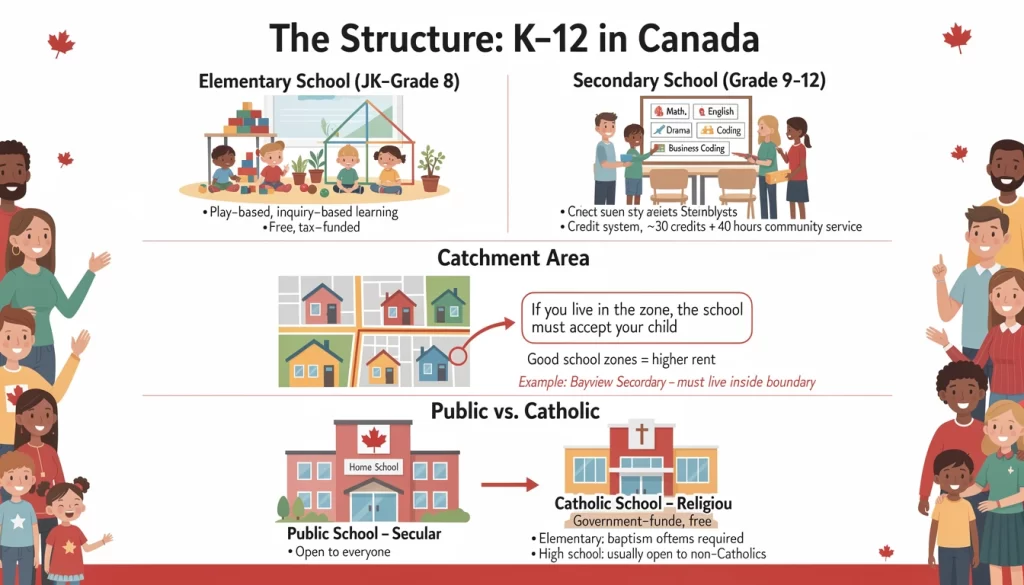
Canadian public education is free to all residents and citizens. It is funded by taxes, so you will never see a tuition bill for a public school. The journey is split into two main phases.
1. Elementary School (Kindergarten to Grade 8)
This starts early. In provinces like Ontario, “Junior Kindergarten” begins at age 4. This is a massive financial relief for parents because it essentially functions as free, high-quality childcare within the school system.
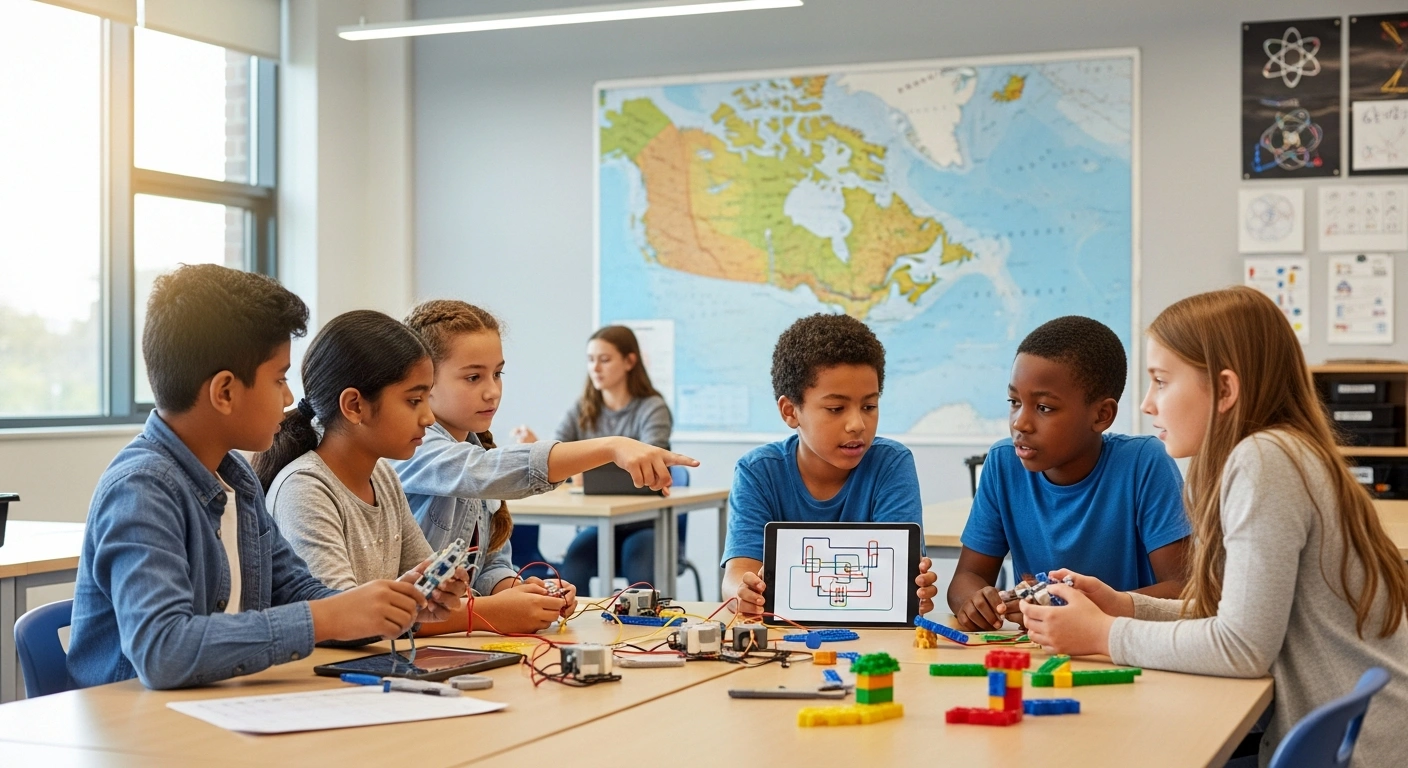
The Vibe: It is play-based and inquiry-based. Your child won’t just memorize multiplication tables; they will build structures to understand geometry or grow plants to learn biology.
2. Secondary School (Grade 9 to 12)
This is what you know as “High School.” Unlike the British system (O-Levels/A-Levels), Canadian high school works on a credit system. Students choose subjects each semester. To graduate, they need roughly 30 credits (a mix of mandatory math/English and electives like drama, business, or coding) and 40 hours of community service.
The “Catchment Area” Trap
This is the single most important thing to know before you sign a lease. In Sri Lanka, you might fight to get your child into Royal or Visakha regardless of where you live. In Canada, geography is destiny.
Every house and apartment is assigned to a specific “home school” based on its address. This is called a Catchment Area.
The Rule: If you live in the zone, the school must accept your child. If you live outside the zone, they almost certainly won’t.
Real World Example: If you want your child to attend a top-rated high school like Bayview Secondary in Toronto, you cannot just apply. You must rent or buy a home within that school’s specific boundary lines. This makes rent in “good school zones” significantly more expensive.
Public vs. Catholic: The Funding Quirk
Coming from outside, this is confusing. In many provinces (specifically Ontario, Alberta, and Saskatchewan), there are two separate, publicly funded school boards:
- Public School Board: Secular (non-religious). Open to everyone.
- Catholic School Board: Religious education is part of the curriculum. Also fully funded by the government (free).
Can non-Catholics attend Catholic school?
At the high school level (Grade 9-12), generally yes. Many non-Catholic immigrant families choose Catholic high schools because they perceive them as having stricter discipline or uniforms (which many public schools don’t have). At the elementary level, rules vary, and you often need a baptism certificate to enroll.
The Great Debate: College vs. University
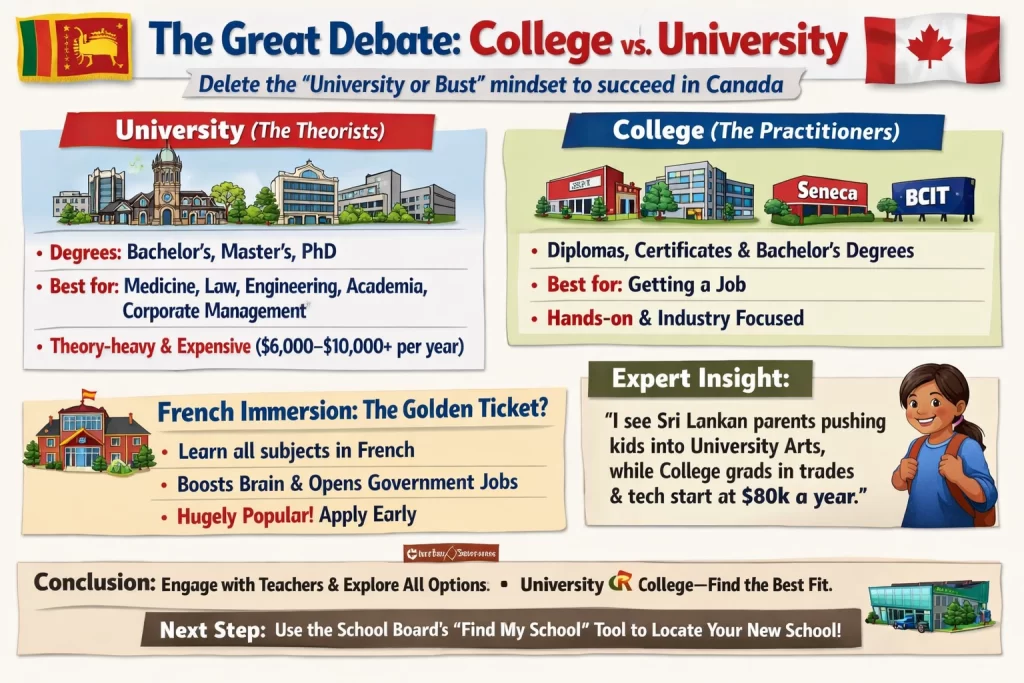
In Sri Lanka, “University” is the gold standard, and technical colleges are often seen as a backup plan. You need to delete that mindset to succeed in Canada.
University (The Theorists)
Institutions like the University of Toronto, UBC, or McGill grant degrees (Bachelor’s, Master’s, PhD).
Best for: Careers in medicine, law, engineering, academia, or high-level corporate management. It is theory-heavy and expensive ($6,000–$10,000+ per year for domestic students).
College (The Practitioners)
Institutions like Seneca, Humber, or BCIT offer Diplomas, Certificates, and increasingly, Bachelor’s Degrees.
Best for: Getting a job. Colleges are industry-focused. If you study “Supply Chain Management” at a college, you will learn the exact software companies use and often do a “Co-op” work term.
Expert Insight: I see many Sri Lankan parents push their kids into generic University Arts degrees where job prospects are low, while overlooking College programs in trades or technology where graduates start at $80,000 a year.
French Immersion: The Golden Ticket?
Canada is bilingual. Most schools offer “French Immersion,” where students learn all subjects in French for the first few years.
Why do it? It is a brain booster, and being bilingual opens massive doors for government jobs later in life.
The Catch: It is incredibly popular. In cities like Toronto, parents sometimes camp out or enter lotteries just to get a spot. If you want this, apply the second the window opens.
Conclusion
The Canadian system is designed to give every child a fair shot, regardless of their background. It rewards creativity and consistency over rote memorization. As a parent, your job isn’t to force them to study for 12 hours a day; it is to engage with their teachers, understand the course options, and help them choose a path—whether University or College—that actually leads to a career they enjoy.
Your next step? Before you rent an apartment, go to the local School Board’s website (e.g., TDSB.on.ca or VSB.bc.ca) and use their “Find My School” tool. Type in the address of the rental you are looking at to see exactly where your kids will go.
References
- Council of Ministers of Education, Canada. (2025). Education in Canada: An Overview.
- People for Education. (2024). Public Education in Ontario: Facts and Statistics.
- Settlement.org. (2025). How do I enroll my child in school?
- Universities Canada. (2025). Facts and Stats about Canadian Universities.
- Colleges and Institutes Canada. (2025). The role of colleges in the Canadian economy.