Have you ever scrolled through LinkedIn, seen a former university batchmate post about their new software engineering job at a FAANG company in California, and wondered exactly how they made that leap? You’re not alone in that ambition. A staggering 57% of Silicon Valley’s STEM workforce is foreign-born, according to a 2021 report by Joint Venture Silicon Valley, proving the path is well-trodden.
But making the move requires understanding a completely different compensation and hiring model. It’s not just about salary; it’s about a total compensation package where Restricted Stock Units (RSUs) can often exceed your base pay. The hiring process itself is a unique challenge, focused on LeetCode-style algorithmic problems and rigorous system design interviews, a world away from typical Sri Lankan recruitment practices.
This article demystifies the entire process. We’ll break down realistic salary expectations for engineers, product managers, and data scientists using aggregated data from platforms like Levels.fyi. You will learn how to navigate the H-1B visa sponsorship process and get a clear picture of what hiring managers at top tech firms are truly looking for.
The Silicon Valley Dream: Why Sri Lankan Talent is in Demand
An estimated 35,000 Sri Lankan developers are already servicing Silicon Valley firms remotely, earning an average USD-equivalent of LKR 400,000 monthly. This isn’t an accident. Silicon Valley has a perpetual, high-stakes demand for engineering talent that its local market simply cannot satisfy. This has forced the world’s most competitive tech hub to look globally, and Sri Lanka has emerged as a consistent source of high-caliber professionals.
The foundation is a strong technical education system that produces graduates with excellent problem-solving skills. This isn’t just theoretical knowledge. We see it in practice with the success of alumni from respected tech firms like WSO2 and Virtusa, who are now in senior roles at major US companies. Hiring managers specifically seek out Sri Lankan talent for proficiency in high-demand frameworks like React.js and Node.js, along with certifications in cloud platforms like AWS. This focus on practical, commercially valuable skills is a significant differentiator.
Beyond pure technical ability, two factors give Sri Lankan professionals a distinct advantage: high English proficiency and cultural adaptability. For distributed teams working across time zones, clear communication is everything. This fluency reduces friction and accelerates project timelines. While direct H-1B visa hires remain challenging, the rise of remote work has opened a more accessible pathway. As Sri Lanka’s IT/BPM industry crossed $1.8 billion in export revenue in 2023, it proved its capacity to deliver. For Silicon Valley, this combination of technical depth, communication skills, and a proven track record makes Sri Lankan talent a strategic choice, not just a cost-effective one.
Decoding Silicon Valley Salaries: What to Expect
According to LankaWebsites, an estimated 35,000 Sri Lankan developers are already earning a USD-equivalent of LKR 400,000 monthly by serving Silicon Valley firms remotely. While that’s a significant income for remote work, it represents just a sliver of an on-site compensation package. This brings us to something often overlooked by professionals aspiring to move to the Bay Area: the multi-layered structure of tech compensation, which goes far beyond a simple monthly paycheck.
Beyond the Base Salary
A Silicon Valley offer is almost never just a base salary. It’s a package, commonly referred to as Total Compensation (TC), built on three pillars:
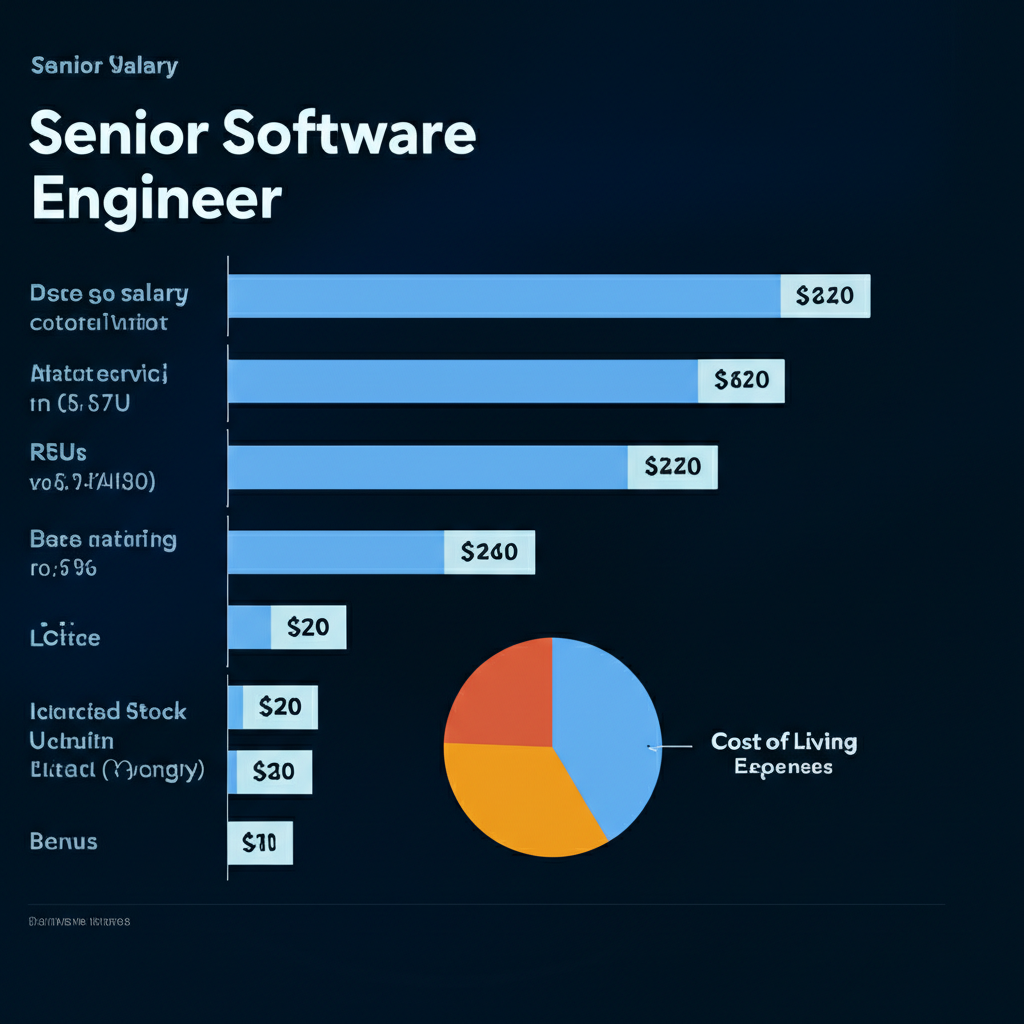
Base Salary: The predictable, bi-weekly income. It’s the foundation but often less than 60% of your total earnings at a top company.
Annual Bonus: A performance-based cash bonus, typically calculated as a percentage of your base salary (e.g., 10-20%).
Equity (RSUs): Restricted Stock Units are shares in the company granted to you. They vest over a period, usually four years, becoming a significant part of your income. For example, a $400,000 RSU grant means you get $100,000 worth of stock each year for four years.
A senior engineer’s offer might be a $200,000 base, a 15% bonus, and $400,000 in RSUs, making their first-year TC a staggering $330,000.
Compensation by Role and Experience
Your role and seniority dictate your earning potential. At major tech firms (FAANG and equivalents), a junior Software Engineer can expect a TC of $180,000-$220,000. A Senior Engineer’s TC often lands between $350,000 and $500,000, while Staff-level engineers can exceed $600,000. Product Managers and Data Scientists follow similar trajectories, with mid-level roles typically commanding TCs of $250,000-$350,000. Startups, on the other hand, usually offer lower base salaries but provide stock options that carry higher risk and potentially enormous rewards if the company succeeds.
The Bay Area’s Financial Bite
So, why are these numbers so high? The Bay Area’s astronomical cost of living provides the answer. Federal and California state taxes can claim 30-40% of your gross income. After that, housing takes the next biggest bite; a modest one-bedroom apartment in a tech hub like Sunnyvale or Mountain View can easily cost $3,500 per month. That $200,000 base salary quickly shrinks after taxes and rent, making the high total compensation not just a luxury, but a necessity for building savings in the world’s most expensive tech ecosystem.
The Hiring Gauntlet: Navigating the Recruitment Process
An estimated 35,000 Sri Lankan developers are already earning the USD-equivalent of LKR 400,000 or more monthly by working remotely for Silicon Valley firms. That’s a massive talent pool contributing to the nation’s $1.8 billion IT export revenue. Here’s what really matters though: getting one of those jobs means surviving a standardized, multi-stage interview process designed to test more than just your coding skills.
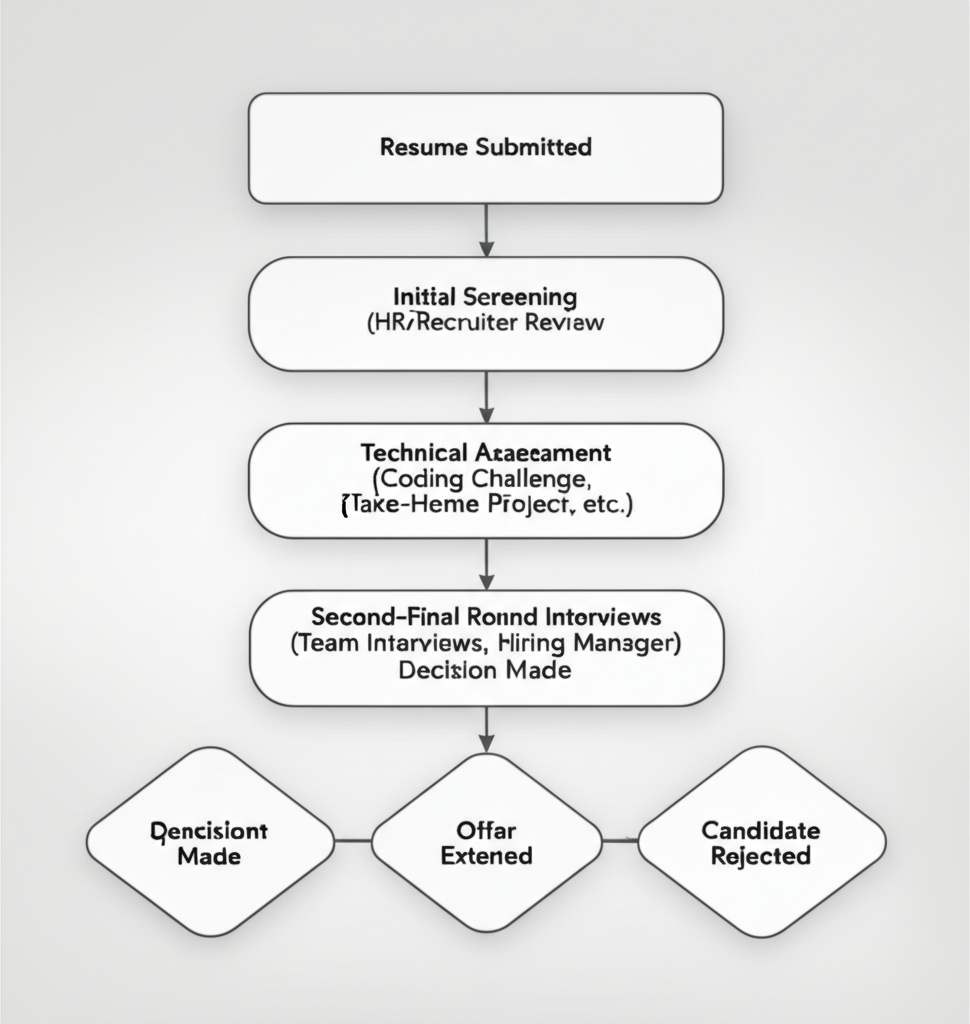
The Application & Recruiter Screen
Your first challenge is the Applicant Tracking System (ATS). Your resume must be machine-readable and packed with the right keywords. Think specific technologies like React.js, Node.js, and any AWS certifications, which organizations like SLASSCOM promote for this very reason. If you pass the machine, a human recruiter gives you a 30-minute call. This isn’t a technical grill; it’s a sanity check. They confirm your experience, discuss salary expectations, and assess your communication skills. Be prepared to talk about your motivations and why you’re interested in their company, not just any US-based role.
The Technical Deep Dive
Next come the technical rounds. Expect one or two interviews focused on practical coding challenges, often using platforms like HackerRank or CoderPad. You’ll be solving problems reminiscent of medium-to-hard LeetCode questions, live with an engineer. For senior roles, a system design interview is standard. You might be asked to architect a simple version of a service like Twitter or a URL shortener. They want to see how you handle ambiguity and trade-offs. You will also face behavioral questions, where you should use the STAR method (Situation, Task, Action, Result) to structure your answers. For example, when asked about a conflict, detail a specific project, your objective, the concrete steps you took, and the measurable outcome.
The Final ‘On-site’ Loop
The final stage is a marathon, not a sprint. Historically an on-site visit, this is now almost always a 4-5 hour block of virtual interviews. You’ll meet a series of people back-to-back: a couple of senior engineers for more technical rounds, a hiring manager to discuss team fit and career growth, and perhaps a product manager to evaluate your business sense. Each interviewer has a specific focus, and the group debriefs afterward to make a collective hiring decision. It’s intense, but it’s the last step before an offer.
The Visa Hurdle: H-1B and Other Pathways for Sri Lankans
Building on that foundation of proven remote success, where an estimated 35,000 Sri Lankan developers already command US-dollar equivalent salaries serving Silicon Valley firms (LankaWebsites), the path to an on-site job presents a formidable challenge: the US visa system. While Sri Lanka’s IT/BPM industry generates over $1.8 billion in export revenue (JS Morlu) from this global talent pool, physically relocating requires clearing a series of complex, time-consuming, and often uncertain legal hurdles.
The H-1B Lottery: A Game of Chance
The most common route for tech professionals is the H-1B visa, designated for “specialty occupations.” Securing one isn’t just about having the right skills; it’s a lottery. Each year, US Citizenship and Immigration Services (USCIS) is inundated with hundreds of thousands of applications for just 85,000 available visas. Companies must register their prospective hires during a brief window in early March. If your registration is selected, only then can the company file the full, costly petition. This process is entirely dependent on company sponsorship. You cannot apply for an H-1B visa on your own.
Beyond the Lottery: L-1 and O-1 Visas
For some, alternative pathways exist. The L-1 visa is designed for intracompany transferees. For example, a senior software architect working for a multinational company with offices in both Colombo and Palo Alto could be transferred to the US office, provided they have worked for the company for at least one year and possess specialized knowledge. The O-1 visa for “Individuals with Extraordinary Ability or Achievement” is much rarer. It is reserved for those at the absolute peak of their field, with evidence of sustained national or international acclaim for their work.
No matter the path, the entire process is managed by immigration lawyers retained by the hiring company. They navigate the extensive paperwork, but they cannot change the odds. A realistic timeline from job offer to having a visa in hand can stretch from six months to well over a year, and that’s assuming a successful lottery draw. The uncertainty is the one constant in this journey.
Building Your Profile: Getting Noticed from Sri Lanka
A surprising 35,000 Sri Lankan developers are already earning a USD-equivalent of LKR 400,000 monthly by serving Silicon Valley firms remotely. According to LankaWebsites, this isn’t a distant dream; it’s a present reality fueled by an IT sector that generated over $1.8 billion in export revenue in 2023. The challenge isn’t a lack of opportunity—it’s cutting through the noise. So, how do you ensure your profile lands at the top of a recruiter’s list?
Master Your Digital Handshake: LinkedIn and GitHub
Your LinkedIn profile is your primary billboard for international recruiters. Don’t just list your job title. Optimize it. A headline like “Senior Software Engineer | React.js, Node.js | AWS Certified Solutions Architect” immediately signals your value and aligns with in-demand skills. Use the summary to narrate a project where you solved a complex problem, quantifying the result. On GitHub, your activity is your proof of work. Contributing to a known open-source project or building a full-stack application that solves a niche problem speaks louder than any resume. For instance, creating a simple expense tracker with a React front-end and a Node.js back-end, deployed on AWS, provides a tangible demonstration of your end-to-end capabilities.
Network with Purpose, Not Volume
Blindly sending connection requests yields little return. Instead, engage strategically. Attend virtual tech conferences and meetups hosted in the US time zone and participate in the Q&A sessions. Identify and connect with Sri Lankan diaspora engineers working at Bay Area companies; a personalized message referencing a shared university or a specific project of theirs can open doors. These connections provide invaluable insights and potential referrals, which are often the fastest way past the initial automated screening process. You are building professional relationships, not just collecting contacts.
Prepare for the Technical Interview
Once you capture a recruiter’s attention, you must pass the technical interview. Silicon Valley’s hiring bar is exceptionally high. Dedicate consistent time to platforms like LeetCode and HackerRank to sharpen your problem-solving and algorithmic skills. For senior roles, expect system design questions. Practice whiteboarding a scalable architecture for a common application, such as a URL shortener or a social media feed. Your ability to clearly articulate your thought process and trade-offs is just as important as the final solution.
From Colombo to Cupertino: Your Next Move
Consider that immigrants have founded 55% of America’s billion-dollar startups, a clear signal that Silicon Valley values proven talent over geographic origin. The journey from Sri Lanka to a six-figure tech salary hinges on one pivotal action: making your skills internationally verifiable. Your primary objective is to build a public portfolio of evidence—a track record that speaks the universal language of code and concrete results, transforming you from a regional expert into a global candidate worthy of a top-tier compensation package exceeding $180,000.
Therefore, take the first concrete step not by applying, but by building: update your LinkedIn, contribute to a public project on GitHub, and start forging the professional network that will champion your arrival.
Frequently Asked Questions
What is a competitive salary for a Sri Lankan software engineer in Silicon Valley?
A junior software engineer can expect a total compensation of $120,000-$180,000 USD, while a senior engineer can earn $200,000-$400,000+ including base salary, stock, and bonus. These figures vary greatly by company and exact location in the Bay Area.
Do US tech companies sponsor H-1B visas for Sri Lankans?
Yes, major tech companies in Silicon Valley regularly sponsor H-1B visas for highly skilled international talent, including professionals from Sri Lanka. However, the H-1B is subject to an annual lottery, making it a competitive process.
How does the cost of living in the Bay Area affect my salary?
While salaries are high, the San Francisco Bay Area has one of the highest costs of living in the world. A significant portion of your salary, often 30-40%, will go towards housing. It is crucial to budget carefully despite the high gross income.
Facebook
X
LinkedIn
WhatsApp
lwsadmin
Daily News Digest
Get the top stories delivered to your inbox every morning. No spam, ever.
Many Sri Lankan artisans believe that getting their products onto global platforms like Amazon and eBay is a logistical nightmare reserved only for large exporters. You might have a stunning
The most expensive myth for foreign investors is that buying a property in a famous US city guarantees Airbnb success. This assumption is a fast track to disappointment. The truth
Most import ventures from Sri Lanka fail before their first container even docks. It’s not a lack of US demand for Ceylon cinnamon or fiery Jaffna curry powder; it’s a
Have you ever had a truly amazing Sri Lankan meal, maybe a lamprais fresh out of the banana leaf, and thought, “Wow, more people in America need to experience this”?