Did you know that immigrants in the United States are nearly twice as likely to start their own business as native-born citizens? It’s a powerful statistic that probably doesn’t surprise you. You’ve likely carried that entrepreneurial spark with you, the same energy that fuels the bustling markets of Pettah or the corner kade back home. It’s a drive to build something of your own, a piece of your heritage remixed for a new world.
But turning that ambition into a reality here is a different game. It’s not just about a solid business plan. It’s about understanding how your visa—whether it’s an H-1B with its strict ‘passive income’ rules or an L-1A for intracompany transferees—defines the very foundation of your company. The choice between an LLC and a C-Corp isn’t just a tax decision; it’s a strategic move tied directly to your immigration status.
This article lays out that specific roadmap. We’ll move past the generic advice and focus on the critical steps unique to your journey, from validating your idea in an unfamiliar market to untangling the legal threads that bind your business to your right to be here. You have the drive; here’s how to build your American dream on solid ground.
Navigating the Legal Labyrinth: Visas and Immigration Status
I once had coffee with a brilliant software developer from Colombo. He had a fantastic idea for a tech startup in Austin, a detailed business plan, and even a few potential investors lined up. He was ready to go. The only problem? He was in the U.S. on a tourist visa, which meant his entrepreneurial dreams were legally impossible. Your great idea is only as good as your legal permission to build it.
Before you register a company name or lease an office, your absolute first step is securing the proper immigration status. For most entrepreneurs, there are a few primary avenues, including the high-investment EB-5 Immigrant Investor program or the L-1 visa for transferring executives from an existing overseas company. However, for many Sri Lankans, the most practical and direct route is the E-2 Treaty Investor visa.
The E-2 Treaty Investor Visa: Your Most Likely Path
Because Sri Lanka holds a commerce and navigation treaty with the United States, its citizens are eligible for the E-2 visa. This is a significant advantage. The E-2 allows you to enter the U.S. to develop and direct an enterprise in which you have invested a substantial amount of capital. What’s substantial? There is no magic number, but the investment must be sufficient to establish a viable business. The U.S. Department of State often considers investments upwards of $100,000 to be serious, but the amount is relative to the type of business. For example, a consulting firm will require less capital than a manufacturing plant.
The key is that your investment must be “at risk,” meaning it’s committed to the business and subject to potential loss. You’ll also need a detailed five-year business plan demonstrating that the enterprise is not marginal—it must have the present or future capacity to generate more than enough income to provide a minimal living for you and your family.
The Non-Negotiable: Hire an Immigration Attorney
I have seen more ventures fail over botched visa applications than poor business models. This is not a DIY project. An experienced U.S. immigration attorney does more than fill out forms; they are your strategist. They will help you structure the investment, prove the lawful source of your funds, and prepare a petition that tells a compelling story to the consular officer. Find one. Interview several. Your business depends on it.
Choosing Your Business Structure: LLC vs. C-Corp
I once worked with a brilliant software developer from Colombo. He had a fantastic idea for a logistics app and spent six months building a beautiful prototype. He was so focused on the product that he completely ignored the business setup until a potential partner asked, “So, are you an LLC or…?” The blank look on his face said it all. This brings us to something often overlooked in the excitement of a new venture: the legal bones of your company.
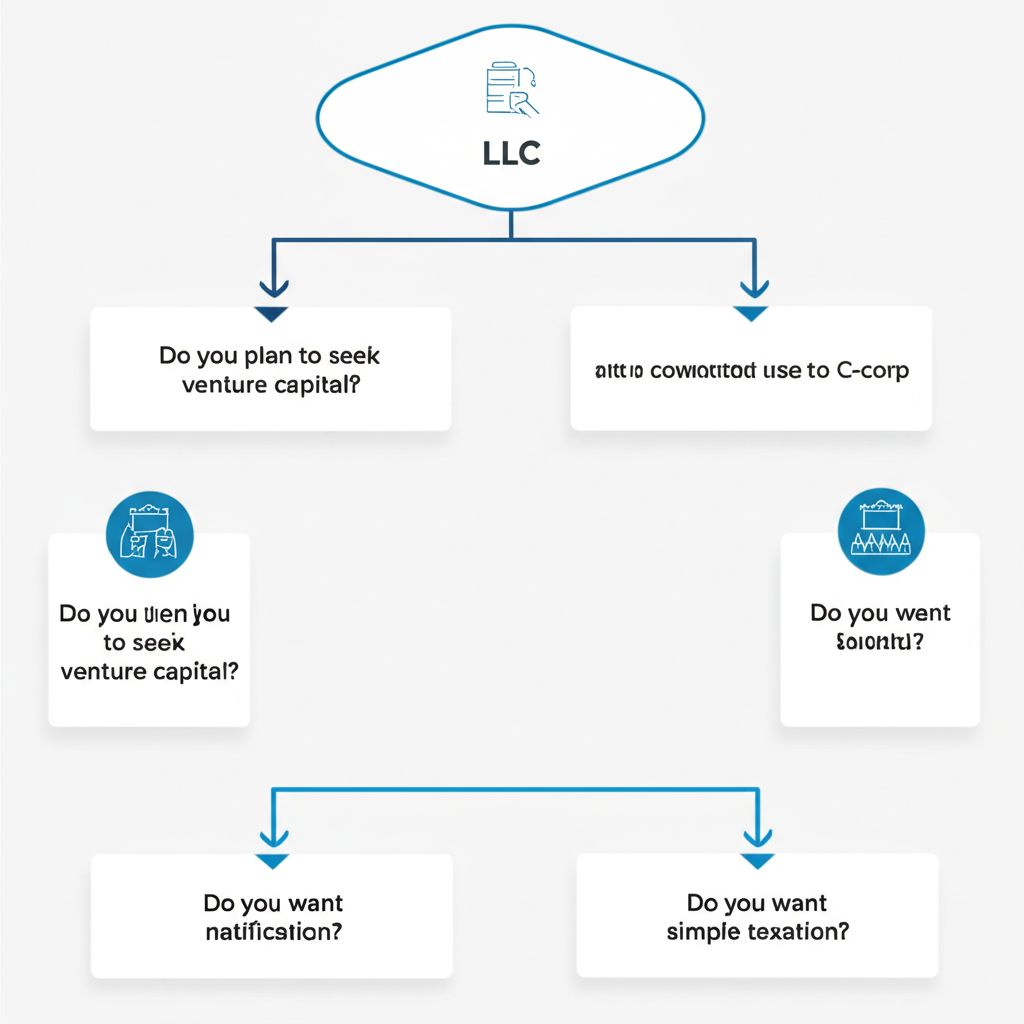
For a founder from Sri Lanka, the choice in the U.S. generally boils down to two main paths: the Limited Liability Company (LLC) or the C-Corporation. You may hear about S-Corporations, but you can set that one aside. The IRS requires S-Corp owners to be U.S. citizens or residents, making it a non-starter for most newcomers.
The Flexible Friend: The LLC
An LLC is often praised for its simplicity and flexibility. It protects your personal assets from business debts, just like a corporation. Its main feature is “pass-through” taxation, meaning the business itself doesn’t pay income tax. Instead, profits and losses are passed directly to you, the owner. For a non-resident, this creates an obligation to file a U.S. personal tax return, which can be complex and subject you to high tax rates on what’s called Effectively Connected Income (ECI). An LLC can be perfect for a service business, like a consulting firm, where you plan to take the profits out each year.
The Growth Engine: The C-Corporation
The C-Corporation is a more formal, separate legal entity. It pays its own taxes at the corporate level. If the corporation then distributes profits to you as dividends, you pay tax on them again. This is the infamous “double taxation.” But here’s the twist: for a foreign founder, this can be an advantage. If you plan to reinvest all your profits back into the business to grow, you may not take a dividend for years. This structure keeps your personal and corporate taxes cleanly separated. More importantly, if you ever plan to seek venture capital funding, investors will almost always insist you are a Delaware C-Corp. It’s the gold standard for startups aiming for high growth.
Financial Foundations: US Banking, Funding, and Taxes
I remember my friend Rohan, fresh from Colombo, holding his first US business debit card. He grinned and said, “This feels more real than the LLC papers.” It’s a small piece of plastic, but it represents legitimacy—a real entry into the American commercial world. It’s the moment your idea starts to feel tangible. But here’s where it gets interesting. That card is the key to a complex, and sometimes confusing, system of money and rules that you must understand to succeed.
Securing Your Business Bank Account
Opening a business bank account is your first major financial step. You don’t need to be a citizen, but banks need to see you’re a legitimate entity. Here’s the typical sequence:
Get an Employer Identification Number (EIN): This is a federal tax ID for your business, obtained from the IRS. Think of it as a Social Security Number for your company.
Establish a US Physical Address: You can’t use a P.O. Box. Many non-resident founders use a virtual mailbox or a registered agent service, which provides a physical street address that most banks accept.
Prepare Your Documents: Walk into a bank with your business formation documents (like Articles of Organization for an LLC) and your EIN confirmation letter.
Finding the Capital
Most of us start by investing our own savings—it’s the simplest path. Don’t spend too much time chasing traditional Small Business Administration (SBA) loans, as they are generally restricted to US citizens or permanent residents. Instead, focus on private funding. I’ve seen tech founders from Sri Lanka find success with angel investors in hubs like Austin or Silicon Valley by demonstrating a strong business plan, not a specific immigration status. For high-growth concepts, venture capital firms are another avenue, though their process is intensely competitive. Your personal network and a compelling story are your strongest assets here.
The Inevitable: Taxes
The US tax system has multiple layers: federal, state, and sometimes local. Your obligations will depend entirely on your business structure (an LLC is taxed differently than a C-Corp) and where you operate. For instance, operating in New York City involves city-level taxes that don’t exist in rural Texas. My most sincere advice is this: hire a qualified Certified Public Accountant (CPA) or a tax advisor before you make your first dollar. A good CPA is not an expense; they are a strategic partner who will save you from costly mistakes and guide your financial decisions.
The Practical Steps: Registration, Licenses, and Compliance
I remember my friend Kumar, shortly after he moved from Colombo, sitting at his kitchen table surrounded by a mountain of forms. He was brilliant at software development, but the sheer volume of American business paperwork almost defeated him before he even started his IT consulting firm. That feeling of being overwhelmed by bureaucracy is a story I’ve heard a hundred times. Let’s shift gears for a moment, take a deep breath, and break that mountain down into manageable hills.
Choosing Your Foundation: Entity and State
First, you must give your business a legal identity. This means registering it as an entity, most commonly an LLC (Limited Liability Company) or a Corporation. You’ll file this paperwork with a specific state. Many international founders choose states like Delaware or Wyoming for their strong corporate privacy and liability protections, even if they don’t live there. However, if your business has a physical presence, like a restaurant or shop, you’ll almost certainly register in the state where you operate. This decision has long-term tax and legal implications, so think of it as choosing the bedrock for your company.
Getting Your Official Numbers
Once your business is registered, your next call is to the IRS to get an Employer Identification Number (EIN). Think of the EIN as a Social Security Number for your business. It’s a nine-digit number you’ll need for everything: opening a business bank account, filing taxes, and hiring employees. You cannot operate professionally without it. At the same time, you’ll need a Registered Agent. This is a service that provides a physical address in your state of incorporation to receive official legal and tax documents. For an immigrant founder who might travel or not have a permanent commercial address yet, this isn’t just a convenience; it’s an essential compliance tool.
The Web of Licenses and Permits
Finally, understand that registration is just the beginning. Depending on your industry and location, you’ll need a specific set of licenses. Imagine opening a small Sri Lankan catering service from your home in Austin, Texas. You’d likely need a local food handler’s permit from the city, a sales tax permit from the State of Texas Comptroller, and you’d have to follow federal FDA guidelines for food safety. Every business, from tech startups to retail shops, has its own unique compliance checklist. The key is to research the requirements at the federal, state, and local levels before you ever make your first sale.
Bridging Cultures: Networking and Marketing in the US Market
I still remember my first “business lunch” in America. I spent the first ten minutes trying to build rapport, talking about family and the weather, just as we do back home. My counterpart, a friendly but focused buyer from Ohio, smiled politely and then cut straight to the point: “So, what can I do for you?” The directness was jarring at first, but it taught me a foundational lesson. American business culture values efficiency. Your time is respected, and theirs is guarded. This means being punctual for meetings, offering a firm handshake, and communicating your intentions clearly and concisely.
Building Your Circle from Scratch
Arriving in a new country means your professional network is essentially zero. You have to build it, brick by brick. Forget just sending out cold emails. You need to create genuine connections. I found success by focusing on three areas:
LinkedIn: Don’t just connect. Find alumni from your university or people in your target industry and send a personalized message. Mention a shared interest or a specific question about their work.
Industry Meetups: Use sites like Meetup.com to find local gatherings for your field. Go with a simple goal: have two meaningful conversations, not collect twenty business cards.
Chamber of Commerce: Your local Chamber is a goldmine for connecting with other small business owners in your immediate community. These are your potential partners and first customers.
Telling Your Unique Story
Your Sri Lankan heritage is not a liability; it is your single greatest marketing asset. American consumers are drawn to authentic stories. For example, instead of just selling “handwoven textiles,” you are selling “Dumbara mats, a craft passed down through three generations of my family in the Kandy highlands.” See the difference? One is a commodity; the other is a story. Weave your personal journey into your brand. Explain the why behind your business. This narrative builds an emotional connection that standard marketing-speak simply cannot match. It transforms your product from an item on a shelf into a piece of a culture that customers want to be a part of.
From Colombo to CEO: Your Story is Your Strength
I still remember the smell of cardamom and cinnamon from my grandmother’s kitchen in Kandy, a scent that always felt like home. Bringing that dream to America isn’t just about navigating paperwork; it’s about understanding that your unique heritage is your most powerful asset. The resilience learned, the flavors remembered, the community values instilled—these are not just parts of your past. They are the very foundation of a business that no one else can build.
The journey from that memory to a successful enterprise is built on clear, organized action. Ready to take the next step? Download our free US Business Launch Checklist for Immigrants to stay organized on your entrepreneurial journey. Imagine a future where the vibrant spirit of Sri Lanka is not just a memory, but a thriving part of the American dream, built by you.
Frequently Asked Questions
What is the E-2 visa and do Sri Lankans qualify?
The E-2 Treaty Investor visa allows a national of a treaty country to be admitted to the United States when investing a substantial amount of capital in a U.S. business. Yes, Sri Lanka is an E-2 treaty country, making its citizens eligible to apply for this visa.
Do I need to be physically in the US to start a business there?
No, you do not need to be physically in the US to register a business entity like an LLC or C-Corporation. You can use online services and a registered agent. However, to operate the business, open a bank account, and legally work for it, you will need the appropriate work visa.
What is the best US state to register my business in?
Many foreign founders choose states like Delaware or Wyoming for their business-friendly laws and privacy protections. However, if you plan to have a physical presence (like an office or store), you will likely need to register in that specific state. It's best to consult with a legal professional.
Can I get an SBA loan as a non-US citizen?
It is very difficult. Most Small Business Administration (SBA) loans are restricted to U.S. citizens and lawful permanent residents (Green Card holders). Most new immigrant entrepreneurs will need to seek alternative funding sources like personal savings, private loans, or equity investors.
Facebook
X
LinkedIn
WhatsApp
Daily News Digest
Get the top stories delivered to your inbox every morning. No spam, ever.
Many Sri Lankan artisans believe that getting their products onto global platforms like Amazon and eBay is a logistical nightmare reserved only for large exporters. You might have a stunning
The most expensive myth for foreign investors is that buying a property in a famous US city guarantees Airbnb success. This assumption is a fast track to disappointment. The truth
Most import ventures from Sri Lanka fail before their first container even docks. It’s not a lack of US demand for Ceylon cinnamon or fiery Jaffna curry powder; it’s a
Have you ever had a truly amazing Sri Lankan meal, maybe a lamprais fresh out of the banana leaf, and thought, “Wow, more people in America need to experience this”?