Realistic cost of living in Colombo, Kandy, Galle, and Jaffna in 2026 (rent, food, transport)
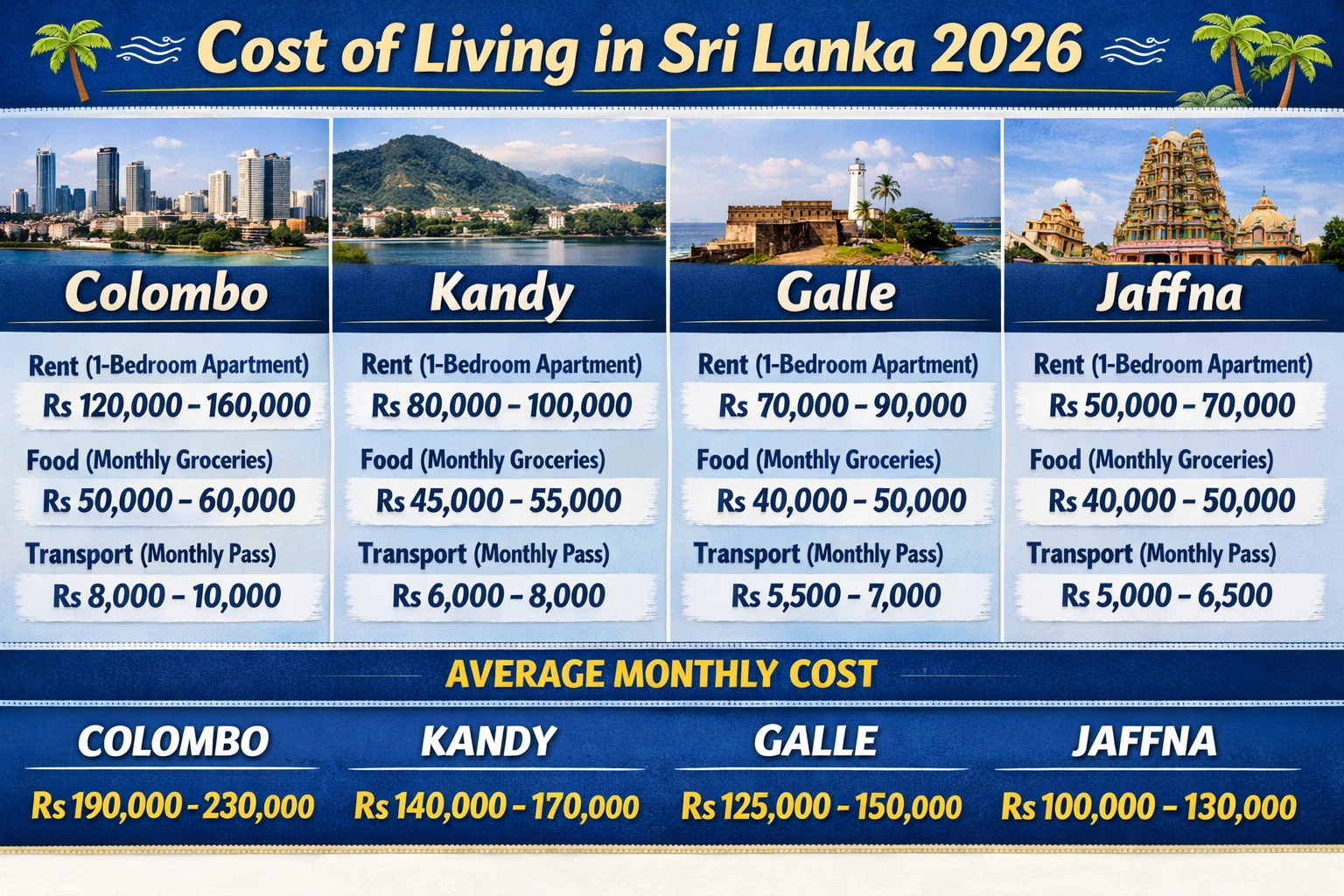
Colombo: Big-City Costs and Expat-Friendly Neighborhoods Colombo is Sri Lanka’s most expensive city, but still affordable by Western standards if you choose your neighborhood carefully. A realistic 2026 monthly budget for a mid-range expat is roughly $1,000–$1,600 for a single and $1,700–$...
Colombo: Big-City Costs and Expat-Friendly Neighborhoods
Colombo is Sri Lanka’s most expensive city, but still affordable by Western standards if you choose your neighborhood carefully. A realistic 2026 monthly budget for a mid-range expat is roughly $1,000–$1,600 for a single and $1,700–$2,500 for a couple, depending mainly on rent and how often you eat out.
Rent in Expat Areas
Colombo 3, 5, 6, 7, and 8 (Kollupitiya, Bambalapitiya, Wellawatte, Cinnamon Gardens, Borella side) are the main expat-friendly zones, with good cafés, gyms, and international schools. Modern 1–2 bedroom apartments here typically run:
- $400–$700 for a simple 1-bedroom in a non-luxury building
- $700–$1,200+ for newer or semi-luxury 1–2 bedroom apartments with security and amenities
Go a bit inland (Dehiwala, Nugegoda, Rajagiriya) and you can cut these figures by roughly 20–30% while staying within commuting distance of the city center.
Food and Daily Expenses
If you mix home cooking with local eateries:
- $200–$300 per month for groceries for one (double for a couple)
- $2–$4 for a local meal; $8–$15 per person in mid-range international restaurants
Cooking most meals and limiting imported products keeps a single person near the lower end of the budget range; frequent restaurant dining, coffee shops, and alcohol can easily add $150–$300 per month.
Transport and Getting Around
Public transport is cheap but traffic is heavy. A realistic monthly transport budget is:
- $20–$40 using mainly buses and trains
- $60–$120 if you rely heavily on ride-hailing (PickMe, Uber) and occasional intercity trips
Many expats in Colombo’s core neighborhoods walk short distances and use tuk-tuks or ride-hailing for everything else, avoiding the cost of owning a car.


Kandy: Balancing Lower Rents with Daily Living Costs
Compared with Colombo, Kandy typically offers noticeably lower rents but only slightly cheaper day‑to‑day expenses. For many expats and remote workers, this makes Kandy attractive if you are willing to trade big-city convenience for a more compact, hill-country lifestyle.
By 2026, a budget‑minded single person can often find a basic one‑bedroom apartment on the outskirts of Kandy for roughly 30–40% less than an equivalent place in central Colombo, with further savings if you are flexible on location and amenities. Local landlords often prefer 6–12‑month leases and may ask for several months’ rent upfront, so cashflow planning matters as much as headline price.
Daily food costs are only marginally lower than in the capital because supermarket prices and many branded goods are similar nationwide. You will save the most by buying fresh produce in local markets and eating at small rice‑and‑curry cafés; cooking at home with seasonal ingredients keeps a single person’s monthly food spend in the modest range, but frequent coffee-shop visits and Western‑style restaurants narrow Kandy’s advantage over Colombo quickly.
Transport is where Kandy’s geography complicates its affordability. Distances are short and public buses and tuk‑tuks are cheaper than running a private car, but steep hills, traffic congestion around the lake, and limited parking can add time and cost to regular commuting. If you live within walking distance of your workplace or co‑working space, you benefit fully from Kandy’s lower rent; if you rely heavily on tuk‑tuks for daily trips, much of your rent savings can be swallowed by transport.
In practical terms, Kandy suits people who:
- Prioritize lower housing costs over nightlife and big‑city services.
- Are comfortable walking or using buses for most journeys.
- Plan to cook at home and use local markets rather than imported‑goods supermarkets.
For those profiles, Kandy strikes a workable balance: meaningfully cheaper rent than Colombo, broadly similar grocery prices, and manageable transport costs if you choose your neighborhood carefully.

Galle: Coastal Living, Tourism Premiums, and Daily Expenses
Galle offers a blend of historic charm and beach-town lifestyle, with prices pushed up in touristy pockets but still manageable if you live a little away from the old fort and main beachfront strip.
Rent and Housing
For a long-term rental, a basic one-bedroom apartment or small annex outside the main tourist core can start around US$120–200 per month, while more modern or better-located places tend to fall in the US$250–400 range. Inside or very near Galle Fort or key surf/beach areas, expect “tourism premiums”: renovated character apartments and small houses commonly ask US$400–700 per month, and fully furnished villas with AC and good internet can run substantially higher. Utilities (electricity, water, gas, internet) for a modest apartment typically add US$50–90 per month, more if you rely heavily on air conditioning.
Food and Groceries
Day-to-day groceries from local markets and mid-range supermarkets are relatively affordable: a single person cooking at home can keep monthly food costs around US$100–160, while a couple might spend US$180–250 if they mix markets with branded goods and some imported items. Eating out, however, reflects Galle’s tourist appeal. Simple rice-and-curry or local takeaway can be US$1.50–3 per meal, but cafés inside/near the Fort, beachfront restaurants, and Western-style spots often charge US$4–10 per main, with coffee and drinks adding up quickly if it’s a regular habit.
Transport and Getting Around
Within Galle, life is compact and transport is usually cheap. Local buses and shared options are very low cost, and short tuk-tuk rides inside the city typically fall under a few US dollars per day even with frequent use. A realistic monthly transport budget for most residents is around US$20–60, depending on how often you travel to nearby beach towns or make longer trips to Colombo. Owning a scooter keeps costs modest (fuel and basic maintenance), while heavy reliance on private taxis for intercity travel can push transport spending toward the upper end of that range.
Overall, a single resident living simply but comfortably outside the peak tourist zones might manage on roughly US$450–750 per month including rent, while a lifestyle centered on Galle Fort cafes, beach bars, and premium rentals can easily double that.

Jaffna: Northern City Affordability and Infrastructure Trade-Offs
Compared with Colombo, Kandy, and Galle, Jaffna is generally the most affordable major city, but you trade off infrastructure quality, job depth, and some lifestyle conveniences. It suits minimalist expats, remote workers, and retirees more than corporate professionals seeking big-city amenities.
Rent
Jaffna’s rental market is still catching up post-conflict, which keeps prices relatively low but choice limited. A basic 1-bedroom outside the center can be 20–40% cheaper than comparable units in Colombo or Galle, especially if you are comfortable with older houses and fewer amenities. Modern apartments with reliable backup power, parking, and good finishes are scarce and priced closer to southern city levels, so “cheap” often means compromising on condition, space layout, or location.
Food
Day-to-day food costs are among the lowest of the four cities. Local markets offer very cheap vegetables, rice, and fish, and eating at simple Tamil eateries is noticeably cheaper than in touristy Galle or central Colombo. However, the variety of supermarkets, imported goods, and international cuisine is limited. If you rely heavily on imported products, your food budget may end up similar to Kandy or Galle because you pay more and travel further for specific items.
Transport
Within Jaffna, distances are short, and many residents use bicycles, scooters, or tuk-tuks, keeping daily transport costs low. Public buses are cheap but slower and less comfortable than intercity options in the south. Long-distance travel is the main cost penalty: reaching Colombo, Kandy, or the south by train, bus, or domestic flight is time-consuming and adds up quickly if you travel frequently for work, healthcare, or schooling.
Infrastructure and Lifestyle Trade-Offs
Jaffna’s core areas now have decent mobile data, basic banking, and essential shops, but you should expect more frequent power cuts, weaker healthcare options, and fewer international schools than in Colombo or Kandy. English is less widely used outside professional settings, and nightlife and entertainment are minimal. In exchange, you get very low baseline living costs, a slower pace of life, and a more community-oriented environment, provided you can live with periodic service disruptions and a narrower set of amenities.

References
- Nomads.com – “Cost of Living in Colombo in Jan 2026”, covering typical monthly expenses including rent, food, and other living costs for different household types in Colombo.
- Livingcostindex.com – “Cost Of Living in Sri Lanka in 2026”, providing national averages for rent, food, utilities, and transport with breakdowns by category, useful as a baseline for Colombo, Kandy, Galle, and Jaffna.
- Numbeo – “Cost of Living Comparison Between Colombo, Sri Lanka And Kandy”, detailing relative price levels (including rent, groceries, and transport) between Colombo and Kandy.
- Expatistan – “Cost of Living in Sri Lanka – 2026 prices”, listing itemized living costs (housing, food, transport, etc.) with Colombo-specific data to benchmark urban expenses.
- Swop.lk – “Sri Lanka Cost of Living 2025 | Full Expense Guide”, a narrative guide explaining how living costs (especially rent and daily expenses) differ between Colombo and smaller cities like Kandy and Galle, with insights applicable when estimating 2026 figures.
Related Articles

How to Tie a Tie
I still remember the first time I had to tie a tie for a job interview. I was nervous, not just about the interview itself, but also about making a good impression with my attire. As I stood in front of the mirror, fumbling with the tie, I wished I had learned how to tie one properly earlier. You m...

How to Draw
Did you know that 75% of people who draw regularly experience a significant reduction in stress levels, according to a study published in the Journal of Art & Design Education? Drawing can be a powerful tool for relaxation and self-expression, but many people are intimidated by the idea of putt...

How to Screenshot on Windows
Have you ever found yourself struggling to capture a screenshot on your Windows computer, only to end up with a messy and disorganized image? You're not alone. Taking screenshots can be a frustrating experience, especially when you need to capture a specific moment or detail. But what if you could...
How to Delete a Facebook Account
So, you're thinking of deleting your Facebook account? I think that's a great idea, and I'm here to guide you through the process. You might be wondering why you'd want to delete your account in the first place, but I'll get to that later. For now, let's focus on the fact that you're taking control...