Introduction: Rising from the Ditwah Crisis Towards Agricultural Renewal
Sri Lanka’s agriculture sector, the backbone of rural livelihoods and national food security, faced unprecedented challenges during the Ditwah crisis—a period marked by economic turmoil, policy missteps like the abrupt organic farming push, and climate vulnerabilities that slashed yields and sparked food shortages. As the nation moves into 2026, the Post-Ditwah Agriculture Strategy emerges as a beacon of hope, blending government reforms, international partnerships, and innovative financing to foster climate-resilient, productive farming. This strategy prioritizes smallholder farmers in regions like the Dry Zone’s Anuradhapura and Polonnaruwa districts, where nearly 70% of Maha season cultivation occurs, addressing monsoon declines and extreme weather threats head-on.
With agriculture employing over 25% of Sri Lanka’s workforce and contributing significantly to GDP, the post-Ditwah era focuses on recovery through sustainable practices, digital integration, and economic integration. Drawing from the 2026 Budget directives under President Anura Kumara Dissanayake and World Bank-backed projects, this comprehensive approach aims to empower 380,000 rural lives while enhancing export potential for tea, rice, and spices— staples of Sri Lankan culture and commerce.
The Ditwah Legacy: Lessons Learned from Agricultural Setbacks
The Ditwah crisis, echoing the 2021-2022 organic farming fiasco that led to a national food crisis, exposed vulnerabilities in Sri Lanka’s agrarian economy. Sudden bans on chemical fertilizers caused rice yields to plummet by up to 40% in key areas like the Central Province’s paddy fields, inflating food prices and straining imports. Climate change compounded woes, with declining Northeast Monsoon rains heightening drought risks in the Dry Zone, home to vast coconut groves and cashew plantations in Puttalam and Hambantota.
Post-Ditwah reforms acknowledge these pitfalls, shifting from rigid policies to balanced, evidence-based strategies. The Department of Agriculture’s E-Agriculture Strategy (2016, updated ongoing) and the Sri Lanka Council for Agricultural Research Policy (SLCARP) now drive innovation, promoting hybrid seeds and integrated pest management suited to local soils in the Wet Zone’s tea estates of Nuwara Eliya and the rice bowls of Ampara.
Key Pillars of the Post-Ditwah Agriculture Strategy
Climate-Resilient Infrastructure and World Bank Partnership
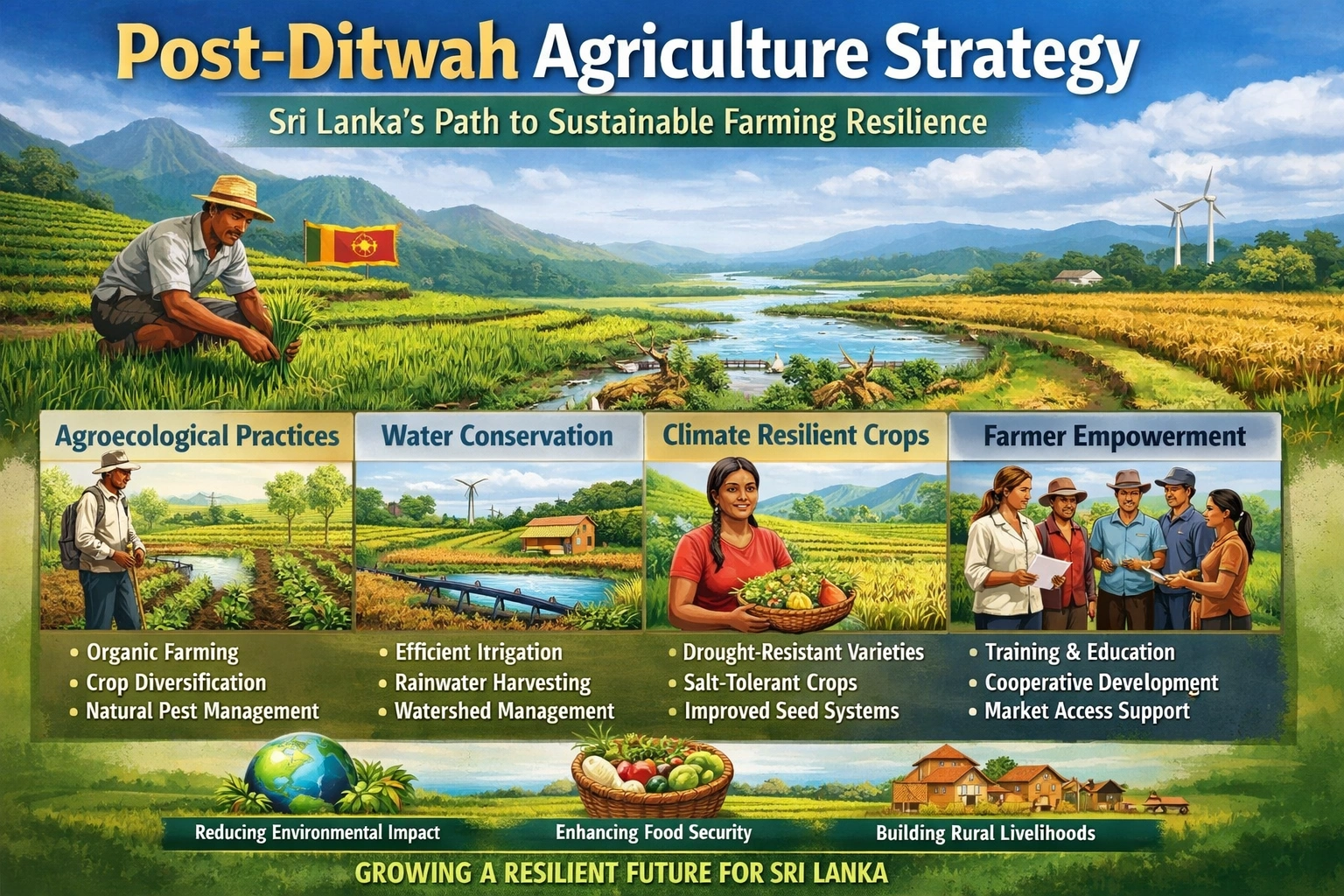
At the forefront is the US$100 million Integrated Rurban Development and Climate Resilience Project, launched with the World Bank in September 2025. This initiative targets 71,000 hectares of farmland, upgrading irrigation networks in water-scarce areas like Rajangane and Gal Oya schemes to optimize water use amid erratic monsoons. It supports 8,000 agri-food producers with climate-smart methods, such as drought-resistant paddy varieties for Yala season in the Eastern Province.
Agricultural insurance schemes will cushion farmers against floods in the Wet Zone or droughts in the Dry Zone, while digital data systems modernize monitoring—vital for real-time advisories via farmer apps in Sinhala and Tamil, resonating with Sri Lanka’s diverse rural communities.
2026 Budget Allocations: Prioritizing Agriculture, Livestock, and Irrigation
President Dissanayake’s 2026 Budget places agriculture, livestock, land, and irrigation at the economy’s core, aiming to eradicate rural poverty. Discussions at the Presidential Secretariat emphasized a sector-wide data system and resolving state-owned land disputes in underutilized areas like Moneragala, enabling expanded cultivation. Livestock gets a major boost, transforming dairy farming in Upcountry regions into an industry, with breed improvements for local breeds like the indigenous Sahiwal cow, culturally tied to village festivals.
Irrigation enhancements will cover major reservoirs, ensuring year-round farming and aligning with Nationally Determined Contributions (NDC 3.0), where agriculture contributes 7.5% to emission reductions through sustainable practices, targeting reduced post-harvest losses—a chronic issue costing billions in lost rice and vegetables annually.
Sustainable Financing and Loan Schemes
Cabinet-approved from 2026, the Sustainable Agriculture Programme offers loans via a Rs. 800 million revolving fund from the Smallholder Agribusiness Partnerships Programme. Channelled through Participatory Finance Institutions, it targets micro-enterprises in value chains—from Kurunegala’s onion farmers to Kandy’s vegetable processors—mobilizing US$17 million in private capital for agribusiness loans and public-private partnerships.
This addresses post-Ditwah credit gaps, enabling investments in cold storage for exports to Middle Eastern markets, where Sri Lankan spices like true cinnamon from Matale dominate.
Innovations Driving Transformation
Digital and E-Agriculture Integration
The Inclusive Digital Agriculture Transformation (IDAT) and E-Agriculture Strategy propel Sri Lanka into tech-driven farming. Mobile apps provide weather forecasts, market prices, and pest alerts tailored for smallholders in Jaffna’s paddy fields or Ratnapura’s rubber plantations. SLCARP-backed research introduces precision farming, reducing fertilizer use by 20-30% while boosting yields.
Nature-Based Solutions and Forestry Synergies
Aligned with NDC 3.0, the strategy promotes forest cover to 32% by 2035, restoring degraded lands in Knuckles Range for agroforestry—integrating cardamom and pepper with timber. Blue carbon ecosystems in coastal Mannar protect mangroves vital for prawn farming, blending conservation with livelihoods.
Empowering Women and Youth
Gender equity features prominently, with training for women in home gardens and youth in agribusiness startups. In rural Gampaha, cooperatives link producers to Colombo markets, fostering jobs in processing and logistics.
Challenges and Opportunities Ahead
Despite progress, hurdles remain: climate extremes threaten Central Highlands tea, and market access needs bolstering. Yet, opportunities abound—exporting organic-certified produce post-reform, leveraging Sri Lanka’s Indian Ocean location for marine-agri synergies like seaweed farming in Trincomalee.
Success hinges on implementation: strengthening extension services in District Agricultural Training Centres and ensuring equitable benefits reach Veddah communities in Dambana or Tamil farmers in Batticaloa.
Conclusion: A Prosperous, Resilient Future for Sri Lankan Agriculture
The Post-Ditwah Agriculture Strategy positions Sri Lanka for a green, inclusive revival. By 2035, enhanced productivity, reduced emissions, and rural prosperity will define success, honoring the farmer’s toil from misty Uva hills to sun-baked Hambantota plains. Stakeholders must collaborate to turn vision into reality, securing food sovereignty for generations.
(Word count: 952)