You’re likely wasting half of your data’s potential if you’re still relying on traditional cloud computing. The truth is, most organizations are stuck in a cloud-centric mindset, unaware that a significant portion of their data is being underutilized due to latency and bandwidth constraints.
As someone who works with data, you know how frustrating it can be to deal with slow processing times and high latency. But what if you could process your data in real-time, right where it’s being generated? This is where edge computing comes in – a paradigm shift that’s transforming the way we process and analyze data.
By reading this article, you’ll gain a deep understanding of edge computing and how it can be applied to your specific use case. You’ll learn how to identify opportunities for edge computing in your organization, and how to implement it in a way that drives real business value.
From industrial automation to smart cities, edge computing is being used to drive innovation and improve efficiency in a wide range of industries. You’ll discover specific examples of companies that have successfully implemented edge computing, and learn from their experiences to inform your own strategy.
Introduction to Edge Computing
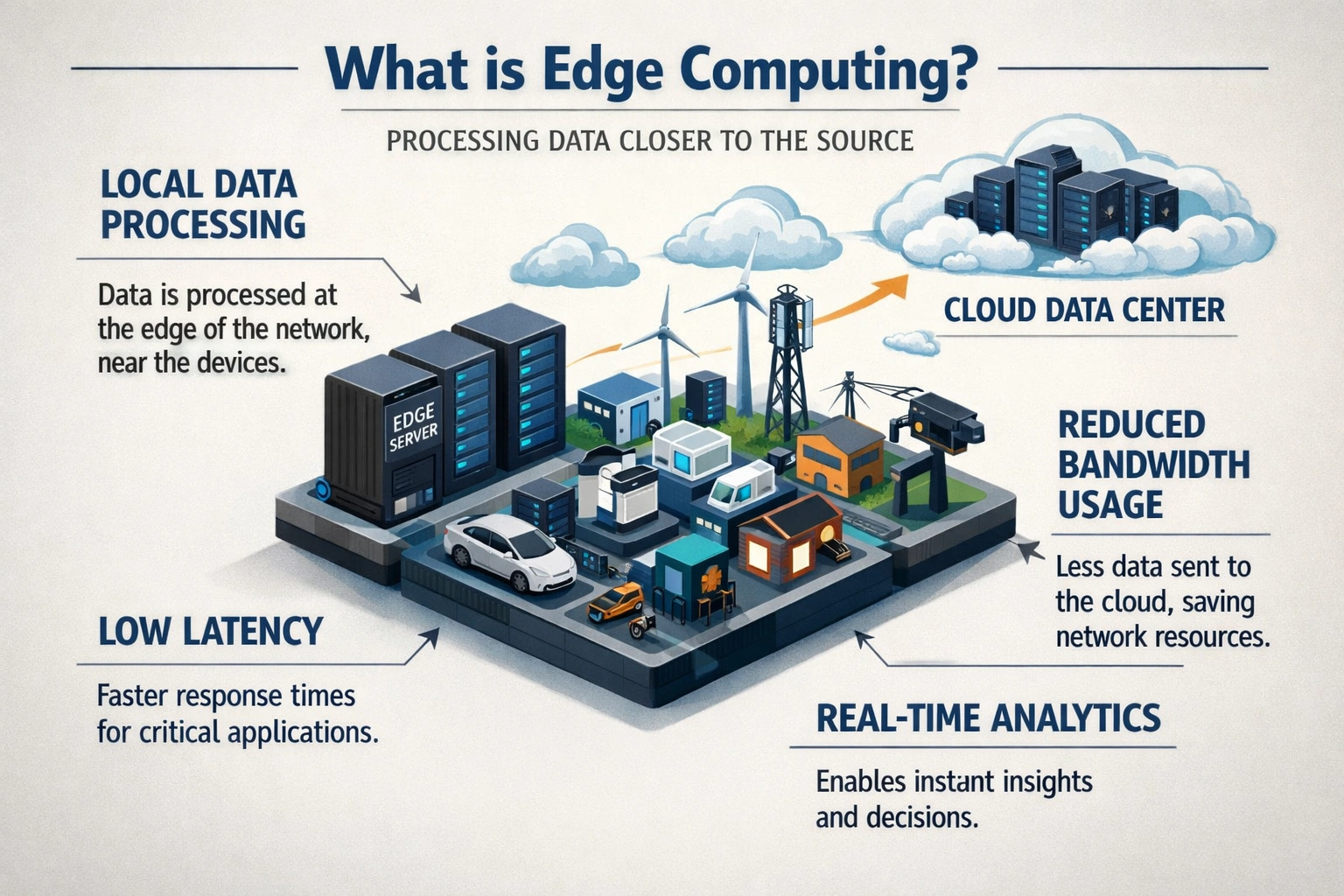
Edge computing is a distributed computing paradigm that brings computation and data storage closer to the source of the data, reducing latency and improving real-time processing. By doing so, edge computing enables faster and more efficient processing of data, which is essential for applications that require instant feedback, such as video streaming, online gaming, and autonomous vehicles. You can think of edge computing as a way to process data at the “edge” of the network, rather than in a centralized cloud or data center.
<img src='https://www.lankawebsites.com/wp-content/uploads/2026/01/pixabay-smart-city-infrastructure-5f150-1024×682.webp’ alt=’Smart City with Edge Computing’ loading=’lazy’ />
A key benefit of edge computing is its ability to reduce latency, which is the time it takes for data to travel from the source to the processing unit and back. By processing data at the edge, you can reduce latency to milliseconds, which is essential for applications that require real-time processing. For example, a smart traffic management system can use edge computing to analyze traffic patterns and adjust traffic lights in real-time, reducing congestion and improving traffic flow. You can achieve this by installing edge computing devices at intersections, which can process data from sensors and cameras and make decisions in real-time.
Real-World Applications
Edge computing has many real-world applications, including industrial automation, smart cities, and healthcare. In industrial automation, edge computing can be used to monitor and control equipment, predict maintenance needs, and improve overall efficiency. In smart cities, edge computing can be used to manage traffic, monitor energy usage, and improve public safety. In healthcare, edge computing can be used to analyze medical images, monitor patient vital signs, and improve patient outcomes. For instance, a hospital can use edge computing to analyze medical images from an MRI machine and provide instant feedback to doctors, enabling them to make faster and more accurate diagnoses.
Edge computing also provides enhanced security benefits, as data is processed and stored closer to the source, reducing the risk of data breaches and cyber attacks. You can use edge computing to encrypt data at the source, making it more difficult for hackers to access sensitive information. Additionally, edge computing enables you to implement security protocols and access controls at the edge, reducing the risk of unauthorized access to data and systems. By doing so, you can protect your data and systems from cyber threats and ensure the integrity of your applications.
How Edge Computing Works
Edge computing is an architecture that processes data closer to where it is generated, reducing latency and improving real-time decision-making. At the heart of this architecture are edge devices, which can range from simple sensors to complex machines like industrial robots or autonomous vehicles. You can think of edge devices as the “eyes and ears” of the edge computing system, collecting data from their environment and sending it to the next layer for processing.
Edge gateways play a key role in collecting and filtering data from edge devices. These gateways are essentially specialized routers that can handle multiple device connections, ensure data security, and perform basic processing tasks. For example, in a smart city scenario, edge gateways can collect data from traffic cameras, sensors, and other devices, and then forward the relevant information to edge servers for analysis. You can set up edge gateways to prioritize certain types of data or to trigger specific actions based on predefined rules.
Edge Servers and Processing
Edge servers are the “brains” of the edge computing system, responsible for processing and analyzing the data collected from edge devices and gateways. These servers can be deployed in various locations, such as on-premises, in colocation facilities, or even in ruggedized enclosures for extreme environments. A great example of edge computing in action is the smart traffic management system implemented in the city of Barcelona. The system uses edge devices to monitor traffic flow, edge gateways to collect and filter the data, and edge servers to analyze the data and adjust traffic light timings in real-time, reducing congestion and improving air quality.
To set up an edge computing system, you can follow a step-by-step approach: first, identify the edge devices and data sources; second, deploy edge gateways to collect and filter the data; and third, configure edge servers to process and analyze the data. You can also use established frameworks like EdgeX Foundry to simplify the deployment and management of edge computing applications. By understanding how edge computing works and applying it to real-world scenarios, you can create more efficient, responsive, and scalable systems that drive business value and improve people’s lives.
Benefits of Edge Computing
This brings us to something often overlooked: the numerous benefits of edge computing. By processing data closer to its source, you can significantly improve performance. For instance, consider a smart traffic management system that relies on real-time data from sensors and cameras to optimize traffic flow. With edge computing, you can analyze this data in real-time, reducing latency and enabling faster decision-making.
A key advantage of edge computing is the reduced bandwidth costs. By processing data locally, you can minimize the amount of data that needs to be transmitted to the cloud or a central server. This can result in significant cost savings, especially for applications that generate large amounts of data. For example, a manufacturing plant with hundreds of sensors and machines can use edge computing to process data locally, reducing the need for expensive bandwidth and minimizing the risk of network congestion.
Enhanced Security
Edge computing also provides enhanced security benefits. By processing data locally, you can reduce the risk of data breaches and cyber attacks. For instance, consider a retail store with a network of IoT devices, including security cameras and payment terminals. With edge computing, you can process sensitive data locally, reducing the risk of data breaches and minimizing the attack surface. You can also implement end-to-end encryption and secure authentication protocols to further protect your data.
A case study by IBM found that edge computing can reduce the risk of data breaches by up to 50%. This is because edge computing enables you to process data locally, reducing the need for data to be transmitted to the cloud or a central server. You can also use edge computing to implement real-time monitoring and anomaly detection, enabling you to quickly identify and respond to potential security threats.
Use Cases for Edge Computing
Here’s what really matters though: the practical applications of edge computing. You can see its potential in various industries, from smart cities to industrial automation and healthcare. Let’s take a closer look at these use cases to understand how edge computing can drive real-world benefits.
<img src='https://www.lankawebsites.com/wp-content/uploads/2026/01/pixabay-healthcare-edge-computing-684b6-1024×576.webp' alt='Healthcare Facility with Edge Computing’ loading=’lazy’ />
In smart cities, edge computing enables the efficient management of urban infrastructure. For instance, intelligent traffic management systems can analyze real-time data from sensors and cameras to optimize traffic flow, reducing congestion and decreasing travel times. The city of Barcelona, for example, has implemented an edge computing-based system to manage its traffic signals, resulting in a significant reduction in traffic congestion. You can achieve similar results by deploying edge computing devices at intersections and feeding them with real-time data from sensors and cameras.
Industrial Automation and Healthcare
In industrial automation, edge computing facilitates the analysis of machine data in real-time, enabling predictive maintenance and reducing downtime. In healthcare, edge computing can be used to analyze medical images and patient data at the point of care, facilitating faster diagnosis and treatment. The University of California, San Francisco has implemented an edge computing-based system to analyze medical images, resulting in faster diagnosis and treatment of diseases. You can apply similar edge computing solutions in your own organization by identifying areas where real-time data analysis can drive significant benefits.
When implementing edge computing solutions, consider the specific requirements of your use case. You may need to assess your network infrastructure to ensure it can support the deployment of edge computing devices. You should also evaluate your data management practices to ensure that you can effectively analyze and act on the insights generated by your edge computing system. By taking a thoughtful and informed approach to edge computing, you can drive real-world benefits and achieve significant returns on your investment.
Future of Edge Computing
The future of edge computing holds significant promise, with several trends and challenges on the horizon. One key factor will be the widespread adoption of 5G networks, which will enable faster data transfer rates and lower latency. This, in turn, will allow for more widespread use of edge computing in applications such as smart cities and industrial automation. For instance, a city like Barcelona is already using edge computing and 5G to manage its traffic flow and public services, resulting in improved efficiency and reduced congestion.
Another significant trend in edge computing is the integration of artificial intelligence (AI). As AI algorithms become more sophisticated, they will be able to process and analyze the vast amounts of data generated by edge devices, providing valuable insights and enabling real-time decision-making. A case study by Accenture found that the use of AI in edge computing can lead to a 25% reduction in operational costs and a 30% increase in productivity. You can apply this to your own organization by starting with small-scale AI-powered edge computing projects and gradually scaling up as you gain more experience and expertise.
Cybersecurity Challenges
As edge computing continues to grow, cybersecurity will become an increasingly pressing concern. With more devices connected to the edge, the potential attack surface will expand, making it essential to implement robust security measures. You can take steps to secure your edge computing infrastructure by implementing end-to-end encryption, regularly updating software and firmware, and conducting thorough risk assessments. For example, a company like Cisco provides a range of edge computing security solutions, including threat detection and response and incident management. By prioritizing cybersecurity, you can protect your organization’s data and ensure the continued success of your edge computing initiatives.
As you consider the future of edge computing, you should think about how these trends and challenges will impact your organization. What steps can you take to prepare for the widespread adoption of 5G and AI? How will you address the cybersecurity challenges associated with edge computing? By answering these questions and developing a comprehensive strategy, you can unlock the full potential of edge computing and stay ahead of the curve in this rapidly evolving field.
Empowering Your Business with Edge Computing
As you consider implementing Edge Computing, remember that the key to success lies in understanding your specific use case and applying the right solution. By doing so, you can significantly reduce latency, improve real-time data processing, and enhance overall efficiency. To take the first step, start by assessing your current infrastructure and identifying areas where Edge Computing can bring the most value. What will you achieve by bringing computation closer to where data is generated, and how will it transform your business operations?
Frequently Asked Questions
What is Edge Computing?
Edge Computing is a distributed computing paradigm that brings computation and data storage closer to the source of the data
How does Edge Computing work?
Edge Computing works by processing data at the edge of the network, reducing latency and improving real-time processing
Facebook
X
LinkedIn
WhatsApp
lwsadmin
Daily News Digest
Get the top stories delivered to your inbox every morning. No spam, ever.
Picture this: you wake up to a smart alarm that monitors your sleep patterns, and as you start your day, your home’s temperature and lighting adjust automatically to your preferences.
You’re likely no stranger to the frustration of slow data access, limited storage, and costly hardware upgrades. As you struggle to keep up with your growing data needs, you might