Managing your health effectively requires data. How many calories should you eat to reach your goals? What’s your ideal weight range? How much water do you actually need daily? These questions have answers, but finding them usually means visiting a doctor or hiring a nutritionist.
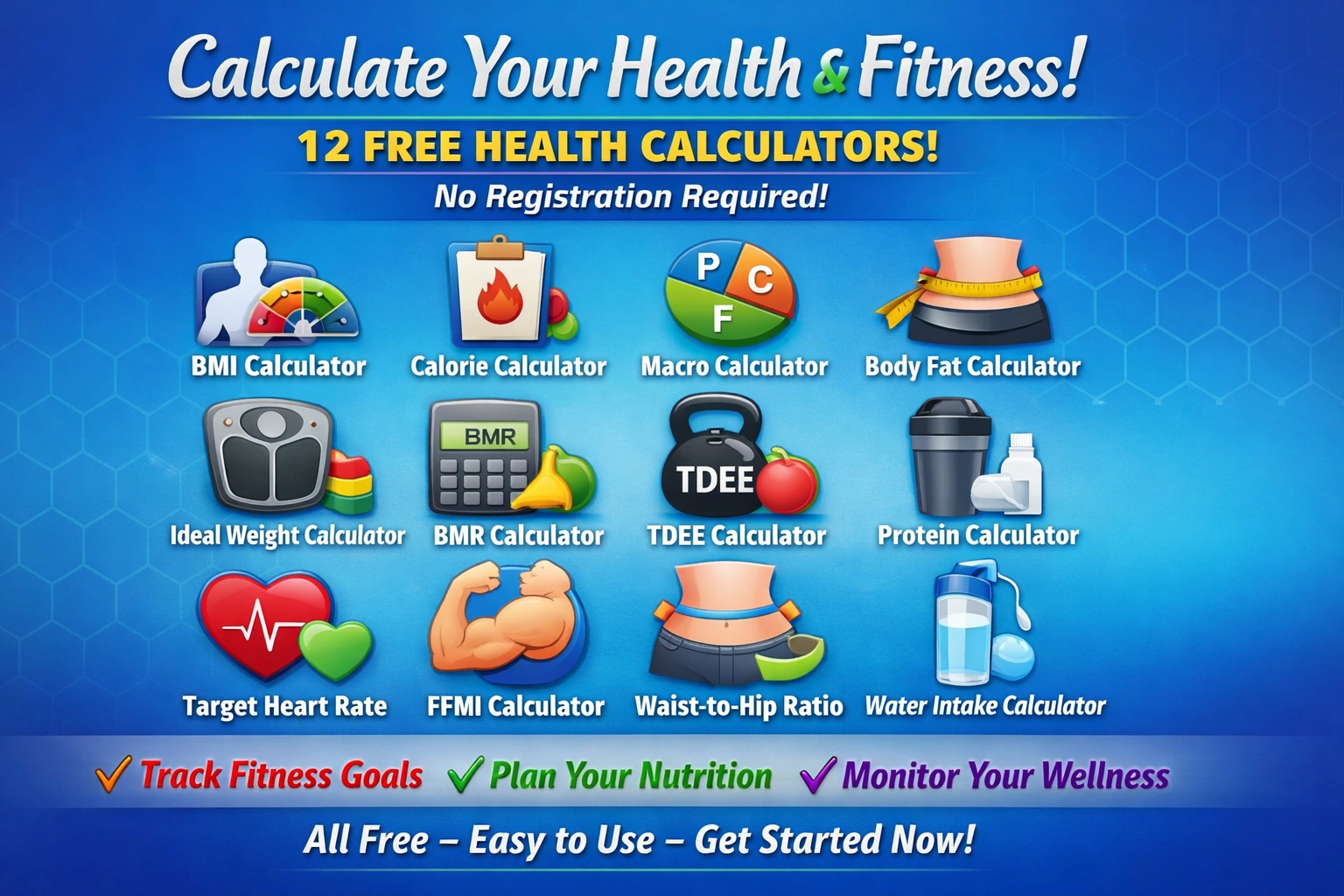
LankaWebsites provides 12 free health and fitness calculators that put essential wellness metrics at your fingertips. From body composition analysis to nutrition planning to reproductive health tracking, these tools use established scientific formulas to give you actionable insights instantly.
Let’s explore each calculator and understand how it can support your health journey.
Body Composition Calculators
Understanding your body composition provides the foundation for any health or fitness plan. These calculators help you assess where you are now and set realistic targets.
1. BMI Calculator – Body Mass Index Assessment
The BMI Calculator determines your Body Mass Index based on your height and weight. BMI provides a quick screening tool to categorize weight status as underweight, normal weight, overweight, or obese.
Simply enter your height (in feet/inches or centimeters) and weight (in pounds or kilograms), and the calculator instantly displays your BMI along with the category it falls into. The tool also shows the healthy BMI range for reference.
Understanding Your Results
While BMI has limitations (it doesn’t distinguish between muscle and fat), it remains widely used by healthcare providers as an initial health indicator. A BMI between 18.5 and 24.9 is generally considered healthy for most adults. Athletes and very muscular individuals may have elevated BMI despite low body fat, so consider using additional metrics like body fat percentage for a complete picture.
2. Body Fat Calculator – Estimate Your Body Composition
The Body Fat Calculator estimates your body fat percentage using the US Navy method. This approach uses body measurements to provide a more nuanced view of body composition than BMI alone.
The calculator requires different measurements for men and women. Men enter neck, waist, and height measurements. Women enter neck, waist, hip, and height measurements. The tool then calculates estimated body fat percentage along with lean body mass.
Why Body Fat Matters
Body fat percentage tells you what portion of your total weight is fat versus lean tissue (muscle, bone, organs, water). Two people with identical BMIs can have very different body fat percentages. Essential fat levels differ by gender – men need approximately 2-5% essential fat while women need 10-13%. Athletes typically maintain 6-13% (men) or 14-20% (women), while fitness-oriented individuals aim for 14-17% (men) or 21-24% (women).
3. Ideal Weight Calculator – Find Your Healthy Weight Range
The Ideal Weight Calculator determines your healthy weight range using multiple established scientific formulas. Rather than giving a single number, it provides a range that accounts for different body types and frames.
Enter your height, gender, and optionally your frame size. The calculator displays results from several formulas including the Devine formula, Robinson formula, Miller formula, and Hamwi formula, giving you a comprehensive view of recommended weight ranges.
Setting Realistic Goals
Having a target weight range helps with goal setting for weight loss or gain programs. The range accounts for natural body variation – not everyone of the same height should weigh exactly the same. Use these results as guidelines rather than absolute targets, and consider factors like muscle mass, bone density, and overall health when evaluating your ideal weight.
Nutrition and Calorie Calculators
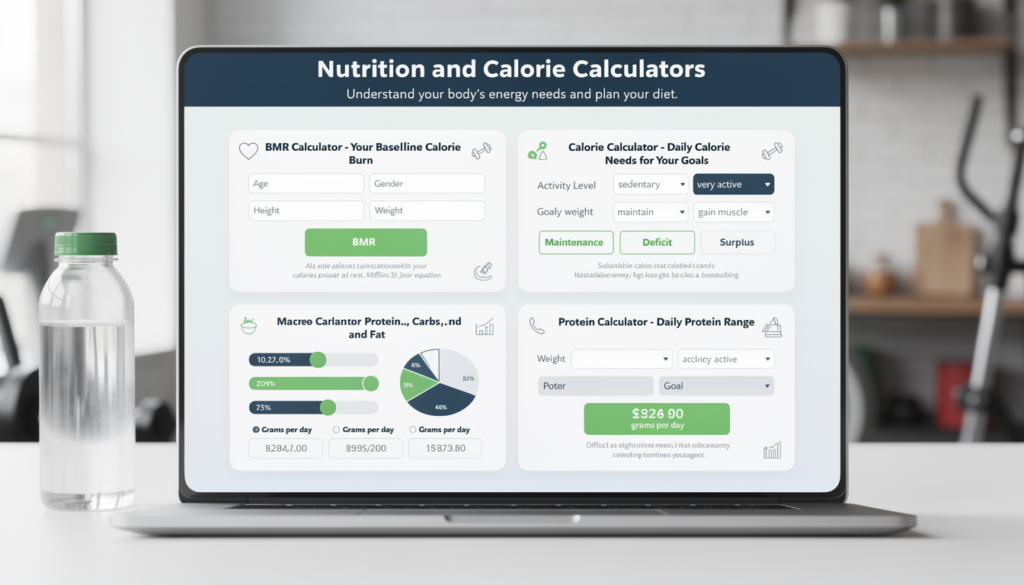
Nutrition forms the cornerstone of health and fitness. These calculators help you understand your body’s energy needs and plan your diet accordingly.
4. BMR Calculator – Your Baseline Calorie Burn
The BMR Calculator determines your Basal Metabolic Rate – the number of calories your body burns at complete rest just to maintain basic functions like breathing, circulation, and cell production.
The calculator uses the Mifflin-St Jeor equation, widely regarded as the most accurate BMR formula for most people. Enter your age, gender, height, and weight to get your BMR. This number represents the minimum calories your body needs daily if you did nothing but rest.
BMR vs. TDEE
BMR is your starting point, not your daily calorie target. Your Total Daily Energy Expenditure (TDEE) adds calories burned through daily activities and exercise. Most people’s TDEE is 1.2 to 1.9 times their BMR depending on activity level. Understanding your BMR helps you avoid setting calorie targets too low, which can slow metabolism and hinder progress.
5. Calorie Calculator – Daily Calorie Needs for Your Goals
The Calorie Calculator determines how many calories you need daily based on your personal stats, activity level, and goals. Whether you want to lose weight, maintain, or build muscle, this calculator provides customized targets.
Enter your age, gender, height, weight, and activity level (sedentary to very active). Then select your goal – lose weight, maintain weight, or gain weight. The calculator provides daily calorie targets for each scenario, typically showing maintenance calories plus deficit and surplus options.
Sustainable Calorie Targets
For weight loss, a deficit of 500 calories per day typically results in about 0.5 kg (1 pound) of weight loss per week. Deficits larger than 1000 calories daily are generally not sustainable and can lead to muscle loss. For muscle gain, a surplus of 250-500 calories supports growth without excessive fat accumulation. The calculator helps you find the right balance for your specific goals.
6. Macro Calculator – Balance Your Protein, Carbs, and Fat
The Macro Calculator breaks down your daily calorie needs into macronutrients – protein, carbohydrates, and fat. Different fitness goals and dietary approaches require different macro ratios.
After entering your personal information and goals, select from preset macro ratios (balanced, low-carb, high-protein, ketogenic) or customize your own percentages. The calculator displays grams of each macronutrient you should consume daily.
Macro Ratios for Different Goals
A balanced diet typically uses a 40/30/30 split (carbs/protein/fat). Those building muscle often increase protein to 30-40% of calories. Low-carb approaches might use 20/40/40, while ketogenic diets drop carbs to 5-10% with fat at 70-75%. The calculator makes it easy to experiment with different approaches and see the resulting gram targets.
7. Protein Calculator – Optimize Your Protein Intake
The Protein Calculator focuses specifically on protein needs, which vary significantly based on activity level and fitness goals. Protein supports muscle maintenance, recovery, and growth.
Enter your weight and select your activity level and primary goal (maintenance, weight loss, or muscle building). The calculator provides a recommended daily protein range in grams, accounting for the increased protein needs of active individuals and those in caloric deficit.
Protein Requirements by Goal
Sedentary individuals need approximately 0.8 grams of protein per kilogram of body weight. Active people and those losing weight benefit from 1.2-1.6 grams per kilogram. Those actively building muscle may need 1.6-2.2 grams per kilogram. The calculator removes guesswork by providing personalized recommendations based on established research.
Hydration and Exercise Calculators
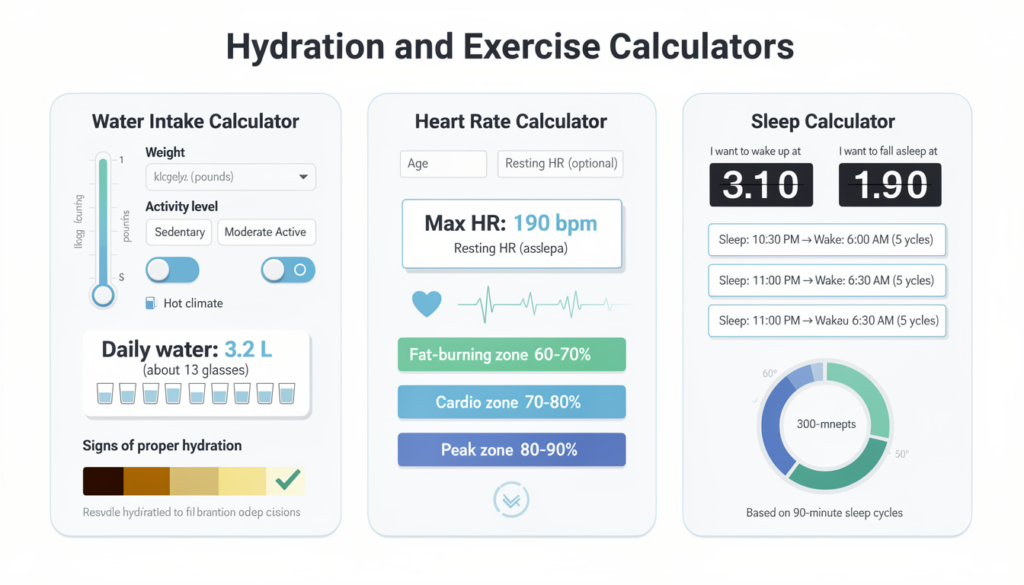
Proper hydration and exercise intensity significantly impact health outcomes. These calculators help you optimize both.
8. Water Intake Calculator – Daily Hydration Needs
The Water Intake Calculator determines how much water you should drink daily based on your weight, activity level, and climate. Hydration needs vary considerably between individuals.
Enter your weight, select your activity level, and indicate whether you live in a hot climate. The calculator provides your recommended daily water intake in liters and glasses, plus tips for maintaining proper hydration throughout the day.
Signs of Proper Hydration
The general guideline of 8 glasses daily doesn’t account for body size or activity. A larger, active person in a hot climate may need 3-4 liters daily, while a smaller, sedentary person in a cool climate might need only 2 liters. Urine color provides a practical indicator – pale yellow suggests adequate hydration, while dark yellow indicates you need more fluids.
9. Heart Rate Calculator – Target Zones for Exercise
The Heart Rate Calculator determines your target heart rate zones for different exercise intensities. Training in the right zone maximizes results for your specific fitness goals.
Enter your age and optionally your resting heart rate (for more accurate results). The calculator displays your maximum heart rate and various training zones including fat-burning zone, cardio zone, and peak performance zone, each with the corresponding heart rate range.
Training Zone Benefits
The fat-burning zone (60-70% of max heart rate) primarily uses fat for fuel and is sustainable for longer durations. The cardio zone (70-80%) improves cardiovascular fitness and endurance. The peak zone (80-90%) builds speed and power but can only be sustained briefly. Understanding these zones helps you train smarter, not just harder.
10. Sleep Calculator – Optimize Your Rest
The Sleep Calculator helps you determine the best times to sleep and wake based on natural sleep cycles. Waking mid-cycle often causes grogginess, while waking between cycles leaves you refreshed.
Enter either your desired wake time or the time you plan to go to bed. The calculator provides optimal sleep and wake times based on 90-minute sleep cycles, showing options for different amounts of total sleep while maximizing the chance of waking between cycles.
Sleep Cycle Science
A complete sleep cycle lasts approximately 90 minutes and includes light sleep, deep sleep, and REM stages. Most adults need 4-6 complete cycles (6-9 hours) per night. The calculator helps you time your sleep to complete full cycles, reducing the jarring experience of alarm interruption during deep sleep.
Reproductive Health Calculators
These calculators support family planning with evidence-based estimates for fertility tracking and pregnancy monitoring.
11. Ovulation Calculator – Track Your Fertile Window
The Ovulation Calculator estimates your ovulation date and fertile window based on your menstrual cycle. This information supports both conception planning and natural family planning approaches.
Enter the first day of your last menstrual period and your average cycle length. The calculator displays your estimated ovulation date, fertile window (the days when conception is most likely), and expected date of your next period.
Understanding Fertility Windows
Ovulation typically occurs about 14 days before the next period in a regular cycle. The fertile window spans approximately 6 days – the 5 days before ovulation plus ovulation day itself. Sperm can survive up to 5 days in the reproductive tract, while eggs remain viable for 12-24 hours after release. The calculator helps identify this optimal window for conception.
12. Pregnancy Calculator – Due Date and Progress Tracking
The Pregnancy Calculator estimates your due date and tracks pregnancy progress based on your last menstrual period. It provides week-by-week information about your pregnancy stage.
Enter the first day of your last menstrual period, and the calculator displays your estimated due date, current week of pregnancy, trimester, and days remaining. This helps expectant parents track milestones and prepare for key stages of pregnancy.
Pregnancy Timeline
Pregnancy is calculated as 40 weeks from the first day of the last menstrual period, though actual gestation from conception is about 38 weeks. The first trimester covers weeks 1-12, the second trimester weeks 13-26, and the third trimester weeks 27-40. The calculator provides context for where you are in this journey and what developmental milestones to expect.
Important Health Disclaimer
These calculators provide general guidance based on established scientific formulas and population averages. They are educational tools, not medical devices, and should not replace professional healthcare advice.
Individual factors including health conditions, medications, genetics, and personal medical history can significantly affect what’s optimal for your specific situation. Always consult healthcare providers before making significant changes to diet, exercise, or health routines, especially if you have existing health conditions.
Why Choose LankaWebsites Health Calculators?
Evidence-Based Formulas
Each calculator uses established scientific formulas like the Mifflin-St Jeor equation for BMR, the US Navy method for body fat, and standard medical calculations for BMI and reproductive health tracking.
Privacy Protected
Your health data stays on your device. Calculations happen in your browser without transmitting personal health information to servers.
No Registration Required
Access any calculator immediately without creating accounts or sharing personal information. Your health journey is private.
Mobile Friendly
Use the calculators anywhere – at the gym, in the kitchen, or during medical appointments. The responsive design works on all devices.
Completely Free
All 12 calculators are entirely free with unlimited use. No premium tiers, no usage limits, no hidden costs.
Getting the Most from These Tools
For comprehensive health tracking, use multiple calculators together. Start with BMI and body fat percentage for baseline body composition. Use the calorie and macro calculators to plan nutrition. Track hydration with the water intake calculator and optimize exercise with heart rate zones.
Reassess periodically as your body changes. Weight loss or gain affects calorie needs, activity level changes impact hydration requirements, and age adjustments modify heart rate zones. Regular recalculation ensures your targets remain accurate.
Record your results to track progress over time. While the calculators don’t store data, keeping your own log helps identify trends and celebrate improvements in your health metrics.
Frequently Asked Questions
How accurate are these health calculators?
The calculators use widely-accepted formulas that provide reliable estimates for most people. However, individual variation means results are starting points rather than absolute answers. Factors like muscle mass, health conditions, and genetics can affect accuracy.
Can I use these calculators if I have health conditions?
The calculators provide general population estimates. If you have diabetes, heart conditions, kidney disease, or other health conditions, consult your healthcare provider for personalized recommendations that account for your specific medical situation.
How often should I recalculate my metrics?
Recalculate whenever significant changes occur – weight changes of 5+ kg, major activity level shifts, or life changes like pregnancy. For ongoing programs, monthly recalculation helps keep targets aligned with your current status.
Are the reproductive health calculators reliable for family planning?
The ovulation and pregnancy calculators provide estimates based on average cycle patterns. Individual cycles vary, and factors like stress, illness, and hormonal conditions can affect timing. For family planning purposes, consider using multiple fertility awareness methods and consulting healthcare providers.
Conclusion
Health management becomes more effective when you have data to guide decisions. The LankaWebsites Health & Fitness Calculators provide 12 essential tools for understanding your body, planning nutrition, optimizing exercise, and tracking reproductive health.
From calculating your daily calorie needs to finding your target heart rate zones to estimating your due date, these free calculators put evidence-based health insights at your fingertips. No registration, no fees, no complicated apps – just straightforward calculations whenever you need them.
Visit the Health & Fitness Calculators page today and take the first step toward data-informed health decisions.