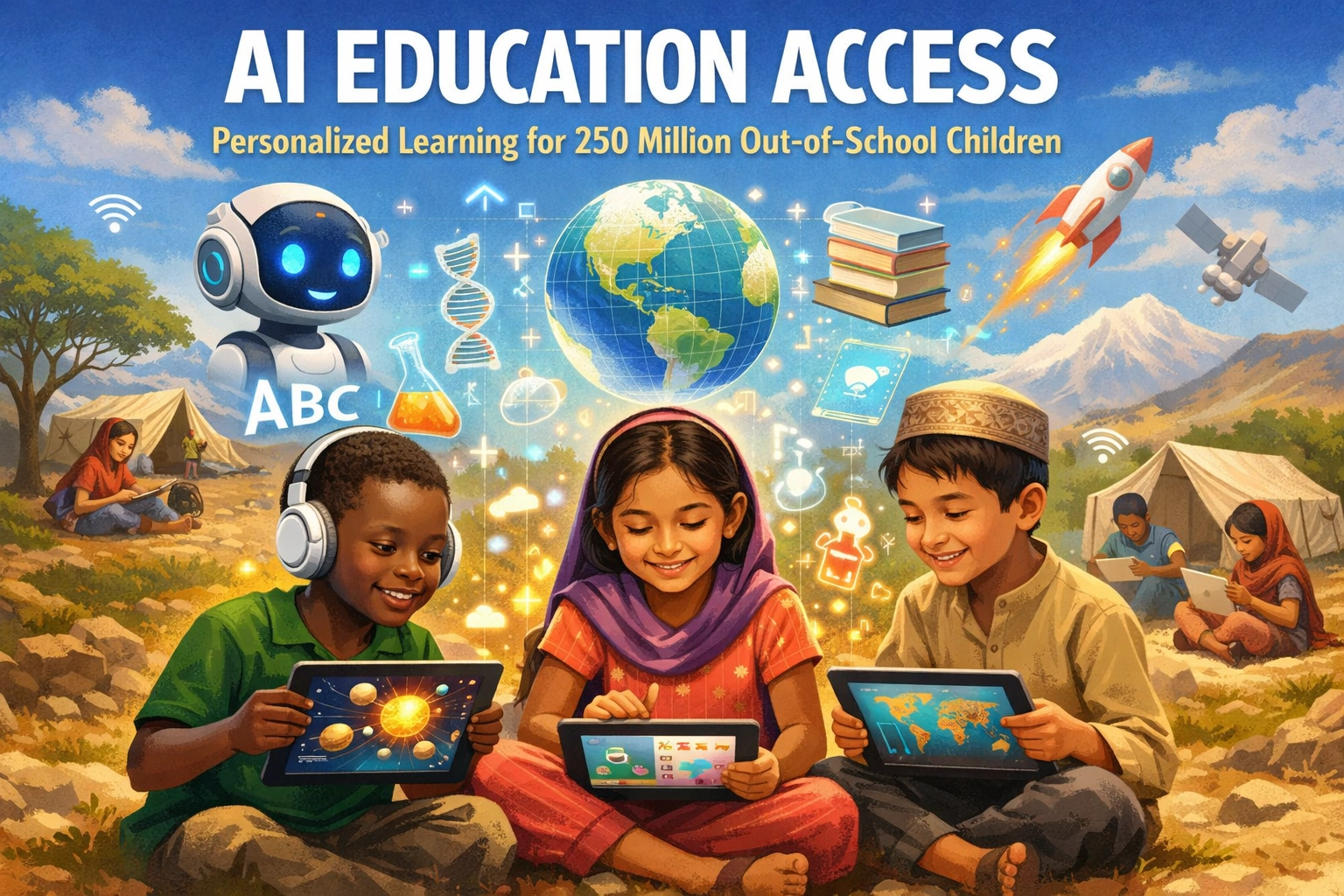
The Girl Who Got Her Education Through a Smartphone
In a village 50 kilometers from the nearest secondary school, a 12-year-old girl in rural Ghana had exhausted her options. The local primary school had no resources for advanced mathematics. The secondary school required a 2-hour daily commute on unreliable transportation. Tuition was unaffordable. Educational opportunity seemed to be determined by geography—her zip code was her ceiling.
Then she discovered an AI-powered learning platform delivered through WhatsApp. No smartphone required—just a basic mobile phone. Structured AI-supported group chats, facilitated collaborative learning among classmates. The platform delivered lessons in her local language, not just English. Progress adapted to her pace—not too fast, not too slow. A year later, she had advanced mathematics skills that would have been impossible without the technology.
In India, a student using Mindspark’s AI-powered math platform made more progress in one semester than she had in four years of traditional instruction. The AI identified her specific gaps (not just “bad at math,” but “struggles with fractions”), provided targeted instruction addressing those gaps, and tracked her progress daily. Traditional teacher couldn’t accomplish what the AI system did because the teacher had 40 students and 40 minutes per week per class. The AI had time to personalize.
In South Africa, Siyavula’s AI platform reached over 1.5 million students on basic smartphones with zero data apps, providing math and science practice tailored to each learner. Users could access practice problems matched to their ability level, receive instant feedback, and progress at their own pace. For students in townships with limited teacher resources, the platform became their tutor—always available, never frustrated, infinitely patient.
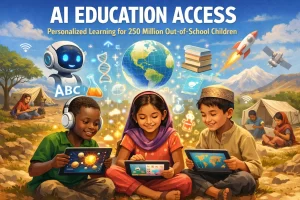
These aren’t isolated successes or expensive pilots. They represent a fundamental shift in what’s possible in education: Artificial intelligence is making quality personalized education accessible to the 250+ million children globally who are out of school or in under-resourced schools. Where traditional education says “one teacher can’t personalize for 40 students,” AI says “the same platform can personalize for millions.”
The Educational Crisis: Why Billions of Children Are Left Behind
To understand AI education’s impact, we must understand the crisis it addresses.
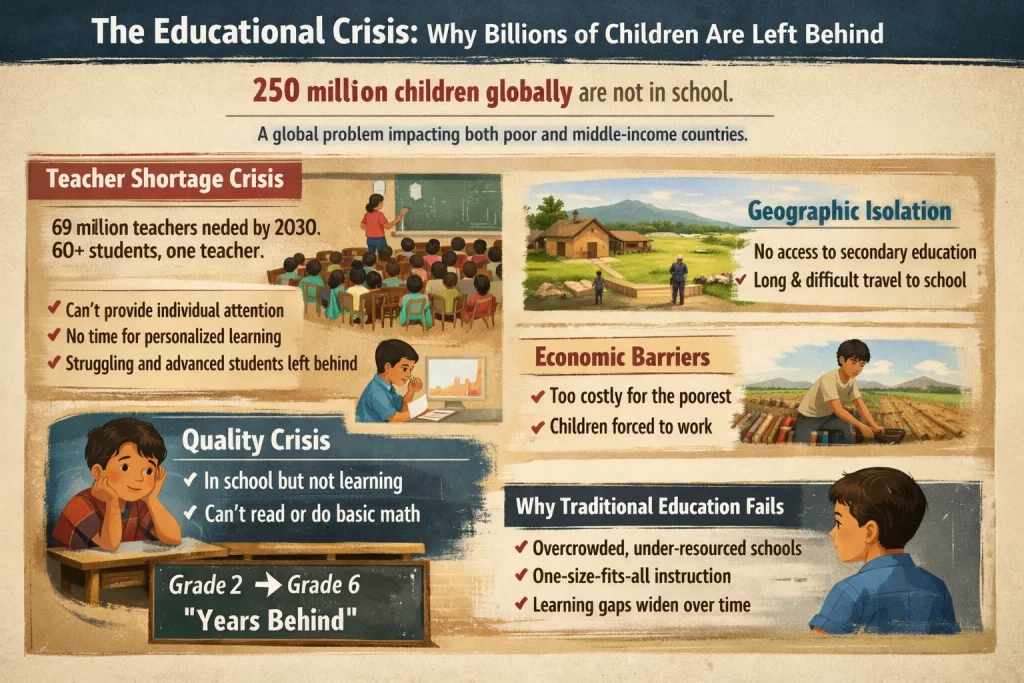
250 million children globally are not in school. This isn’t primarily a low-income country problem (though concentrations are highest in Sub-Saharan Africa and South Asia)—it’s a resource problem. Even in middle-income countries, millions of children attend school but learn little because:
Teacher Shortage Crisis: The ILO estimates a global shortage of 69 million teachers by 2030. In Sub-Saharan Africa, the shortage is acute today. A classroom might have 60+ students and one teacher. A single educator cannot possibly:
- Know each student’s strengths and weaknesses
- Provide individual feedback on assignments
- Slow down for students falling behind
- Accelerate for advanced learners
- Offer practice tailored to individual needs
One teacher, 60 students, 40 minutes per week per subject. The math is brutal—it’s impossible to personalize at scale without technology.
Geographic Isolation: In rural areas, students might have access to a primary school but no secondary school. Advanced education requires travel—hours of commuting on bad roads or boarding school (unaffordable). Geographic destiny becomes educational destiny.
Economic Barriers: Tuition, uniforms, transportation, books—the costs of school exclude the poorest. A family earning $2-3 daily cannot afford education costs while also needing their children’s labor for farm work or household tasks.
Quality Crisis: In many developing countries, the challenge isn’t access—it’s learning. Children attend school but don’t learn. A UNICEF study found that 258 million children globally are in school but learning little. They can’t read at appropriate grade level, can’t perform basic math. School is happening, but education isn’t.
Why Traditional Education Fails in Resource-Constrained Contexts: One-size-fits-all instruction assumes students start at the same place and learn at the same pace. In reality, learning gaps compound. A student missing foundational skills in Grade 2 falls further behind in Grade 3. By Grade 6, they’re years behind and losing motivation. Traditional teacher-led instruction cannot address this diversity—one pace serves some students and leaves others behind.
How AI Personalizes Education: The Magic Behind the Scenes
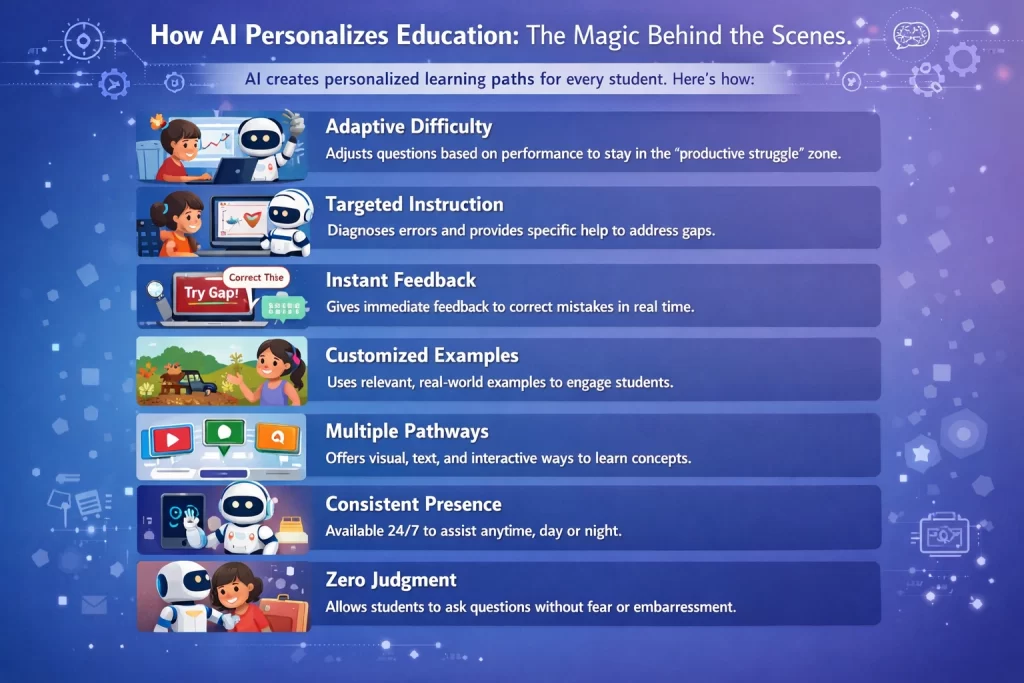
Artificial intelligence personalizes education by analyzing each student’s performance and adapting instruction in real-time.
What AI-Powered Personalization Means:
Rather than one teacher creating one lesson plan for 40 students, AI creates 40 (or 1,000 or 1 million) personalized learning paths. Here’s how:
1. Adaptive Difficulty: A student works through math problems. The AI tracks performance—accuracy, speed, confidence indicators. If accuracy is 90%+, difficulty increases. If accuracy drops below 60%, difficulty decreases. The platform continuously adjusts to stay in the “productive struggle zone”—challenging but not discouraging.
Traditional teacher can’t do this for 40 students. AI does it for all simultaneously.
2. Targeted Instruction: When a student makes an error, traditional teaching often moves forward. AI diagnoses the error. Does the student not understand the concept? Did they make a careless mistake? Did they understand the concept but apply it wrong? The AI distinguishes these and provides targeted instruction.
A student struggles with fractions. A traditional teacher might review fractions generally. AI identifies specifically: “This student understands numerators/denominators but struggles with finding common denominators.” Instruction is precisely targeted to the gap.
3. Instant Feedback: In a traditional classroom, a student completes an assignment. The teacher collects it, grades papers at night, returns them a week later. The student has forgotten the context. A week of learning intervenes.
AI provides feedback instantly. “Incorrect. You correctly identified the denominator but forgot to multiply the numerator. Try again.” The student immediately corrects understanding while the concept is fresh.
4. Customized Examples: AI adapts not just difficulty but context. A student in rural Nigeria learns fractions through examples relevant to her life (dividing crop yields, sharing between family members) rather than abstract examples. Relevance increases engagement and transfer of learning.
5. Multiple Pathways: Students learn differently. Some understand through visual explanation, others through text, others through real-world examples. AI can offer multiple pathways to the same concept. The student who doesn’t understand written explanation watches an animation. Still confused? Try a real-world problem.
6. Consistent Presence: A student doesn’t understand at 9 PM when the teacher isn’t available. With an offline-capable AI app, the student can ask the question and get explanation at 9 PM, at midnight, at 2 AM. The tutor is always available.
7. Zero Judgment: Students sometimes hide confusion to avoid embarrassment. An AI tutor never judges. A student can ask the same question 100 times without shame. Psychological safety enables learning.
Real-World Evidence: AI Education Platforms at Scale
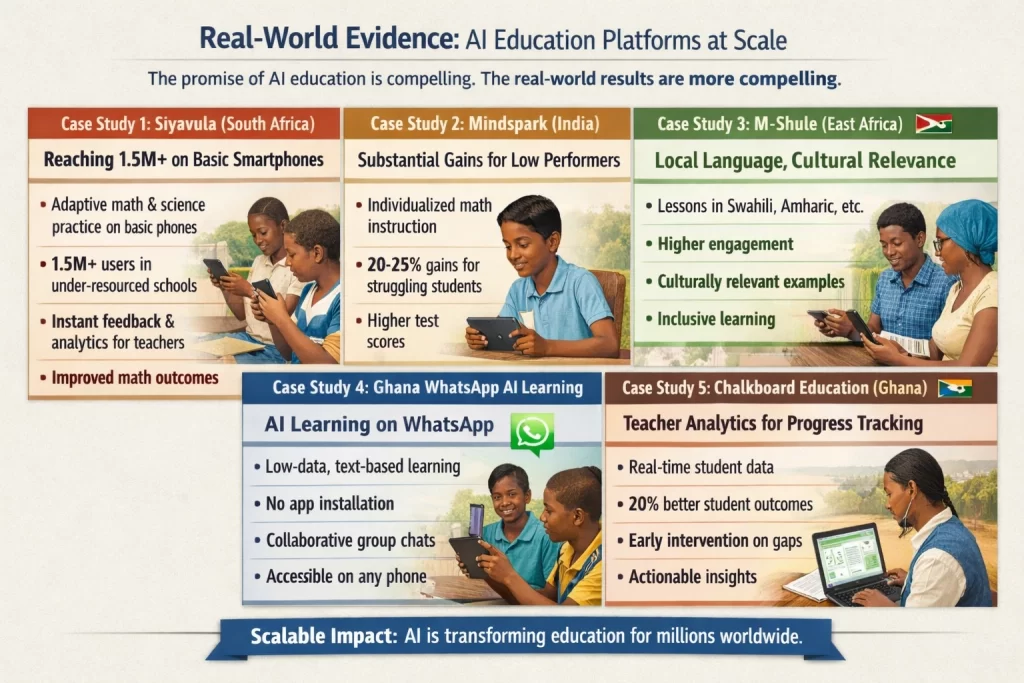
The promise of AI education is compelling. The real-world results are more compelling.
Case Study 1: Siyavula (South Africa) – Reaching 1.5M+ on Basic Smartphones
Siyavula is a South African edtech company providing AI-powered practice in mathematics and science. The platform is revolutionary not for complexity but for accessibility.
The Challenge Addressed: South African schools have teacher shortages. Student-teacher ratios of 35:1 are common. Additional practice is needed but teachers don’t have time to provide it. Students in township schools lack access to tutoring services available in wealthy suburbs.
The Solution: Siyavula provides adaptive practice problems accessible via basic smartphone (even older phones). No expensive app—just mobile web. Minimal data usage (works on slow connections). Content in local South African languages, not just English.
Results (as of 2024):
- 1.5+ million users reached across South Africa
- Free access for students in under-resourced schools
- Adaptive difficulty keeps students engaged
- Instant feedback on practice problems
- Teachers gain analytics: Which students struggle with which concepts
Learning Impact: Schools using Siyavula show improved outcomes in mathematics. The platform doesn’t replace teachers—it amplifies their effectiveness. Teachers can see which concepts students still struggle with and focus classroom time on those gaps.
Scalability: The platform scales with zero additional teacher investment. One Siyavula platform serves 1.5 million students with the same staff and infrastructure as it served 100,000. This is impossible with teacher-led instruction.
Case Study 2: Mindspark (India) – Substantial Gains for Low Performers
Mindspark is an Indian adaptive learning platform providing AI-powered mathematics instruction. The platform analyzes student performance and adapts content, difficulty, and pacing.
The Challenge Addressed: Indian schools average 40+ students per class. Learning gaps are severe—students in the same Grade 6 class have math skills ranging from Grade 2 to Grade 6 level. One-pace instruction leaves everyone behind somewhere.
The Solution: Mindspark provides individualized math instruction. Each student works at their own pace and difficulty level. The platform continuously assesses understanding and adjusts.
Results (from rigorous evaluations):
- 20-25% learning improvement for low-performing students
- Substantial gains in test scores when measured carefully
- Engagement increases because instruction is appropriately challenging
- Teacher workload decreases (less grading, more instruction time)
Specific Impact: Students who were years behind grade level showed the most dramatic gains. A student performing at Grade 2 level in Grade 6 could access instruction at their level—not sitting bored through content too advanced, not left behind by pace-inappropriate instruction. With appropriate instruction, they made rapid progress.
Why This Works: Mindspark doesn’t make math easier—it makes it appropriately challenging. The platform provides the individualized instruction impossible in a classroom of 40.
Case Study 3: M-Shule (East Africa) – Local Language, Cultural Relevance
M-Shule is an East African learning platform delivering content in local languages with culturally relevant examples.
The Challenge: Many African students learn in English—a language they don’t speak at home. Mathematical concepts are taught through English examples unfamiliar to their context. Engagement suffers. Learning suffers.
The Solution: M-Shule delivers content in local languages (Swahili, Amharic, Somali, etc.) with examples relevant to students’ lives. A mathematics lesson about volumes uses examples about grain storage (familiar to rural students), not abstract geometric shapes.
Results:
- Higher engagement from content relevance
- Better retention from culturally meaningful examples
- Increased motivation from instruction in native language
- Accessible to diverse learner populations (girls, non-native speakers, isolated students)
Impact on Equity: M-Shule disproportionately helps marginalized students—girls in conservative regions, refugees learning in temporary camps, students with disabilities. The platform meets them where they are.
Case Study 4: Ghana WhatsApp AI Learning
In Ghana, AI-powered learning is delivered through WhatsApp—the platform already ubiquitous in communities.
The Challenge: Low-connectivity environments can’t support video-heavy apps. Infrastructure limitations restrict access to traditional edtech platforms.
The Solution: Structured AI-supported group chats in WhatsApp facilitate collaborative learning. The AI can answer questions, provide explanations, suggest practice problems. The familiar platform removes technical barriers.
Results:
- Zero app installation barrier (uses existing WhatsApp)
- Minimal data requirements (text-based)
- Collaborative learning (group features build peer interaction)
- Accessible to all phone types (feature phones and smartphones)
Impact: Students in areas with poor internet suddenly have access to personalized learning support.
Case Study 5: Chalkboard Education (Ghana) – Teacher Analytics
Chalkboard Education provides Ghana’s teachers with AI-driven analytics to track individual student progress.
The Challenge: Teachers know which students are struggling but lack real-time data about specific gaps. By the time annual test results arrive, it’s too late to help.
The Solution: AI analytics dashboard shows teachers which concepts each student understands and which they don’t. Teachers can intervene immediately when gaps appear.
Results (2023 pilot):
- 20% improvement in student outcomes in partner schools
- Teachers catch struggling students early (before failure compounds)
- Actionable insights (not just “Johnny is behind” but “Johnny struggles with addition of mixed numbers”)
- Teacher professional development (analytics highlight teaching effectiveness)
The Teacher’s Role: Enhanced, Not Replaced
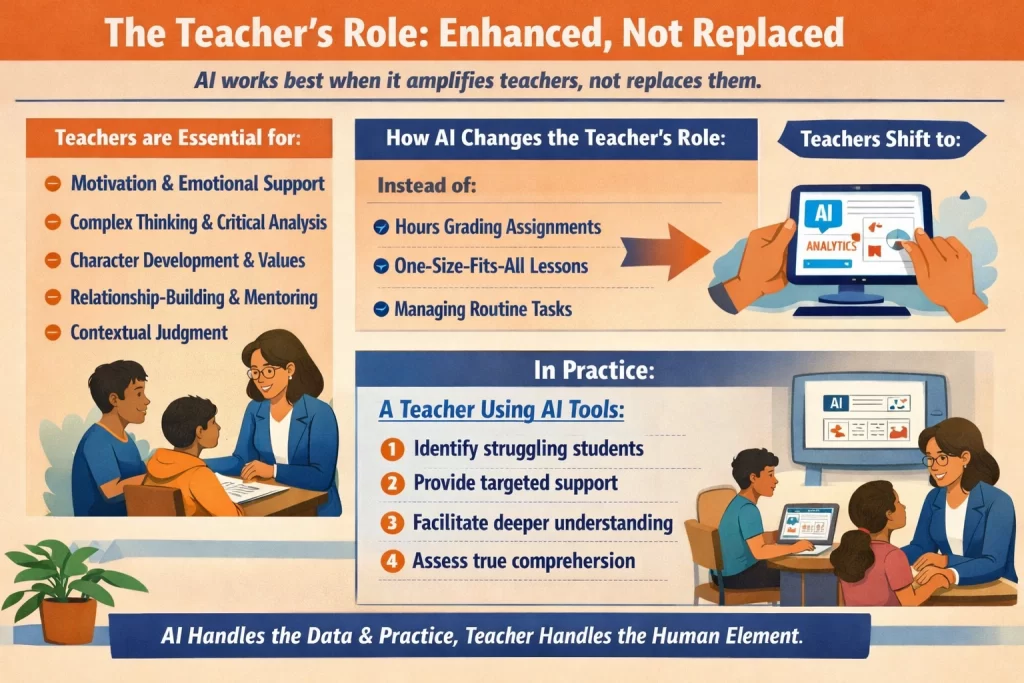
A critical point that often gets lost in AI education discussion: AI works best when it amplifies teachers, not replaces them.
The concern is legitimate. Powerful AI could be misused to eliminate teachers and have machines “teach.” That would be a disaster for learning. Teachers are essential for:
- Motivation and emotional support
- Complex thinking and critical analysis
- Character development and values
- Relationship-building and mentoring
- Contextual judgment that algorithms can’t make
How AI Changes the Teacher’s Role:
Instead of:
- Spending hours grading assignments → Review AI-generated analytics showing learning patterns
- Creating lesson plans for all students identically → Focus on students most in need
- Managing classroom behavior from explaining content repeatedly → Engage in deeper learning conversations
Teachers shift to:
- Supporting student learning (AI handles content delivery, teacher focuses on understanding)
- Mentoring and motivation (humans are better at this than algorithms)
- Complex problem-solving and critical thinking (AI can assist but teachers guide)
- Social-emotional development (fundamentally human)
In Practice: A teacher with a classroom of 40 students using Siyavula can:
- See which students struggle with fractions (AI identifies this)
- While some students practice independently (AI provides appropriate practice), focus time on students needing support
- Use classroom time for discussion and deep understanding rather than content delivery
- Assess whether students truly understand (AI provides intermediate data; teacher confirms with questioning and observation)
The teacher becomes more effective, not unnecessary. AI handles the scaling problem (thousands of personalized practice problems), and the teacher handles the human element (motivation, judgment, relationship).
Addressing Implementation Challenges
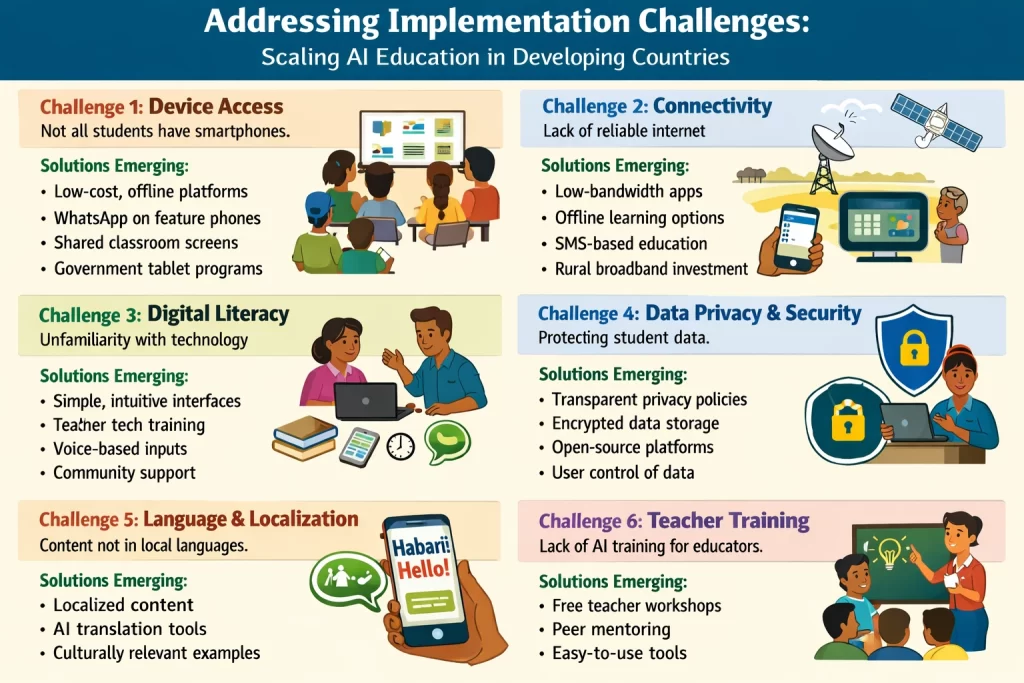
AI education is powerful but faces real barriers to scaling across developing countries.
Challenge 1: Device Access
Not all students have smartphones. Even where phones exist, they might be shared family devices.
Solutions Emerging:
- Platforms designed for low-cost devices (Siyavula works on older Android phones)
- Text-based platforms (WhatsApp) work on feature phones
- One-to-many delivery: Shared screens in classrooms with limited devices
- Government device subsidy programs (some countries providing tablets to students)
- Offline capability: Content downloaded for use without connectivity
Challenge 2: Connectivity
Many regions lack reliable internet. Video-heavy platforms won’t work.
Solutions Emerging:
- Text/image-based platforms requiring minimal bandwidth
- Offline-capable apps (content syncs when connection available)
- SMS-based learning (no app, no data required)
- Government broadband investment in rural areas
- Satellite internet expanding coverage (Starlink-type services)
Challenge 3: Digital Literacy
Some students and teachers are unfamiliar with technology.
Solutions Emerging:
- Interfaces designed for non-technical users (simple, intuitive)
- Teacher training on technology use
- Progressive disclosure (basic features first, advanced features optional)
- Voice-based input (speak instead of typing)
- Community facilitators helping peers use platforms
Challenge 4: Data Privacy and Security
Parents worry about student data collection. Education data is sensitive.
Solutions Emerging:
- Transparent privacy policies
- User control over data (students understand what data is collected)
- Encryption of data transmission and storage
- Regulatory frameworks protecting education data
- Open-source platforms (where code is publicly auditable)
Challenge 5: Language and Localization
Global platforms often have English default. Local languages are missing.
Solutions Emerging:
- Platforms being localized into local languages (M-Shule example)
- Community translation efforts
- AI translation (though imperfect) making content accessible in more languages
- Culturally relevant examples and context
Challenge 6: Teacher Training
Teachers often lack training on using AI platforms effectively.
Solutions Emerging:
- Free training programs from platform providers
- Teacher-to-teacher mentoring
- Integration into teacher training curricula
- Low-barrier tools (tools designed for ease of use, not requiring extensive training)
Responsible AI in Education: Avoiding the Pitfalls
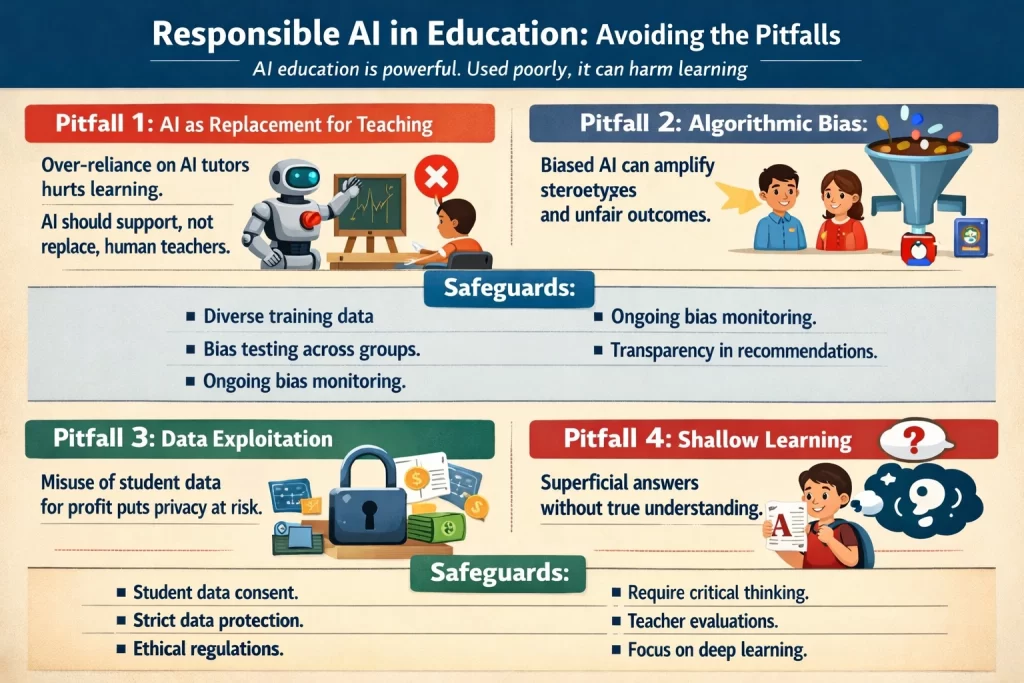
AI education is powerful. Used poorly, it can harm learning.
Pitfall 1: AI as Replacement for Teaching
Schools might attempt to reduce costs by having students use AI platforms with minimal teacher involvement. Research from Turkey showed that students overly reliant on AI tutors performed worse after losing access, compared to peers who learned with human instruction supported by AI. This “crutch effect” demonstrates that AI works best alongside human instruction, not replacing it.
Pitfall 2: Algorithmic Bias
If training data is biased, AI can perpetuate or amplify that bias. An AI trained on data showing lower performance from girls might learn to recommend less challenging content to girls—self-fulfilling the bias.
Safeguards:
- Diverse training data
- Bias testing across demographic groups
- Continuous monitoring for disparate impact
- Transparency in how recommendations are made
Pitfall 3: Data Exploitation
Educational data is sensitive. Student learning patterns, struggles, and progress should be protected. Companies might exploit data for commercial purposes contrary to student interests.
Safeguards:
- Clear consent mechanisms
- Student/parent control over data
- Regulation preventing exploitative data use
- Transparent data practices
Pitfall 4: Shallow Learning
AI might enable students to appear to learn without actually understanding. Multiple-choice answers from pattern-matching without comprehension. Memorization without understanding.
Safeguards:
- Platforms designed to require explanation and reasoning, not just answer selection
- Teacher assessment of actual understanding (not just algorithm indication)
- Emphasis on conceptual understanding, not test-taking tricks
Looking Forward: The Future of AI Education
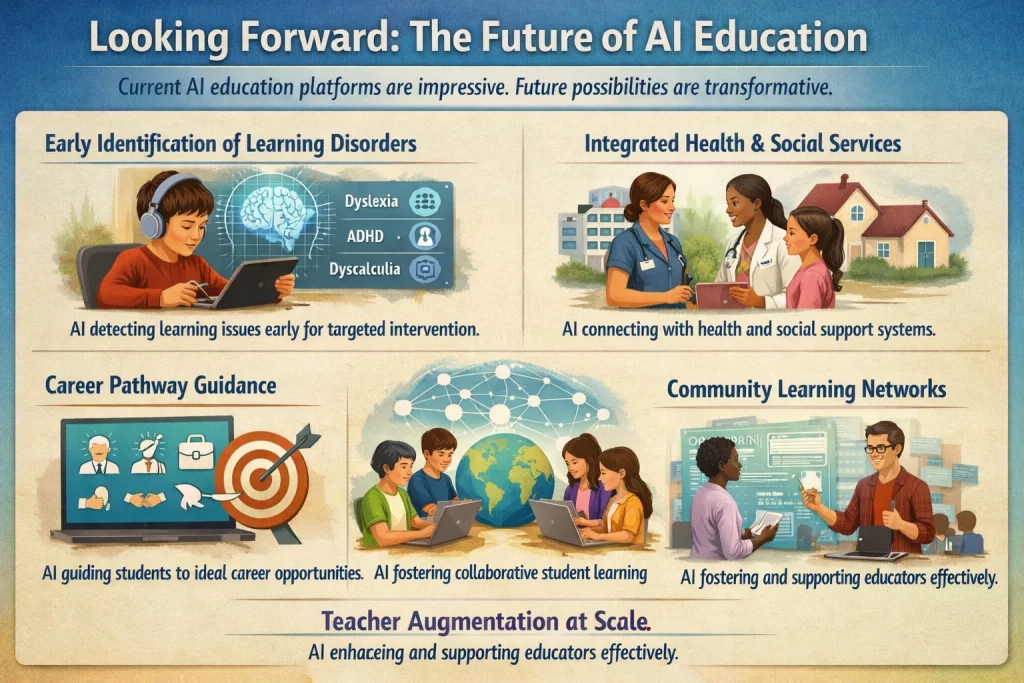
Current AI education platforms are impressive. Future possibilities are transformative.
Predictive Identification of Learning Disorders: AI could identify learning disabilities early (dyslexia, dyscalculia, ADHD) before they compound. Early identification enables targeted support preventing years of struggle.
Integration with Health and Social Services: Education doesn’t happen in isolation. A malnourished child can’t learn. A child experiencing abuse focuses on survival, not learning. AI platforms integrating with health and social services could identify children needing support beyond academics.
Career Pathway Guidance: AI analyzing student aptitudes and market opportunities could guide students toward careers where they’d excel and that have job market demand.
Community Learning Networks: Rather than isolated student-platform relationships, AI could facilitate learning communities where students learn together while AI provides support and adaptation.
Teacher Augmentation at Scale: Currently, good teachers provide better instruction than algorithms. Future AI might augment teacher instruction in ways that approach or exceed human-only instruction.
Conclusion: Education Finally Reaching the Unreached
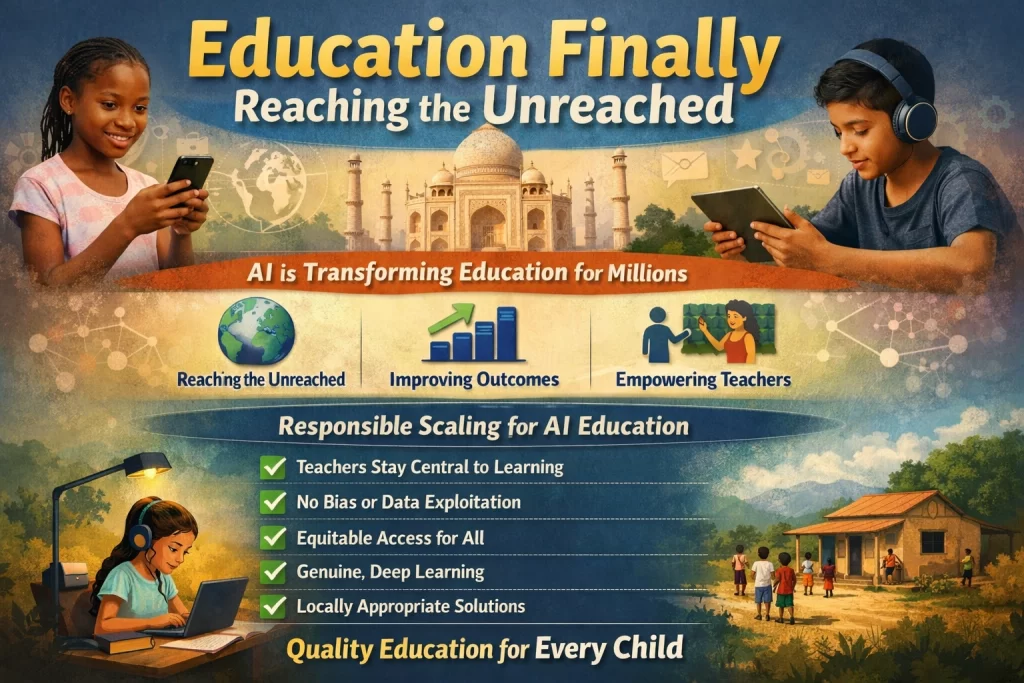
For centuries, education was fundamentally limited by teacher availability. A teacher could instruct perhaps 30 students per day. To educate a population of millions required millions of teachers—expensive, time-consuming, impossible in low-income countries.
AI changes this equation. One AI platform can instruct millions simultaneously, personalizing instruction to each. A teacher with an AI platform can serve more students with better outcomes than a teacher alone.
For 250 million out-of-school children and hundreds of millions more in under-resourced schools, this is transformative. The 12-year-old girl in Ghana accessing advanced mathematics through WhatsApp would have had zero opportunity without AI. The student in India making substantial progress through Mindspark would have sat confused in a 40-student classroom.
The evidence is clear: AI personalized learning works. It increases engagement, improves outcomes, reaches the unreached, and empowers teachers.
The challenge now is scaling responsibly—ensuring that:
- Teachers remain central to education (AI augments, doesn’t replace)
- Students aren’t harmed by bias or exploitative data use
- Access is equitable (not just for wealthy)
- Learning is genuine (not shallow)
- Implementation is locally appropriate (not one-size-fits-all)
With these safeguards, AI education can finally make good education accessible to all children—regardless of their zip code, their school funding, or their family wealth. That’s not hype. That’s the promise that thousands of students are already experiencing.
References and Sources
This article draws from recent research on AI-powered personalized learning platforms, EdTech implementations in developing countries, and peer-reviewed evaluations of learning outcomes. Below are authoritative sources supporting the evidence, case studies, statistics, and outcomes presented:
Comprehensive Reviews and Studies
- Global Study of the Impact and Implications of Artificial Intelligence in Education in Developing Countries (2025). A global study examining AI’s role in education across developing nations, documenting implementations, outcomes, and best practices. Published in NHS Journal of Studies, covering diverse platforms, use cases, and regional variations.
- Brookings Institution (2025). “Generative AI in Education: A Framework for Leveraging Digital Tools in Latin American Classrooms.” Comprehensive study examining how AI tools (particularly chatbots and adaptive systems) can support teacher instruction rather than replace it. Documents reframing of AI from automation to augmentation, phased integration models, teacher training requirements, and policy recommendations for responsible deployment. Includes specific examples from Uruguay, Ghana, India, and Turkey.
- UNESCO Report on AI and Education (2024-2025). Policy frameworks and global analysis of AI integration in education, emphasizing equity considerations, teacher roles, and responsible deployment across developing country contexts.
Platform-Specific Case Studies
- Siyavula (South Africa). Educational platform documentation showing 1.5+ million users served across South Africa. Platform features: adaptive practice problems in mathematics and science, accessibility on basic smartphones, content in South African local languages, free access for under-resourced schools, minimal data usage (zero data app). Learning outcomes: improved mathematics performance in schools using the platform, engagement increases through adaptive difficulty, teacher analytics showing which concepts students struggle with.
- Mindspark (India). AI-powered personalized mathematics instruction platform. Documented results from rigorous evaluation: 20-25% learning improvement for low-performing students, substantial gains in test scores particularly for students years behind grade level, increased engagement from appropriate challenge level, reduced teacher workload in grading enabling more instruction time. Details on adaptive mechanisms: real-time assessment of understanding, content and difficulty adjustment, personalized feedback, multiple pathway options.
- M-Shule (East Africa). Learning platform operating in East Africa (Kenya, Uganda, Ethiopia, etc.) delivering content in local languages (Swahili, Amharic, Somali) with culturally relevant examples. Evidence of higher engagement from local language instruction, better retention from culturally meaningful context, particular benefits for marginalized students (girls in conservative regions, refugees, students with disabilities). Demonstrates localization importance for equity.
- Ghana AI WhatsApp Learning Platform. Implementation of AI-powered learning through WhatsApp, demonstrating low-barrier platform accessibility. Features: structured group chats, AI-supported collaborative learning, text-based platform (works on feature phones and smartphones), minimal data requirements, familiar platform removing technical barriers. Results: increased learning access in low-connectivity areas, peer interaction and collaboration enabled.
- Chalkboard Education (Ghana). Platform providing teachers with AI-driven analytics dashboard tracking individual student progress. Features: real-time identification of learning gaps, specific concept-level insights (not just “Johnny is struggling” but “Johnny struggles with addition of mixed numbers”), enables early teacher intervention. 2023 pilot results: 20% improvement in student outcomes in partner schools, demonstrating teacher-facing analytics effectiveness.
- Coursera/EdX African Expansion. Large-scale MOOC platforms (Massive Open Online Courses) expanding in Africa with growing user bases. Documentation of AI recommendation systems matching courses to student career goals and prior knowledge, enabling tailored learning pathway selection.
- Ubongo (Pan-African EdTech). Pan-African educational company using AI to analyze viewership data for educational TV/radio programming, optimizing content for maximum impact. Over 30 million weekly viewers across Africa. Demonstrates AI application to broadcast education optimization.
Research on Personalized Learning and AI
- Adaptive Learning Research. Academic literature documenting how adaptive systems improve learning outcomes compared to one-size-fits-all instruction. Particular benefits documented for low-performing students and learners with diverse prior knowledge. Mechanisms: appropriate challenge level reduces disengagement and cognitive overload, targeted feedback reduces confusion, multiple pathways accommodate learning diversity.
- AI Tutor Effectiveness Studies. Research on AI tutoring systems showing they can match or exceed human tutor effectiveness in some contexts, particularly for supplemental instruction and practice. Research on limitations: “crutch effects” where students overly reliant on AI show worse performance when AI unavailable (Turkey case study), importance of AI as supplement not replacement.
- Personalized Learning at Scale Research. Studies documenting how AI enables personalization at scale—something impossible with human-only instruction due to time and cognitive limitations. One platform can personalize for millions simultaneously.
Teacher Role and Integration Research
- Teacher Augmentation Studies. Research documenting how AI tools best support rather than replace teachers. Shows that: teachers with AI support are more effective than teachers without; automated grading frees teacher time for instruction and mentoring; analytics help teachers understand student learning; teachers remain essential for motivation, judgment, relationship-building, and complex thinking.
- Teacher Training for AI Integration. Research on effective training programs for teachers using AI tools. Findings: technical training alone insufficient; pedagogical training on when/how to use AI appropriately is critical; phased implementation (starting with teacher-facing tools, progressing to student-facing with teacher oversight) is more effective than rushing implementation.
Implementation and Equity Research
- Digital Divide and Education Access. Research documenting how AI education platforms can reduce digital divide when appropriately designed. Platforms working on basic phones, offline-capable platforms, text-based platforms (vs. video-heavy) enable broader access.
- Language and Localization in EdTech. Research showing significant engagement and learning benefits when content delivered in local languages with culturally relevant examples. Localization particularly benefits marginalized groups and non-native speakers.
- Bias and Fairness in AI Education. Research documenting risks of algorithmic bias in educational AI (e.g., systems learning to recommend less challenge to girls, perpetuating gender disparities). Documentation of mitigation strategies: diverse training data, bias testing, continuous monitoring for disparate impact.
- Data Privacy in Education. Research on protecting student educational data from exploitation. Importance documented for: transparent data practices, student/parent consent mechanisms, regulation preventing commercial data exploitation, student control over personal data.
Regional and Specific Context Studies
- UNESCO Region-Specific Analyses. Detailed analysis of AI education implementation in Sub-Saharan Africa, South Asia, Latin America, Southeast Asia, documenting region-specific challenges and solutions.
- Rural Education and Connectivity Solutions. Research on educational technology implementation in rural low-connectivity areas. Documentation of SMS-based learning, offline-capable apps, satellite internet expansion, and other solutions enabling access in geographically isolated areas.
- Early Learning and Foundational Skills. Research on AI applications for literacy and numeracy in early grades, where learning foundations are critical. Documentation of AI tools addressing foundational skill gaps before they compound.
- Higher Education and Vocational Training. Documentation of AI applications in higher education and skills training in developing countries, including STEM education, vocational pathways, and career guidance.
Educational Outcomes and Impact Measurement
- Learning Outcome Studies. Quantified results from AI education platform implementations: test score improvements, engagement increases, learning gain measurements, equity impact (particularly for low-performing students, girls, isolated learners).
- Cost-Effectiveness Research. Analysis of cost per student served by AI platforms compared to traditional teacher-led instruction. Documentation of AI platform scalability advantages (increasing users with minimal cost increase).
- Equity Impact Analysis. Documentation of how AI education platforms can reduce or increase inequality depending on design and implementation. Evidence that well-designed platforms can disproportionately benefit disadvantaged students.
- Longitudinal Impact Studies. Research following students using AI education platforms over multiple years, documenting sustained learning gains and long-term educational outcomes.
- Teacher Satisfaction and Workload Research. Documentation of how AI tools affect teacher workload, job satisfaction, and professional development. Evidence that appropriately designed tools reduce workload and increase job satisfaction.